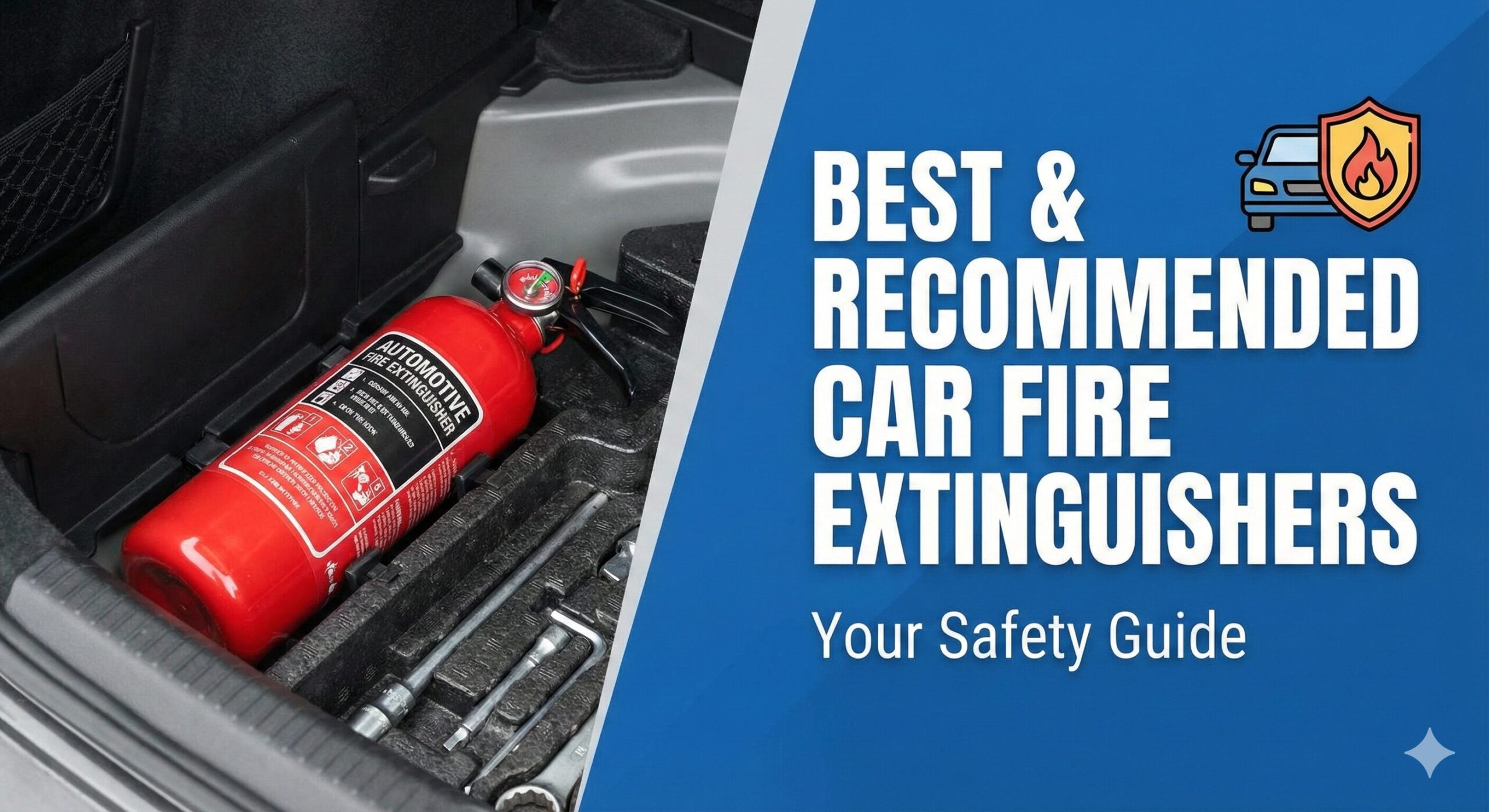
Best and Recommended Car Fire Extinguisher: The Ultimate Safety Review
Your vehicle is one of your most valuable assets, but it’s also a machine filled with flammable liquids, complex electronics, and high heat. When things go wrong, the best car fire extinguisher isn’t just an accessory—it’s a lifeline.
Many drivers invest in the best car safety tools or stock up on gadgets, yet they overlook the one item that can prevent a mechanical failure from becoming a total loss. Whether you are a daily commuter, an off-road enthusiast, or someone who loves track days, carrying a dedicated automotive fire extinguisher is a non-negotiable aspect of responsible driving.
Standard household extinguishers are often too bulky, susceptible to vibration damage, or filled with chemicals that will destroy your car’s engine wiring. In this comprehensive guide, we have reviewed the top-rated fire suppression systems specifically designed for the unique environment of a vehicle.
From traditional dry chemical tanks to modern “clean agent” gas systems and compact aerosol sticks, we break down the pros, cons, and performance of each to help you drive with peace of mind.
Quick Comparison: Top 3 Picks
| Product | Best For | Type | Rating |
|---|---|---|---|
| Amerex B402 | Overall Best Reliability | Dry Chemical | 5/5 |
| Element E50 | Compact Storage | Aerosol Stick | 4.8/5 |
| H3R Performance HalGuard | Protecting Electronics | Clean Agent (Gas) | 4.9/5 |
Why You Need a Specialized Car Fire Extinguisher
You might be asking, “Can’t I just throw a kitchen extinguisher in the trunk?” The short answer is no. Vehicles present specific challenges that generic extinguishers fail to address.
- Vibration Resistance: Cars vibrate constantly. A standard extinguisher’s plastic valve can crack or the powder inside can compact into a brick, rendering it useless. Automotive units have heavy-duty metal valves and specialized brackets.
- Class B & C Fires: Car fires usually involve fuel/oil (Class B) or electrical components (Class C). You need an agent designed for these, not just wood and paper.
- Temperature Fluctuations: If you prepare your car for a road trip in the summer, the interior temperature can soar. Automotive extinguishers are tested for high heat tolerance.
Furthermore, if you are driving a modified vehicle, or even if you drive with the engine light on ignoring potential overheating issues, the risk increases. Having a suppressor on hand is the difference between a repair bill and a burnt-out shell.
Top Recommended Car Fire Extinguishers Reviewed
1. Amerex B402: The Gold Standard

The Verdict: The Amerex B402 is widely considered the best all-around fire extinguisher for passenger vehicles. It is a 5lb dry chemical unit that strikes the perfect balance between capacity and portability.
Unlike cheap plastic models, the B402 features all-metal valve construction. This is critical for durability. It uses a dry chemical agent (Monoammonium Phosphate) which effectively smothers Class A (trash/wood), Class B (liquids), and Class C (electrical) fires. While the powder is messy to clean up, it is incredibly effective at stopping a fire fast.
If you are building a winter car emergency kit checklist, this robust tank is a must-add item alongside your jumper cables.
Key Features:
- Class: 5BC or ABC (depending on specific sub-model)
- Material: Heavy-duty steel cylinder with metal valve
- Bracket: Includes vehicle mounting bracket
- Warranty: 6-Year Manufacturer’s Warranty
|
PROS
|
CONS
|
2. Element E50: The Space-Saving Revolution

The Verdict: If you drive a compact sports car or just hate clutter, the Element E50 is a game-changer. It looks like a road flare but fights fire with advanced aerosol technology.
The E50 is 80% smaller than a traditional extinguisher but offers 50 seconds of discharge time (compared to 10 seconds for a standard 5lb tank). It uses a clean agent gas that fights fire at the molecular level, meaning it leaves zero residue behind. This is ideal for modern cars with sensitive sensors. You can easily store this in the door pocket or glove box, making it one of the must-have car gadgets for long drives.
Key Features:
- Discharge Time: ~50 Seconds
- Weight: Under 1lb
- Maintenance: Zero maintenance, no expiration date
- Tech: Potassium-based aerosol
|
PROS
|
CONS
|
3. H3R Performance HalGuard: The Enthusiast’s Choice

The Verdict: For those who drive iconic muscle cars or luxury vehicles, the fear isn’t just the fire—it’s the cleanup. Standard dry chemicals can ruin an engine block or corrode wiring harnesses.
The H3R HalGuard uses a premium “Clean Agent” gas (Halotron 1). It is an electrically non-conductive liquid that turns into a gas upon impact. It shocks the fire and extinguishes it without leaving a speck of dust. It is highly recommended for show cars, race cars, and high-value restorations. It comes in sleek chrome or black finishes to match your interior aesthetics.
Key Features:
- Agent: Halotron 1 (Clean Agent)
- Range: 6 to 10 feet
- Certifications: UL Listed
- Mounting: diverse bracket options available
|
PROS
|
CONS
|
4. First Alert AUTO5: The Budget Pick

The Verdict: If you are looking for basic protection without breaking the bank, the First Alert AUTO5 is a staple. While it lacks the metal valve durability of the Amerex, it is UL rated specifically for automotive use.
It is compact enough to fit in most trunks and comes with a mounting bracket. While we prefer metal valves for serious off-roading, this unit is perfectly adequate for the average commuter or as a secondary backup. It’s an essential addition to any list of budget-friendly car gadgets.
Key Features:
- Rating: 5-B:C (Liquids and Electronics)
- Weight: Approx 2.7 lbs
- Validation: UL Rated
- Included: Mounting bracket
|
PROS
|
CONS
|
How to Choose the Best Car Fire Extinguisher
Selecting the right safety gear is different from choosing aesthetic accessories like best driving sunglasses. The criteria must be technical and precise. Here is what you need to look for.
1. Understanding Fire Classes
Not all fires are the same. For automotive purposes, you are primarily concerned with two classes:
- Class B: Flammable liquids (Gasoline, Oil, Diesel, Grease).
- Class C: Electrical equipment (Wiring, Fuse boxes, Battery fires).
- Class A: Combustibles (Upholstery, plastic, wood).
We recommend a unit rated BC or ABC. Using a water-based extinguisher (Class A only) on a grease or electrical fire can make the situation significantly worse.
2. Chemical Agent vs. Clean Agent
Dry Chemical (Powder): These are the most common and affordable. They work by smothering the fire. However, the powder is corrosive to metal and electronics. If you use this on a small engine fire, you might save the car but ruin the engine block due to corrosion.
Clean Agent (Halotron/Novacool): These are gases that displace oxygen or interrupt the chemical reaction. They leave no residue. They are expensive but are the best luxury driving gift for someone who cherishes their vehicle.
3. Size and Weight
A 2.5lb extinguisher is the standard “handheld” size for cars. A 5lb unit offers more protection but is harder to mount. Do not go smaller than 2lbs unless you are using a high-efficiency aerosol like the Element E50.
4. Mounting Hardware
This is the most overlooked factor. In a collision, a loose 5lb steel tank becomes a lethal projectile. You must secure the extinguisher with a metal bracket, ideally bolted to the floor in front of the seat or to a roll bar. Do not rely on Velcro strips in the trunk.
Safety Tips: What to Do in a Car Fire
Even with the best equipment, panic can set in. Whether you are dealing with a breakdown or have just hit an obstacle (see: what to do if you hit a deer), follow these steps if you smell smoke:
- Stop Immediately: Pull over safely. Turn off the ignition to cut fuel flow.
- Get Out: Evacuate all passengers. Do not try to retrieve personal items.
- Assess: If the fire is massive, retreat and call 911. Only fight small, budding fires.
- Hood Safety: If smoke is coming from the hood, DO NOT open it fully. The sudden rush of oxygen will cause a fireball. Pop the hood latch, leave it on the safety catch, and spray the extinguisher through the gap.
- P.A.S.S. Technique:
- Pull the pin.
- Aim at the base of the fire.
- Squeeze the lever.
- Sweep side to side.
Once the fire is out, do not attempt to drive the vehicle. Even if it seems minor, the damage to brake lines or fuel lines makes it unsafe. This is a scenario where knowing what to do if your brakes fail becomes relevant if you try to limp the car home.
Frequently Asked Questions (FAQ)
Final Verdict
Choosing the best car fire extinguisher comes down to your specific vehicle and budget. For the absolute best reliability and “stopping power,” the Amerex B402 is the professional’s choice. However, for modern daily drivers where space is a premium, the Element E50 offers incredible technology in a tiny package.
Remember, safety isn’t just about how well you drive; it’s about how prepared you are for the unexpected. Just as you would store your summer tires correctly or research tips for driving in fog, equipping your car with a fire extinguisher is a hallmark of a smart, responsible owner.
Don’t wait until you see smoke to think about fire safety. Secure your extinguisher today.
Shop All Top Rated Extinguishers on Amazon