5 Best Car Battery Testers : Don’t Get Stranded
The sound of a car failing to start—that sluggish, groaning “rur-rur-rur” followed by silence—is a universal driver’s nightmare. It usually happens when you are already late for work, or worse, in the middle of a road trip safety checklist scenario miles from home.
While having a portable jump starter is an excellent reactive measure, it doesn’t solve the core problem: knowing why your battery failed. Is it just old? Is your alternator not charging it? Or did you leave a light on?
This is where a dedicated car battery tester becomes essential. Unlike a basic multimeter that only tells you voltage, a proper battery tester analyzes the State of Health (SOH) and Cold Cranking Amps (CCA). It’s the difference between guessing and knowing.
At DriveSafeGuide, we’ve analyzed the market to bring you the 5 best car battery testers available in 2025. Whether you are a DIY novice or a seasoned mechanic, one of these tools belongs in your garage alongside your emergency flashlight and OBD2 scanner.
Quick Comparison: Top Rated Battery Testers
| Model | Type | Best For | Voltage | System Test |
|---|---|---|---|---|
| TOPDON BT100 | Digital Conductance | Overall Best | 12V | Cranking & Charging |
| ANCEL BA101 | Digital Professional | Data Lovers | 12V | Yes + PC Print |
| FOXWELL BT705 | Heavy Duty | Trucks/Commercial | 12V & 24V | Full System |
| Schumacher BT-100 | Analog Load | Budget/Old School | 6V & 12V | Load Only |
| QUICKLYNKS BM2 | Bluetooth Monitor | Tech Savvy | 12V | App Monitoring |
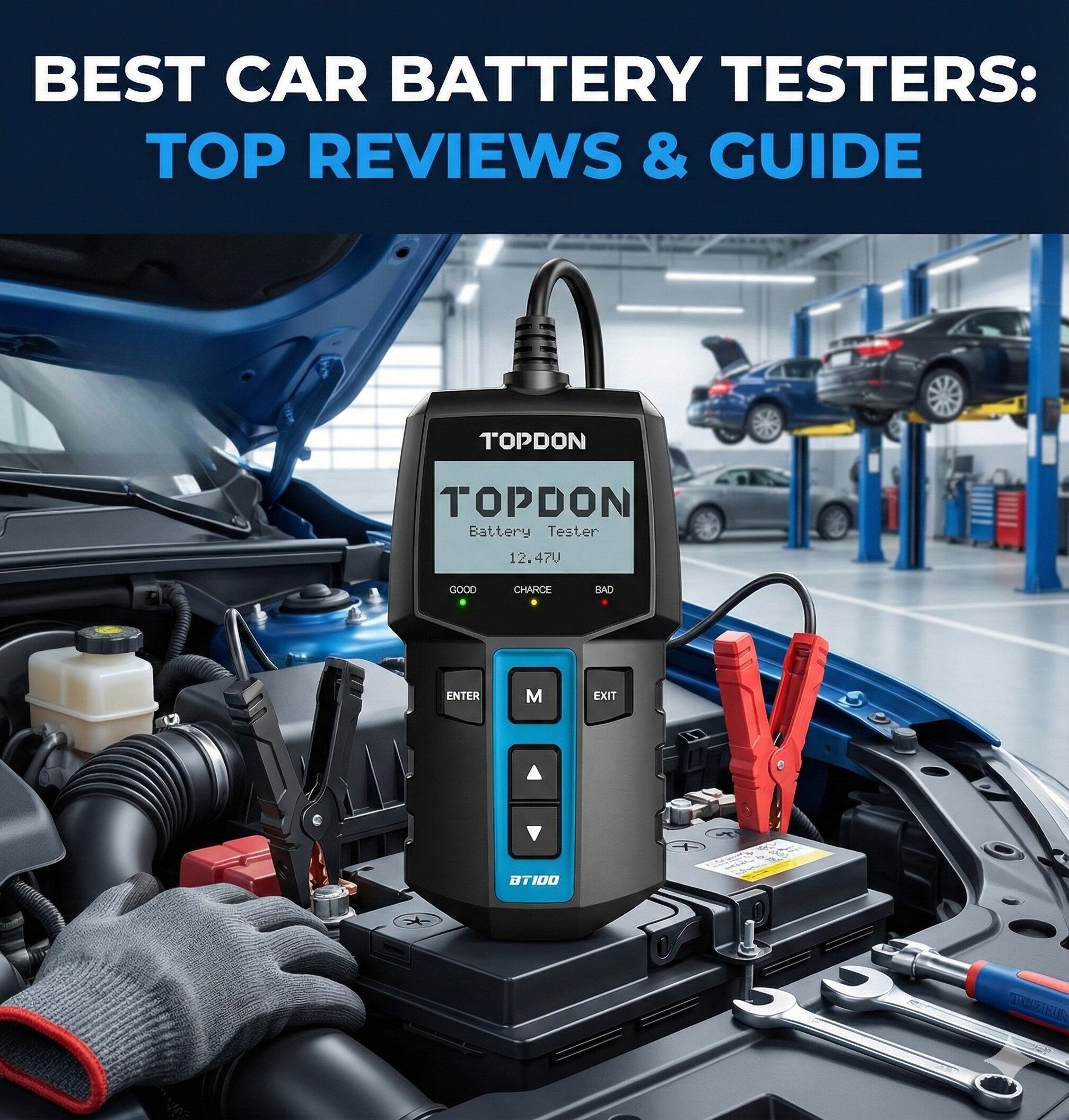
1. TOPDON BT100: The Best Overall Value

If you want a device that is plug-and-play, accurate, and affordable, the TOPDON BT100 is the undisputed champion for most passenger vehicles. It strikes the perfect balance between professional features and user-friendly interface.
Why It Stands Out
The BT100 doesn’t just give you a “Good/Bad” light. It provides specific metrics including voltage, internal resistance, and CCA rating. It utilizes advanced conductance testing technology, meaning it won’t drain your battery while testing it, nor will it get dangerously hot like older analog testers.
It also features a Cranking Test (to check the starter) and a Charging Test (to check the alternator). If your car is struggling to start, this tool helps you verify if the issue is the battery or if you need to look into engine warning lights related to the charging system.
- Extremely easy to use, even for beginners.
- Compact size fits in any glovebox.
- Tests batteries both in and out of the vehicle.
- Clear LCD screen with intuitive navigation.
- Cable length is adequate but could be longer for large trucks.
- No data printing capability.
2. ANCEL BA101: The Professional’s Choice for Data

For those who want a deeper dive into their vehicle’s electrical health, the ANCEL BA101 offers capabilities usually found in much more expensive shop tools. It is a favorite among DIY mechanics who already own specialized gear like the best car safety tools.
Precision and Printing
The standout feature of the BA101 is its extended cable range and the ability to print data via a PC. If you are diagnosing a car for a friend or a customer, being able to hand them a printed report of their battery health is a professional touch.
It covers a wide range of battery types including Regular Flooded, AGM Flat Plate, AGM Spiral, and Gel batteries. Whether you are prepping for winter (check our winter emergency checklist) or just doing routine maintenance, the BA101 provides peace of mind.
- Long 3-foot cable makes reaching terminals easy.
- USB port for printing test results via computer.
- Very fast analysis speed.
- Rugged housing design.
- The PC software interface looks a bit dated.
- Slightly bulkier than the TOPDON unit.
3. FOXWELL BT705: The Heavy-Duty Powerhouse
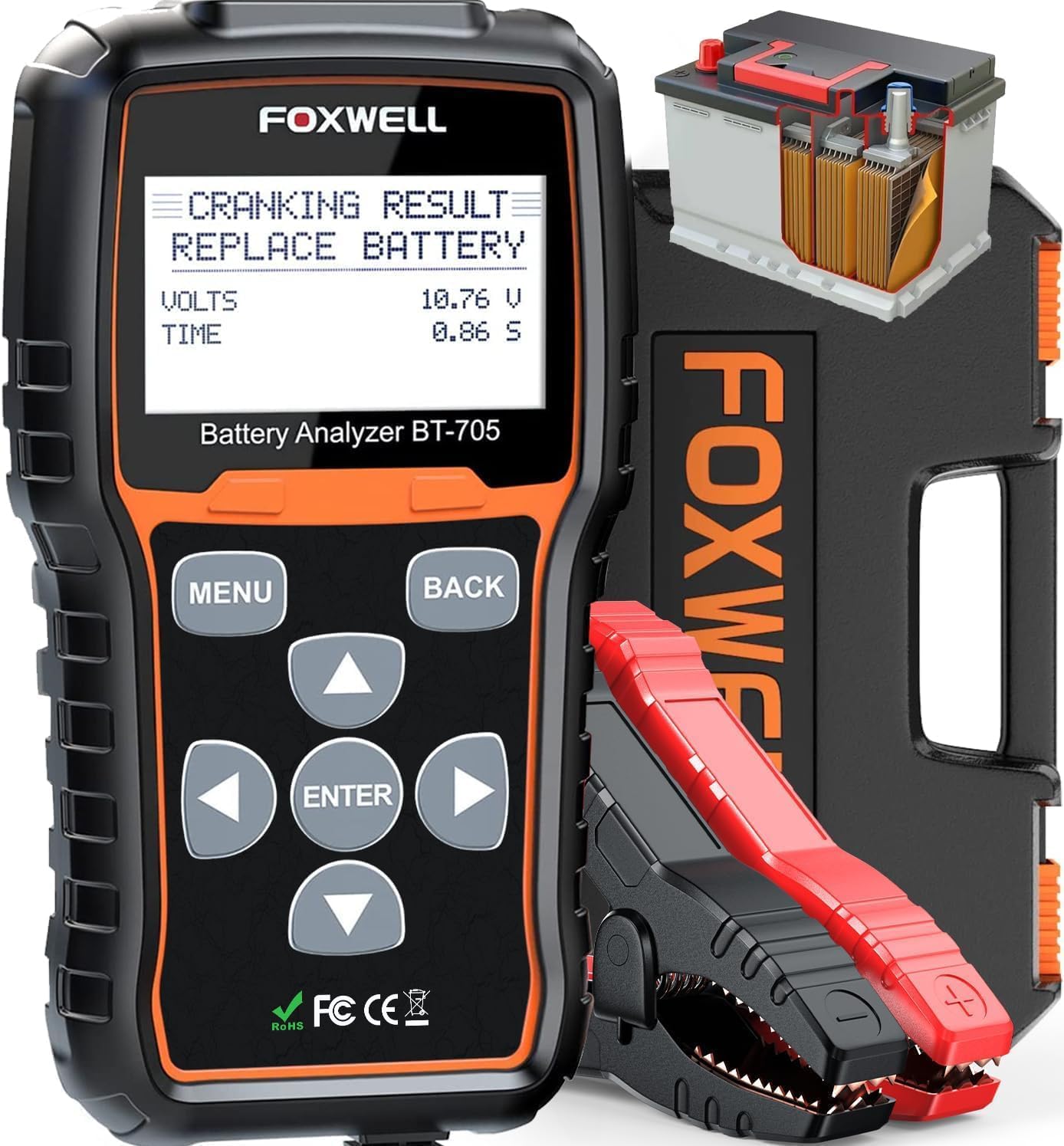
Do you own a diesel truck, an RV, or a car with a 24V system? Standard testers won’t cut it. The FOXWELL BT705 is designed to handle the heavy lifting. This unit is built for the garage that has everything from air compressors to hydraulic jacks.
Versatility Across Vehicles
The BT705 is unique because it can test both 12V and 24V charging systems, making it indispensable for commercial vehicles or heavy-duty pickups. It uses advanced Kelvin clamp technology to ensure a solid connection even on corroded terminals.
If you are wondering why your car shakes when you drive, it’s usually mechanical, but if your electronics flicker simultaneously, a deep system test with the BT705 can rule out alternator spikes or voltage drops.
- Compatible with 12V and 24V systems.
- Premium copper clamps for accurate readings.
- Detects “surface charge” for more accurate results.
- Rubberized sleeve for impact protection.
- Significantly more expensive than basic 12V testers.
- Overkill for a standard compact sedan.
4. Schumacher BT-100: The Budget “Old School” Load Tester

Sometimes, technology isn’t the answer. Sometimes, you just need physics. The Schumacher BT-100 is a traditional load tester. It works by applying a physical 100-amp load to the battery—simulating the act of starting the car—and seeing if the voltage holds.
Simple and Effective
This is one of the top budget-friendly car gadgets available. It has no digital screen to break and no batteries to replace. You hook it up, flip the switch, watch the needle, and feel the heat. It is incredibly definitive; either the battery holds the load, or it doesn’t.
However, be careful. The unit gets very hot during use (because it converts that electrical energy into heat). It’s great for checking batteries on cars, lawn tractors, or even motorcycles (6V systems).
- Extremely affordable.
- No internal batteries required to operate.
- Works on 6V and 12V batteries.
- Simple “Pass/Fail” analog gauge.
- Generates significant heat (safety caution required).
- Requires a “cool down” period between tests.
- Not as precise as digital analyzers.
5. QUICKLYNKS BM2: The Bluetooth Battery Monitor

What if you didn’t have to pop the hood to check your battery? The QUICKLYNKS BM2 stays permanently attached to your battery terminals and sends data to your phone via Bluetooth. This is the future of maintenance.
Continuous Monitoring
This device is perfect for vehicles that sit for long periods, such as convertibles stored for winter or classic cars. It alerts your phone if the voltage drops too low. It pairs perfectly with other safe driving apps for smartphones to create a complete digital dashboard for your car.
While it doesn’t perform a heavy load test like the Schumacher, it excels at tracking trends. You can see a graph of your voltage over 30 days, helping you identify if your battery drains overnight (parasitic draw).
- Wireless monitoring via smartphone app.
- Great for detecting parasitic drains.
- Sends notifications when charge is low.
- Installation is “set and forget.”
- Bluetooth range is limited (must be near the car).
- App interface can be finicky on some phones.
Buying Guide: How to Choose the Right Battery Tester
Not all testers are created equal. Before you buy, consider these factors to ensure you’re getting the right tool for your vehicle.
1. Compatibility (CCA and Voltage)
Most cars run on 12V systems. However, if you have a vintage car (6V) or a heavy truck (24V), you need a specific tester. Also, check the CCA range. A small tester might handle a Honda Civic (400 CCA) but struggle with a diesel Ford F-350 (900+ CCA).
2. Test Types
A basic tester checks voltage. A good tester checks Health. The best testers checks the System (Cranking and Charging).
- Battery Test: Tells you if the battery is dead or needs charging.
- Cranking Test: Checks if the starter motor is pulling too much voltage.
- Charging Test: Verifies the alternator is replenishing the battery.
3. Climate Considerations
Batteries behave differently in the cold. If you are learning how to drive on black ice or live in freezing regions, ensure your tester has temperature compensation features. Cold batteries show lower CCA, and a good tester accounts for this.
4. Ease of Use
If you aren’t a mechanic, avoid the analog load testers (like the Schumacher) which get hot and spark. Stick to digital conductance testers (like TOPDON or ANCEL). They are safer, cooler, and give clear “Replace” or “Good” instructions. These make excellent gifts for new car owners.
Maintenance Tips: Extending Your Battery Life
A tester diagnoses the problem, but maintenance prevents it. Here are quick tips to keep your battery healthy:
- Clean Terminals: Corrosion adds resistance. Clean the posts with a wire brush and baking soda solution.
- Drive Regularly: Short trips don’t allow the alternator to fully recharge the battery. Take a longer drive once a week, especially if you are wondering how long it takes to drive around Oahu or just cruising the highway.
- Secure the Hold-Down: Vibration kills batteries. Ensure the battery is clamped down tight so internal plates aren’t damaged.
- Turn Off Accessories: Don’t leave headlights or AC on when the engine is off. This is a common mistake seen in common driving test mistakes.
Frequently Asked Questions (FAQ)
What is the difference between a load tester and a conductance tester?
A load tester (traditional) applies a physical electrical load to the battery to see if it holds voltage, generating heat. A conductance tester (digital/modern) sends a low-frequency signal through the battery to calculate health without draining it or creating heat.
Can I test a battery while it is still in the car?
Yes, most modern digital battery testers allow you to test the battery while it is connected to the vehicle (in-vehicle test). However, ensure the engine and all accessories are turned off before starting the test.
How do I know what CCA my battery should have?
The Cold Cranking Amps (CCA) rating is printed on the label of your car battery. You will need to input this number into digital testers to get an accurate State of Health (SOH) reading.
Can a multimeter replace a battery tester?
Not entirely. A multimeter can only measure voltage (State of Charge). It cannot measure the Cranking Amps or internal resistance (State of Health). A battery can show 12.6V but still fail to start the car under load.
How often should I test my car battery?
It is recommended to test your battery twice a year, specifically before winter and summer, as extreme temperatures are the hardest on battery chemistry.
Will a tester work on a dead battery?
Most digital testers require a minimum voltage (usually around 7-8V) to power on. If the battery is completely flat, you may need to charge it slightly before the tester can analyze it.
Does the tester check the alternator too?
Yes, most of the top-rated testers on our list (like the TOPDON and FOXWELL) include a system test mode that analyzes the starter motor (cranking test) and the alternator (charging test).
Is it safe to use these testers?
Yes, modern conductance testers are spark-free and do not generate heat, making them very safe for users. Traditional load testers generate heat and require more caution.
Conclusion
A dead battery is more than an inconvenience; it’s a vulnerability. Whether you are prepping for a family vacation or just want to ensure you can get to work on time, a reliable battery tester is a small investment that pays massive dividends in peace of mind.
For most drivers, the TOPDON BT100 offers the perfect mix of price and performance. For the data-obsessed or semi-pro mechanic, the ANCEL BA101 is a fantastic upgrade. Whichever you choose, don’t wait until you hear that dreaded “click-click-click” to buy one.