Mastering Wet Weather: Essential Tactics for Driving in Heavy Rain
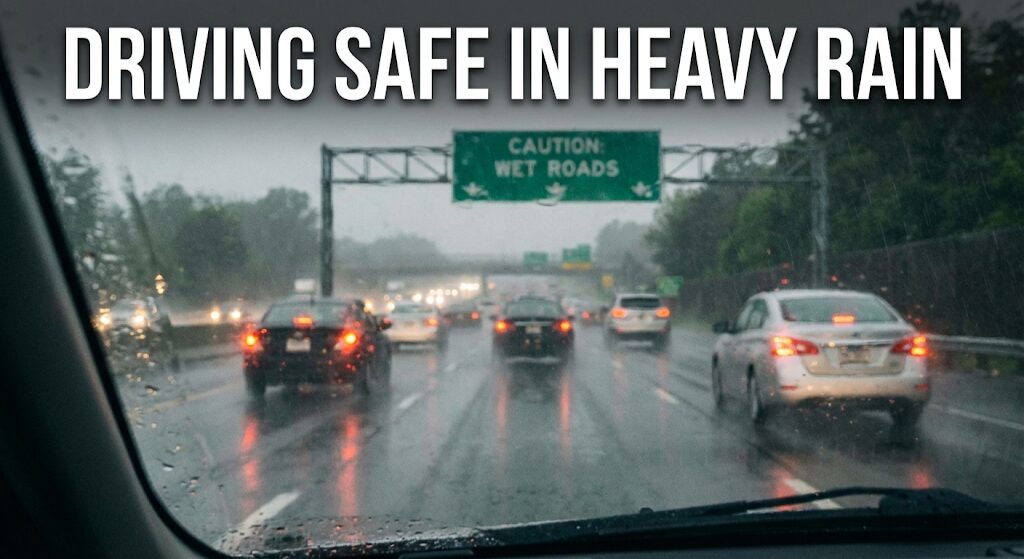
Driving in heavy rain is one of the most stressful and hazardous conditions a motorist can face. The combination of drastically reduced visibility, compromised tire traction, and the unpredictable behavior of other drivers creates a high-stakes environment where a split-second decision can mean the difference between arriving safely and suffering a severe collision. While many drivers take dry, sunny roads for granted, an unexpected torrential downpour completely alters the physics of how your vehicle interacts with the pavement.
Whether you are caught in a sudden summer thunderstorm or navigating days of endless, freezing winter rain, preparation and knowledge are your best defenses. In this comprehensive, deep-dive guide, we will break down the precise mechanics of wet-weather driving. From understanding the terrifying phenomenon of hydroplaning to executing proper skid recovery techniques, this 12-step mastery guide covers everything you need to know to command your vehicle safely through the heaviest of storms.
1. The Science of Hydroplaning (and How to Avoid It)
Hydroplaning (also known as aquaplaning) is arguably the most terrifying experience a driver can face in the rain. It occurs when your vehicle’s tires completely lose contact with the road surface, skating instead on a thin layer of water. At this exact moment, you have zero steering, zero braking, and zero control. Your two-ton vehicle essentially becomes a fast-moving, unguided sled.
To understand how to prevent it, we must understand the physics. Modern tire treads are designed with deep channels. As the tire rolls, these channels act like microscopic water pumps, squeezing water out from beneath the rubber so the tire can grip the asphalt. However, when the volume of water on the road exceeds the tire’s ability to channel it away—either due to the depth of the water, the speed of the vehicle, or the baldness of the tire—water pressure builds up in front of the tire. Eventually, this pressure lifts the vehicle off the road.
How to Prevent Hydroplaning:
- Reduce your speed: The faster you drive, the harder it is for your tires to disperse water. Hydroplaning can occur at speeds as low as 35 mph in heavy downpours.
- Maintain proper tire tread depth: Tires with less than 4/32 of an inch of tread are highly susceptible to hydroplaning.
- Ensure correct tire pressure: Under-inflated tires bow inward, creating a “cup” in the center of the tread that traps water rather than expelling it.
- Drive in the tracks of the car ahead: The vehicle in front of you has already displaced some of the water on the road, leaving a slightly drier path for your tires to follow.

2-in-1 Digital Tire Pressure & Tread Depth Gauge
Don’t guess when it comes to hydroplaning risks. Accurately measure your PSI and tread depth in seconds to ensure your tires are rain-ready.
Check Price on Amazon2. Pre-Drive Vehicle Inspection for Wet Conditions
Safety in heavy rain begins in your driveway, not on the highway. A vehicle that is poorly maintained will fail you exactly when you need it the most. Before the rainy season hits, or if you know you are about to drive into a major storm, a strict pre-drive inspection is non-negotiable.
First, evaluate your windshield wipers. Wiper blades are made of rubber, which degrades rapidly due to UV exposure, heat, and standard wear. If your wipers leave streaks, make a chattering noise, or skip across the glass, they are failing. In a torrential downpour, failed wipers mean total blindness. Replace them every six to twelve months.
Next, check all exterior lighting. Heavy rain absorbs light, making your vehicle incredibly difficult for others to see. Walk around your car and verify that your low beams, high beams, taillights, brake lights, and turn signals are fully operational. Furthermore, check your washer fluid reservoir; heavy rain often mixes with road grime, grease, and mud, splashing onto your windshield and requiring constant cleaning while driving.
3. Mastering Visibility: Wipers, Lights, and Defrosters
When the skies open up, visibility drops to near zero in seconds. Managing the interior and exterior visibility of your vehicle is a constant balancing act during heavy rain. The immediate reaction is to turn the wipers to the highest setting, but managing internal climate control is just as critical.
Rain cools the exterior of the windshield, while the ambient heat and humidity from your breath warm the interior. This temperature differential causes instantaneous, blinding internal condensation (fog). To combat this, you must understand your vehicle’s HVAC system.
The Perfect Anti-Fog Setting:
- Turn on the AC: Yes, even if it’s cold. The air conditioning system inherently acts as a dehumidifier, pulling moisture out of the cabin air.
- Turn off air recirculation: You want to pull fresh air from the outside. Recirculating the damp air inside the cabin will only make the fog worse.
- Set the dial to the Defrost setting: Direct the dry air exclusively at the windshield.
Externally, always turn on your headlights. Many modern cars feature automatic headlights, but sensors may not detect rain if it is still relatively bright outside during a daytime shower. Manually switch your headlights to the “ON” position. This isn’t just to help you see; it is to ensure you are seen by oncoming traffic and vehicles behind you.

Rain-X Original Glass Water Repellent
Dramatically improve wet weather driving visibility. This hydrophobic treatment makes raindrops bead up and roll away before your wipers even touch them.
View on Amazon4. Speed Management and Braking Dynamics in the Rain
The speed limit posted on the side of the road is intended for ideal, dry, daylight conditions. When heavy rain alters the environment, that speed limit is no longer safe or legally applicable under the “basic speed law” (which dictates you must drive at a speed safe for current conditions).
In wet conditions, your vehicle’s braking distance increases dramatically. On a dry road, a standard car traveling at 60 mph requires roughly 120 to 140 feet to come to a complete stop. On a wet road, that distance can double, requiring upwards of 250 feet. If you do not adjust your speed and your following distance, you are physically unable to stop in time to avoid a sudden obstacle.
The golden rule for rain driving is to increase your following distance from the standard 3 seconds to a minimum of 5 or 6 seconds. Pick a stationary object on the side of the road (like a signpost). When the car in front of you passes it, begin counting. If you pass that same object before reaching “five,” you are following too closely for wet conditions.
5. The Danger of Cruise Control on Wet Roads
One of the most dangerous, yet common, mistakes drivers make is leaving their cruise control activated when the rain begins to fall. Cruise control is designed to maintain a constant speed, completely ignoring traction levels. It is a convenience feature, not a safety system.
If you hit a patch of standing water with cruise control on, your tires will lose traction and begin to hydroplane. Because the wheels lose resistance, your vehicle’s computer will interpret this as a drop in speed and will automatically deliver more power to the engine to compensate. The sudden surge in wheel spin while you have zero grip will violently throw your car into an unrecoverable spin.
It is vital to understand the intricate details of rain driving safety, cruise control, and high speeds. The moment precipitation begins, tap your brakes lightly or hit the “cancel” button on your steering wheel. Your foot must remain intimately connected to the accelerator pedal so you can instantly sense traction loss and lift off the gas immediately.

Bosch ICON Premium Beam Wiper Blades
Don’t compromise on visibility. Upgrade to aerodynamic, beam-style wiper blades that provide a streak-free wipe even in hurricane-force winds and torrential downpours.
Shop Wiper Blades on Amazon6. Navigating Puddles, Flooded Roads, and Standing Water
“Turn Around, Don’t Drown.” This National Weather Service slogan exists for a reason. Heavy rain can quickly lead to flash flooding, turning dips in the road, underpasses, and poor drainage areas into deep bodies of standing water.
It is nearly impossible to judge the depth of a puddle or flooded street from the driver’s seat. What looks like an inch of water might be a massive sinkhole or a foot-deep washout. Driving into deep water is catastrophic for several reasons:
- Engine Hydrolock: If your vehicle’s air intake (usually located in the front bumper or grille area) sucks in water instead of air, the water will enter the engine cylinders. Because water cannot be compressed like air, the engine will violently seize, destroying the connecting rods and pistons instantly.
- Loss of Buoyancy: It only takes 12 inches of rushing water to sweep a small car off the road, and 18 to 24 inches to carry away large SUVs and pickup trucks.
- Hidden Debris: Floodwaters hide sharp rocks, logs, and debris that can puncture tires and tear off your vehicle’s undercarriage components.
If you encounter a flooded roadway, do not attempt to cross it. Put the car in reverse, turn around, and find an alternate route. If you must drive through shallow standing water (less than a few inches), do so at a crawling speed (1-2 mph) to avoid splashing water into the engine bay.
7. Defensive Driving Strategies for Inclement Weather
Driving in heavy rain requires a radical shift in mindset. You must transition from a passive driver to an active, hyper-vigilant operator. Anticipating the mistakes of others is your greatest shield against accidents in terrible weather.
Visibility is poor for everyone, not just you. This means the driver approaching the intersection from your left may not see their red light, or the truck merging onto the highway might not see you in their side mirror. Always cover your brake pedal when approaching intersections, and actively scan the road 15 to 20 seconds ahead of your vehicle.
Furthermore, actively cultivating defensive driving habits to reduce collision risks involves smooth inputs. Avoid sudden acceleration, abrupt braking, or sharp steering wheel movements. Imagine there is an egg between your foot and the brake pedal, and a cup of hot coffee resting on your dashboard. Drive so smoothly that you don’t break the egg or spill the coffee.

Heavy-Duty All-Weather Floor Mats
Keep your car interior pristine. Deep-channel, laser-measured floor liners trap rainwater, mud, and muck from your shoes, preventing slippery pedals and carpet rot.
Find Your Vehicle Fit8. Dealing with Reduced Visibility and Secondary Fog
Heavy rain is rarely an isolated phenomenon; it is often accompanied by dark storm clouds, mist, and fog created by the impact of rain on warm pavement. When your visibility drops below a quarter of a mile, your driving strategy must change immediately.
A common error drivers make in severe rain and fog is turning on their high-beam headlights. High beams angle light upward; when this intense light hits the millions of suspended water droplets in the air, the light reflects directly back into your eyes, creating an impenetrable white wall of glare. Always use your low beams in rain and fog.
If your vehicle is equipped with fog lights, activate them. These lights are mounted low to the ground and have a wide, flat beam pattern designed to cut under the rain and illuminate the lane markers directly in front of you. Navigating these conditions is very similar to applying fog driving strategies for visibility. Keep your eyes locked on the right-side white line of the road as a guide if oncoming headlight glare becomes blinding.
9. Braking Systems and Stopping Distances in the Rain
Understanding how your vehicle’s brakes function when wet is critical. Modern vehicles are equipped with Anti-lock Braking Systems (ABS). In the past, slamming on the brakes in the rain would lock the wheels, causing the car to slide out of control. ABS prevents this by rapidly pumping the brakes (up to 15 times per second) to maintain steering control while stopping.
If you have to make an emergency stop in the rain and your car has ABS, press the brake pedal down as hard as you can and hold it there. You will feel a harsh pulsing or shuddering sensation in the pedal, and hear a loud grinding noise. Do not let up! This means the system is working. Continue to steer around the obstacle while holding the brake pedal down.
Additionally, wet brake rotors lose initial bite. If you have been driving on the highway in heavy rain for an hour without braking, a layer of water forms on the brake discs. When you finally press the pedal, there may be a split-second delay before the pads wipe the water away and begin to grip. It’s crucial to understand how to react to brake fade vs. hydraulic failure; if you anticipate needing to stop soon, lightly tap the brakes a few times beforehand to generate heat and wipe the rotors dry.
10. Sharing the Road: Trucks, Motorcycles, and Pedestrians
Heavy rain affects different vehicles in vastly different ways. You must adjust your behavior based on who you are sharing the road with.
Semi-Trucks & Large Vehicles
Large trucks create massive plumes of spray (often called a “rooster tail”) that can instantly blind a passenger car following too closely. Never hover next to a semi-truck in the rain. Either drop back to a safe distance where the spray dissipates, or pass them quickly and decisively. Remember, a fully loaded 80,000 lb truck takes significantly longer to stop on wet pavement than you do.
Motorcycles & Bicycles
Riders face the highest risk in the rain. They have only two small contact patches with the ground, and rain gear can restrict their vision and movement. Painted road lines, manhole covers, and metal bridge grates become as slippery as ice for motorcycles when wet. Give them extra following distance and an incredibly wide berth when passing.
Also, remain highly vigilant in urban areas. Pedestrians carrying umbrellas or wearing hoods often have their peripheral vision blocked and may step into crosswalks hastily to escape the rain. Be prepared to yield instantly.

Waterproof LED Emergency Road Flares
If you break down in heavy rain, traditional flares won’t light. These magnetic, crush-proof LED discs flash brightly to warn oncoming traffic and keep your family safe on the shoulder.
Secure Your Safety Kit11. What to Do If Your Vehicle Starts to Skid
Even with the best preparation, a hidden slick spot or oily patch combined with rain can cause your vehicle to skid. Panic is your worst enemy in this scenario. Stomping on the brakes or aggressively jerking the steering wheel will only exacerbate the slide.
| Type of Skid | Characteristics | Proper Recovery Technique |
|---|---|---|
| Understeer (Front-Wheel Skid) | You turn the wheel, but the car plows straight ahead. Common in FWD cars entering corners too fast. | Take your foot completely off the gas. Do NOT slam the brakes. Unwind the steering wheel slightly until the front tires regain traction, then gently steer back into the curve. |
| Oversteer (Rear-Wheel Skid) | The back of the car breaks loose and tries to spin out to the side. Common in RWD cars. | Look exactly where you want the car to go (not at the wall). Steer smoothly into the direction of the skid. Ease off the gas, but avoid heavy braking. |
| Four-Wheel Hydroplane | The steering goes completely light, and the car feels like it’s floating. | Do not brake. Do not turn the wheel. Ease off the accelerator completely and wait for the vehicle to slow down enough for the tires to cut through the water and touch the road again. |
12. Post-Drive Care: Drying Out Brakes and Inspecting for Damage
Surviving the storm doesn’t mean your responsibilities as a driver are over. Driving through heavy rain, especially if you encountered deep puddles, puts immense strain on your vehicle’s mechanical components.
As you approach your destination and the rain subsides, perform a “brake drying” maneuver. In a safe area with no traffic behind you, lightly drag your left foot on the brake pedal while maintaining your speed with your right foot for about 5 to 10 seconds. The friction generates heat, evaporating the remaining water off the brake pads and rotors, ensuring they are dry and ready for your next drive.
Once parked, do a quick visual inspection. Check your front grille to ensure no plastic bags or debris were washed up and stuck against your radiator, which could cause overheating on your next trip. Check your wheel wells for mud buildup, and if you drove through flooded streets with salt or heavy mud, consider taking the car to a touchless car wash with an undercarriage spray in the following days to prevent rapid rusting and corrosion of your suspension components.
Frequently Asked Questions (FAQs)
Still have questions about navigating severe wet weather? We’ve compiled the most common inquiries drivers have about safety in the rain.
1. What should I do if my car starts to hydroplane?
Take your foot off the accelerator immediately. Do not slam on the brakes, and do not make sudden steering wheel movements. Keep the wheel straight and allow the vehicle to naturally slow down until you feel the tires grip the road again.
2. Why is the road most slippery when it first starts raining?
During dry spells, oil, grease, brake dust, and rubber particles accumulate on the road surface. When the first drops of rain fall, this mixture turns into an incredibly slick, soapy film. After a few hours of heavy rain, most of this oil is washed away.
3. Is it safe to use cruise control while driving in the rain?
No, it is highly dangerous. Cruise control attempts to maintain a constant speed. If you hit standing water, the system may cause the wheels to spin faster, leading to immediate hydroplaning and loss of control.
4. How much should I reduce my speed in heavy rain?
As a general rule, reduce your speed by at least 1/3 when driving on wet roads. If visibility is severely compromised or water is pooling on the road, reduce your speed even further and increase following distance to 5-6 seconds.
5. Should I use my high beams in heavy rain or fog?
No. High beams reflect off the water droplets in the air, creating a wall of white glare that reduces visibility. Always use low beams in rain, fog, or snow.
6. Is it legal to drive with my hazard lights on in a downpour?
This depends on your state laws. However, safety experts generally advise against it. Hazard lights disable your turn signals and can confuse other drivers into thinking your vehicle is stopped. It is better to use your low beam headlights and taillights.
7. How do I stop my windshield from fogging up in the rain?
Turn on your air conditioning (even if the temperature is set to warm), turn off the air recirculation button to draw in fresh air, and direct the airflow to the windshield using the defrost setting.
8. What depth of water is dangerous to drive through?
Just 6 inches of moving water can knock over an adult. 12 inches of water can float many small cars, and 24 inches can carry away SUVs and pickup trucks. Never drive through standing water if you cannot see the road beneath it.
9. Can heavy rain damage my car’s engine?
Yes, if you drive through deep water. If water is sucked into the engine’s air intake, it causes “hydrolock,” which bends connecting rods and completely destroys the engine in seconds.
10. How often should I replace my windshield wipers?
Wiper blades should be replaced every 6 to 12 months, or as soon as you notice streaking, skipping, or a chattering noise. Sun and heat degrade the rubber over time, making them ineffective when rain finally arrives.
Ready to Conquer the Roads, Rain or Shine?
Mastering heavy rain driving requires patience, proper vehicle maintenance, and a defensive mindset. Don’t let the next storm catch you off guard. Equip yourself with the right knowledge and gear today.
Download the Ultimate Emergency Car Prep Guide