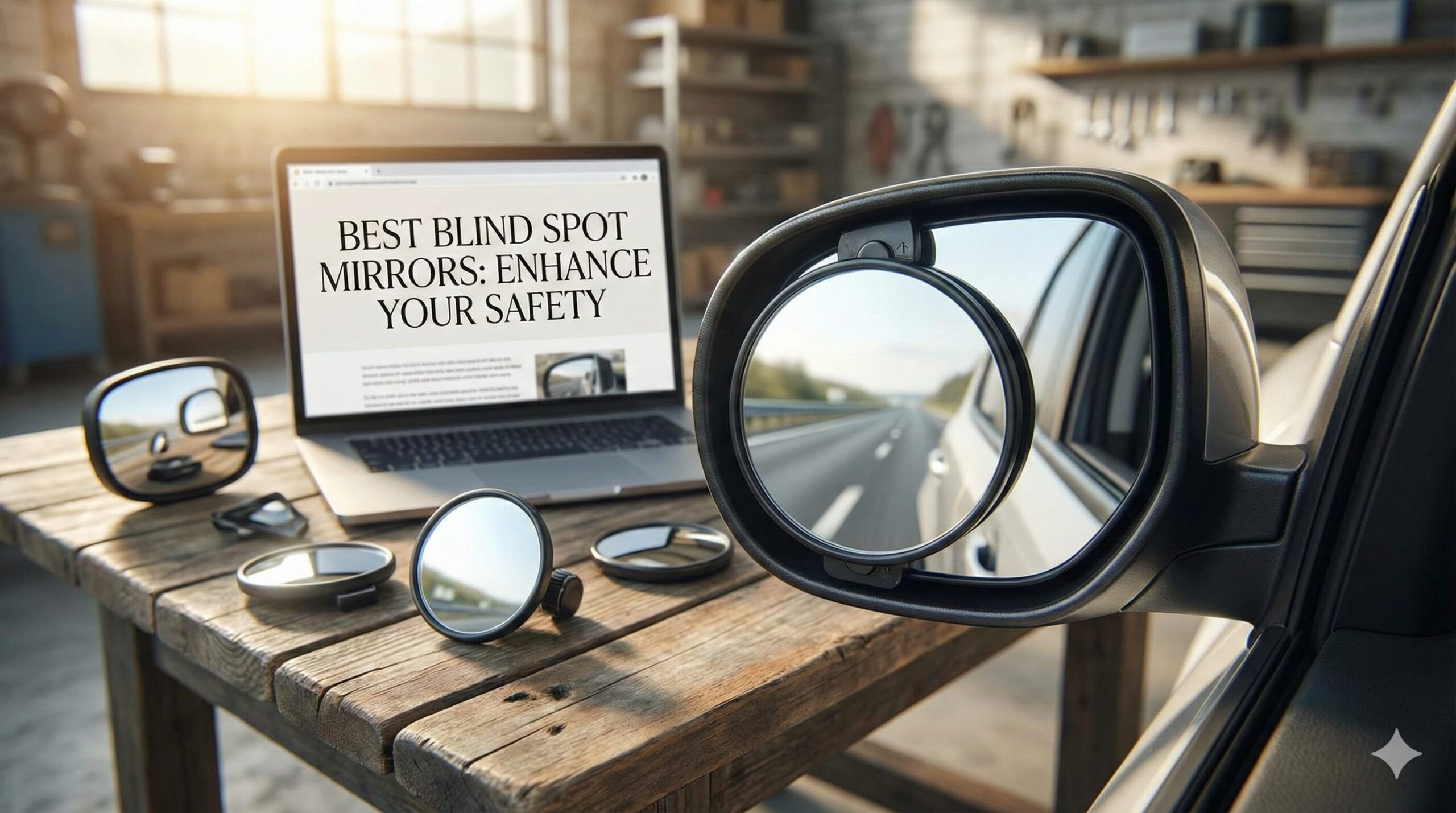
5 Best Blind Spot Mirrors
See what you’ve been missing. We tested the top brands for clarity, adhesion, and field of view to keep you safe on the road.
Don’t Drive Blind: The Safety Upgrade You Need
Every driver knows the panic: you check your mirrors, signal, start to merge, and suddenly hear the blare of a horn from a car you never saw. Blind spots are an inherent flaw in automotive design, and relying solely on a shoulder check isn’t always enough, especially at high speeds or in bad weather.
Blind spot mirrors are one of the most cost-effective car safety tools available. For less than the price of a lunch, they dramatically expand your field of vision, making lane changes safer and parking easier. Whether you are a new driver prone to common driving mistakes or a seasoned pro, these small additions can prevent major accidents.
In this guide, we analyze the top 5 blind spot mirrors, evaluating them on optical clarity, adhesive strength, and aerodynamic design.
Blind Spot Accidents: The Statistics You Can’t Ignore
Understanding the severity of blind spot dangers helps underscore why these small mirrors matter so much. The National Highway Traffic Safety Administration has documented that lane-change and merge accidents account for approximately 9% of all crashes reported to police annually. This translates to roughly 540,000 accidents each year where blind spot visibility played a contributing factor.
What’s particularly alarming is that a study conducted by the Insurance Institute for Highway Safety found that drivers typically have a blind spot zone extending from approximately 11 feet behind the rear bumper to 22 feet back on the left side, and even larger on the right side. This “danger zone” can completely hide a vehicle traveling alongside you at highway speeds.
Motorcyclists face an even greater risk, with the Hurt Report indicating that nearly 75% of motorcycle accidents involve collisions with passenger vehicles, and in 65% of those cases, the driver failed to detect the motorcycle due to blind spot limitations. A properly positioned blind spot mirror can reveal an entire motorcycle that would otherwise remain invisible in your standard side mirror.
Commercial truck drivers face the most severe blind spot challenges. The Federal Motor Carrier Safety Administration reports that large trucks have “No-Zones” that can extend up to 20 feet in front of the cab, 30 feet behind the trailer, and alongside both sides of the truck. While passenger vehicle blind spots are concerning, understanding these commercial vehicle limitations makes you a more defensive driver.
For everyday commuters, the most dangerous scenario is the highway merge. At 65 miles per hour, you travel approximately 95 feet per second. A vehicle hidden in your blind spot for even two seconds covers nearly 200 feet of road without you ever seeing it. Blind spot mirrors reduce that vulnerability window to near zero when properly adjusted.
Choosing the Best Blind Spot Mirror for Your Specific Vehicle
Best Blind Spot Mirrors for SUVs and Crossovers
Sport utility vehicles and crossovers present unique challenges due to their higher ride height and larger physical dimensions. The elevated seating position, while providing excellent forward visibility, creates more pronounced blind spots along the vehicle’s flanks. For SUV owners, we recommend blind spot mirrors with at least a 2-inch diameter and strong convex curvature to compensate for the larger vehicle footprint.
The Ampper 2-inch round mirrors work exceptionally well on compact and mid-size SUVs like the Honda CR-V, Toyota RAV4, and Ford Escape. Their 360-degree swivel capability allows SUV drivers to angle the mirror downward slightly to catch those low-profile sports cars that might slip beneath the beltline of taller vehicles. For full-size SUVs such as the Chevrolet Suburban or Ford Expedition, consider installing slightly larger 3-inch mirrors or the Utopicar elongated design for maximum coverage.
Best Blind Spot Mirrors for Pickup Trucks
Pickup truck owners face distinct challenges, particularly those driving crew cab models with full-size beds. The extended wheelbase and tall bed sides create massive blind spots that standard mirrors struggle to cover. Truck drivers should strongly consider the LivTee fan-shaped mirrors because the adjustable swivel base allows for precise angling to see around the truck bed.
For heavy-duty truck owners who frequently tow trailers, fifth-wheel campers, or boats, the TYC replacement mirror assemblies become increasingly attractive. These complete mirror systems often include integrated convex sections specifically designed for towing applications. The stick-on solutions can supplement these factory systems but should not be considered complete replacements on commercial-grade vehicles.
Best Blind Spot Mirrors for Compact Cars and Sedans
Sedan drivers benefit from the widest range of compatible blind spot mirror options. The lower ride height and smaller vehicle dimensions mean that even the most compact mirrors provide meaningful visibility improvements. The Essential Contraptions mirrors shine in this category because their frameless, minimalist design complements the sleek aesthetics of modern sedans like the Honda Accord, Toyota Camry, and Tesla Model 3.
For subcompact cars such as the Honda Fit, Toyota Yaris, or Chevrolet Spark, the 2-inch round format provides proportional coverage without overwhelming the smaller mirror housing. The key consideration for compact car owners is avoiding mirrors that are too large, which can obstruct the already limited surface area of smaller side mirrors.
Best Blind Spot Mirrors for Motorcycles
While this guide focuses primarily on passenger vehicles, motorcyclists can benefit tremendously from supplementary convex mirrors. Many riders attach small circular blind spot mirrors to their existing motorcycle mirrors or handlebar mounts. The vibration-resistant properties of glass mirrors become critical on motorcycles, where engine vibration can blur plastic mirrors into uselessness.
Best Blind Spot Mirrors for RVs and Motorhomes
Recreational vehicle operators face the most extreme blind spot challenges of any vehicle class. Class A motorhomes can stretch 40 feet or longer, with blind spots that swallow entire passenger vehicles. While stick-on blind spot mirrors help, RV owners should prioritize comprehensive mirror systems with multiple convex sections. The principles of blind spot mirror placement become especially critical when piloting a vehicle that cannot make quick evasive maneuvers.
Quick Comparison: Top Picks at a Glance
| Brand | Best For | Shape | Material | Mount |
|---|---|---|---|---|
| Ampper | Budget / Universal | Round | HD Glass | 3M Stick-on |
| Utopicar | Highway Driving | Semi-Oval | Reflective ABS | 3M Stick-on |
| LivTee | Adjustability | Fan Shape | Glass | Swivel Base |
| Essential Contraptions | Optical Clarity | Round | Real Glass | 3M Stick-on |
| TYC | Factory Replacement | OEM Fit | Glass/Plastic | Bolt-on |
1. Ampper Blind Spot Mirror (2 Pack)

The Standard for Safety. Ampper has dominated the market with a simple, effective design. These are 2-inch round convex mirrors made from real HD glass, not plastic. This ensures they won’t haze or yellow over time from sun exposure.
What sets them apart is the frameless design. Without a bulky plastic border, the mirror blends seamlessly into your existing side mirror, looking almost like a factory upgrade. They come with a 360-degree swivel mount, allowing you to angle the mirror perfectly for your height and seating position. The waterproof, rust-resistant housing ensures they survive car washes and heavy rain.
- Real HD glass for crystal clear visibility.
- Frameless ultrathin design looks sleek.
- 360° adjustable swivel mount included.
- Extremely affordable.
- 2-inch size might be small for large trucks.
- Adhesive is very strong (hard to reposition).

Get maximum visibility for a minimal price. A must-have safety upgrade.
Check Price on Amazon2. Utopicar Blind Spot Mirrors

Engineered for Speed. Utopicar took a different approach. Instead of the standard round “fish-eye” shape which distorts distance, they designed a semi-oval mirror specifically to extend your horizontal field of view. This allows you to see cars in the lane next to you and two lanes over, without the image looking like a funhouse mirror.
The “Frameless” design is laser-cut for a sophisticated look that complements modern car aesthetics. By prioritizing width over height, it takes up less vertical space on your main mirror while giving you more of the information you actually need: checking traffic for lane changes. This is an essential addition to your list of best road trip essentials.
- Unique shape maximizes horizontal view.
- Less distortion than standard round mirrors.
- Automotive grade adhesive.
- Looks like an OEM factory part.
- More expensive than round options.
- Not adjustable (fixed mounting).

See more of the lane next to you with less distortion.
Check Price on Amazon3. LivTee Fan-Shaped Mirror

Flexibility Meets Function. The LivTee mirror features a unique “fan” shape that fits perfectly into the corner of most side mirrors. This shape is optimized to curve with the aerodynamics of the housing.
The standout feature is its mounting mechanism. It sits on a highly articulate swivel base that allows for significant angle adjustment. This is perfect for families where multiple drivers share one car. A tall husband and a shorter wife can both easily adjust the blind spot mirror to their specific line of sight without having to peel it off and restick it. It’s a great companion product if you’re shopping for gifts for new car owners.
- Fan shape fits corners perfectly.
- Excellent adjustability for multiple drivers.
- Waterproof and rust resistant.
- Wide angle view aids in parking.
- Swivel base adds bulk/depth.
- Can vibrate slightly on rough roads.

Perfect for shared family vehicles. Adjusts in seconds.
Check Price on Amazon4. Essential Contraptions Blind Spot Mirror

No Gimmicks, Just Visibility. Essential Contraptions focuses on one thing: optical purity. Their mirrors use aluminum-coated glass which provides a brighter, clearer reflection than standard chrome-coated options. This is particularly helpful during night driving, where glare can be an issue.
They guarantee the adhesive for the life of the car, which is a bold claim that holds up in user testing. Unlike plastic mirrors that get scratched by ice scrapers or cloudy from UV rays, these remain crisp year after year. They are a fantastic, durable investment for safety.
- Superior aluminum-coated glass clarity.
- “Stick-on forever” adhesive guarantee.
- Rust-resistant aluminum frame.
- Simple, unobtrusive design.
- Frame is slightly visible (not fully frameless).
- Basic round shape (no wide-angle oval option).

Crystal clear glass that won’t haze or yellow over time.
Check Price on Amazon5. TYC Replacement Mirrors

When a Stick-On Isn’t Enough. Sometimes, the problem isn’t just a blind spot; it’s a broken or severely damaged factory mirror. TYC is the industry leader in aftermarket replacement mirrors. If your current mirror is cracked, hazy, or missing, sticking a small convex mirror on it won’t help.
TYC offers full replacement assemblies that often include built-in blind spot sections (like the towing mirrors found on trucks). These bolt on exactly like the original part but at a fraction of the dealer price. If you are prepping your vehicle for sale or just want to restore it to showroom safety standards, TYC is the route to take.
- Complete factory-look replacement.
- Often includes heated/power functions.
- Restores full visibility, not just blind spots.
- High-quality OEM-grade materials.
- Requires tools and installation time.
- More expensive than stick-on mirrors.

Restore your vehicle’s full visibility with a factory-fit replacement.
Check Price on AmazonManual Blind Spot Mirrors vs. Electronic Detection Systems
Modern vehicles increasingly come equipped with electronic blind spot monitoring systems that use radar sensors to detect vehicles in adjacent lanes. These systems typically illuminate a warning light in the side mirror or provide audible alerts when a vehicle enters your blind zone. While these electronic aids represent genuine safety advances, they come with significant limitations that make manual blind spot mirrors a valuable complementary tool.
The most critical advantage of manual convex mirrors is their zero-latency performance. An electronic system requires the sensor to detect a vehicle, process the signal, and activate the warning indicator, a process that can take 200-500 milliseconds. At highway speeds, that delay translates to 20-50 feet of travel before you receive the warning. A manual mirror provides instantaneous visual confirmation without any electronic intermediary.
Electronic systems also struggle in certain conditions that manual mirrors handle effortlessly. Heavy rain, snow, and accumulated road grime can obscure radar sensors and camera lenses, causing system deactivation precisely when you need them most. Many drivers have experienced the frustration of a “Blind Spot System Unavailable” warning message during a snowstorm, exactly the scenario where visibility is most compromised.
Perhaps the most compelling argument for maintaining manual blind spot mirrors alongside electronic systems is the cost comparison. Factory blind spot monitoring systems typically add $500-$1,500 to a vehicle’s purchase price as part of optional packages. Aftermarket electronic systems can cost $200-$500 plus professional installation. In contrast, premium blind spot mirrors cost between $8 and $25, offering roughly 80% of the functional benefit at less than 5% of the cost.
For drivers of vehicles equipped with electronic blind spot monitoring, we recommend installing manual mirrors as a backup verification system. The combination of electronic warning and visual confirmation creates a robust safety net that neither system can provide independently. Professional driving instructors increasingly recommend this dual-system approach for new drivers still developing their situational awareness skills.
How Blind Spot Mirrors Perform in Different Weather Conditions
Winter Performance and Cold Weather Durability
Cold weather presents the most challenging conditions for blind spot mirror longevity. The combination of freezing temperatures, road salt, and aggressive ice scraping can compromise even high-quality installations. Glass mirrors like the Ampper and Essential Contraptions models excel in cold climates because glass maintains its optical properties at temperatures where plastic becomes brittle and prone to cracking.
When temperatures drop below freezing, the 3M VHB (Very High Bond) adhesive used on premium mirrors actually requires special consideration. The adhesive cures and bonds most effectively at temperatures above 50°F (10°C). If you must install blind spot mirrors in cold weather, warm both the mirror surface and the adhesive pad with a hair dryer or heat gun set to low before application. This simple step dramatically improves bond strength and longevity.
Ice accumulation presents another winter challenge. When scraping ice from your side mirrors, exercise caution around the edges of stick-on blind spot mirrors. Aggressive scraping can catch the edge and potentially break the adhesive seal. Glass blind spot mirrors resist scratching from plastic ice scrapers far better than acrylic alternatives, another reason to prioritize glass construction for cold-climate vehicles.
Heavy Rain and Hydrophobic Considerations
Rainy conditions test both the adhesive integrity and optical clarity of blind spot mirrors. Premium mirrors with sealed, waterproof housings prevent moisture from penetrating behind the mirror surface, which would otherwise compromise the reflective coating and cause delamination over time. The Ampper mirrors specifically advertise IPX waterproof ratings that ensure performance through automated car washes and torrential downpours.
Water beading on the convex surface can temporarily reduce visibility during heavy rain. Some drivers apply hydrophobic treatments like Rain-X to their blind spot mirrors to encourage water to sheet off rather than bead up. However, exercise caution with chemical treatments, as some formulations can attack the mirror’s backing or adhesive over time. Test any treatment on a small corner before full application.
Extreme Heat and UV Exposure
Drivers in southern states like Arizona, Texas, and Florida face the opposite challenge: extreme heat and intense ultraviolet radiation. Plastic blind spot mirrors degrade rapidly under these conditions, with acrylic yellowing and becoming cloudy within 12-18 months of constant sun exposure. The UV stabilizers added to automotive-grade plastics slow this degradation but cannot prevent it entirely.
Glass mirrors demonstrate clear superiority in high-UV environments. The aluminum or chrome reflective coating is protected behind the glass substrate, shielded from direct UV exposure. The Essential Contraptions mirrors, with their aluminum-coated glass construction, show virtually no degradation even after five years of Arizona sun exposure according to long-term user reviews.
High heat also challenges adhesive performance. Interior car temperatures can exceed 150°F (65°C) on summer days, and side mirror housings absorb additional radiant heat. Quality 3M automotive adhesive is rated for continuous exposure up to 200°F (93°C), well within the range experienced by external mirror surfaces. However, cheap generic adhesives can soften and fail under these conditions, causing the mirror to shift or detach entirely.
What Professional Drivers Know About Blind Spot Mirrors
Professional drivers, those who spend 40+ hours weekly behind the wheel, develop unique insights into blind spot mirror effectiveness that casual drivers might overlook. We interviewed delivery drivers, rideshare operators, and commercial fleet managers to understand how they maximize blind spot visibility.
Delivery drivers operating in urban environments emphasized the parking benefits of blind spot mirrors above the highway safety aspects. “I parallel park 30-40 times a day,” explained Marcus, a five-year Amazon delivery veteran. “My blind spot mirror angled down saves me from curbing my wheels at least twice a week. That alone has paid for the mirrors a hundred times over in prevented tire and wheel damage.”
Uber and Lyft drivers highlighted the passenger safety dimension. Rideshare vehicles frequently stop in active traffic lanes to pick up and drop off passengers. The ability to monitor approaching traffic in the blind spot while focusing on passenger entry and exit provides an extra layer of safety. Several drivers noted that passengers have commented positively on the visible safety equipment, appreciating the driver’s attention to their wellbeing.
Commercial fleet managers reported significant reductions in minor collision incidents after standardizing blind spot mirror installation across their vehicle fleets. One regional distribution company documented a 23% reduction in lane-change and backing incidents in the year following a fleet-wide blind spot mirror program. The $15 per vehicle investment generated thousands in reduced insurance claims and vehicle downtime.
Driving instructors consistently recommend blind spot mirrors for student drivers. The convex mirror provides an intermediate step between the limited view of standard mirrors and the more advanced skill of shoulder checking. Students learn to verify blind spot clearance in the small mirror before committing to a full head turn, developing safer habits that persist long after they pass their driving test.
Buyer’s Guide: Choosing the Right Blind Spot Mirror
Not all mirrors are created equal. A poor choice can actually reduce visibility or fall off on the highway. Here is what to look for:
1. Material: Glass vs. Plastic
Always opt for Real Glass (like Ampper or Essential Contraptions). Plastic and acrylic mirrors scratch easily during car washes and will eventually turn yellow and cloudy due to UV exposure. Glass stays clear and provides a sharp, undistorted reflection.
2. Shape & Field of View
- Round: The standard choice. Good balance of vertical and horizontal view. Great for parking.
- Elongated/Oval: (Like Utopicar). Best for highway driving. They extend the view further into the next lane without showing you too much sky or ground.
3. Mounting Type
- Fixed Stick-On: Low profile, less likely to vibrate. Once it’s on, it’s on.
- Swivel Adjustable: Sits on a small ball joint. Allows you to tune the angle. Adds slightly more bulk but offers better customization.
4. Adhesive Quality: The Make-or-Break Factor
The difference between a mirror that stays attached for years and one that falls off in a car wash comes down to adhesive quality. Premium manufacturers use 3M VHB (Very High Bond) tape, an automotive-grade acrylic foam adhesive originally developed for attaching exterior trim components. This adhesive creates a permanent bond that actually strengthens over time as it cures.
Generic or unbranded blind spot mirrors often use economy adhesive pads that lack the temperature resistance and shear strength of 3M VHB. These adhesives may hold initially but fail under thermal cycling (the repeated expansion and contraction from daily temperature changes). When shopping, look specifically for “3M adhesive” mentioned in the product description. This single specification predicts long-term reliability better than any other factor.
5. Size Considerations by Mirror Housing
Measure your existing side mirror before purchasing. A blind spot mirror that consumes more than 25-30% of your primary mirror surface area may obstruct legally required rear visibility. For compact cars with smaller mirrors, the 2-inch round format typically represents the sweet spot between added visibility and preserved primary mirror function. Full-size trucks and SUVs can accommodate 3-inch or larger supplementary mirrors without compromising the primary reflective surface.
How to Install for Maximum Adhesion
Most failures happen because of poor installation. Follow these steps to ensure your mirror never falls off:
- Clean: Wash your side mirror thoroughly with soap and water.
- Degrease: Use rubbing alcohol (isopropyl) to remove wax, Rain-X, or oil residue. This is crucial.
- Heat: If it’s cold outside, use a hair dryer to warm up your side mirror and the adhesive on the blind spot mirror. Warm adhesive bonds better.
- Position: The upper outer corner is usually best for highway visibility, while the lower outer corner is better for seeing parking lines.
- Press: Apply firm pressure for at least 30 seconds. Do not wash the car for 24 hours.
Safety Tip: While mirrors help, they don’t replace checking over your shoulder. Also, ensure you have emergency road flares in case of an accident.
Installation Troubleshooting Guide
My Mirror Fell Off After a Car Wash
This is the most common complaint and almost always traces back to surface preparation. Wax, sealant, or silicone-based water repellents create a barrier that prevents adhesive bonding. The solution is aggressive degreasing with 91% isopropyl alcohol (not the 70% variety, which contains too much water). Scrub the application area firmly with an alcohol-soaked microfiber cloth, then allow it to evaporate completely before applying the mirror. This removes invisible contaminants that compromise adhesion.
The Mirror Vibrates at Highway Speed
Vibration typically indicates that the adhesive hasn’t fully seated against the mirror surface. This occurs when the blind spot mirror is applied to a curved section of the primary mirror, creating air gaps at the edges. Reposition the mirror to the flattest available area of your side mirror. If vibration persists with a swivel-mount mirror like the LivTee, a tiny drop of clear silicone adhesive on the swivel joint can dampen movement without permanently freezing the adjustment.
I Positioned It Wrong and Can’t Remove It
Don’t despair if you’ve placed the mirror in a suboptimal position. The dental floss method works reliably: take a length of waxed dental floss and work it behind the mirror using a sawing motion. The floss cuts through the foam adhesive core without scratching the glass. Once removed, clean all residue with adhesive remover, then re-prep the surface and reapply with a fresh adhesive pad (most quality mirrors include spares, or you can purchase 3M VHB tape separately).
The Mirror Looks Distorted or Blurry
If your new blind spot mirror appears cloudy or distorted, first check for a protective film covering the mirror surface. Many manufacturers apply a clear plastic film during production to prevent scratching during shipping. This film can be nearly invisible but significantly degrades optical clarity. Run your fingernail gently across the surface; if you feel an edge, peel away the protective layer to reveal the pristine mirror beneath.
Maintenance & Care
To keep your mirrors effective, clean them regularly with standard glass cleaner. Avoid using abrasive scrubbing pads on the blind spot mirror itself, as even glass can scratch if grit is trapped in the sponge. In winter, be gentle when scraping ice off the side mirrors to avoid knocking the stick-on mirror loose. If you live in a rainy area, consider applying a hydrophobic coating (like Rain-X) to keep the view clear, which pairs well with our tips for driving in heavy rain.
Legal Considerations: Blind Spot Mirror Regulations by State
While small convex blind spot mirrors are legal in all 50 states, the specific regulations governing their use vary. Understanding these nuances helps you avoid potential citations and ensures your vehicle remains compliant with state vehicle codes.
Federal Motor Vehicle Safety Standard 111 governs rear visibility requirements for all vehicles sold in the United States. This standard specifies the minimum field of view that must be provided by the driver-side and passenger-side mirrors. Critically, the standard does not prohibit supplementary mirrors as long as the primary mirror continues to meet the minimum field of view requirements. In practice, this means your blind spot mirror should not cover more than approximately 30% of your primary mirror surface.
California Vehicle Code Section 26709 provides a representative example of state-level regulation. It requires that vehicles be equipped with mirrors providing a view of at least 200 feet to the rear. Supplementary convex mirrors are permitted but cannot serve as a substitute for the required primary mirror. Other states follow similar frameworks, with minor variations in the specific distance requirements.
Commercial vehicles face stricter mirror requirements under Federal Motor Carrier Safety Regulations. Truck drivers should verify that supplementary mirrors do not interfere with the mandatory mirror configuration specified for their vehicle class. The TYC replacement mirrors mentioned earlier maintain compliance with these regulations by replicating OEM specifications.
For international readers, European regulations differ significantly. ECE Regulation 46 governs mirror requirements in the European Union and is generally more prescriptive about aftermarket modifications. If you plan to drive your U.S.-registered vehicle in Europe, research the specific requirements for your destination countries.
Blind Spot Mirror Price Analysis: Value Beyond the Purchase Price
At first glance, blind spot mirrors appear nearly identical, with prices ranging from $4 for generic brands to $25+ for premium options. Understanding what differentiates these price points helps you make an informed decision without overspending or sacrificing quality.
The $4-$8 Range: Economy Options
Budget blind spot mirrors typically use acrylic plastic construction and generic adhesive. While functional initially, these mirrors often yellow within 6-12 months and may detach during temperature extremes. For a secondary vehicle used occasionally, these can suffice. However, for a daily driver, the replacement cost (both money and time) usually exceeds the initial savings.
The $8-$15 Range: The Sweet Spot
The Ampper and LivTee mirrors occupy this price bracket, offering genuine glass construction and 3M adhesive at a reasonable cost. This represents the optimal balance of quality and value for most drivers. The additional $5-$7 over economy options buys years of additional service life and superior optical clarity.
The $15-$25 Range: Premium Features
The Utopicar and Essential Contraptions mirrors justify their premium pricing through specialized features: the Utopicar’s unique aerodynamic shape and the Essential Contraptions’ aluminum-coated glass and lifetime adhesive guarantee. For drivers who prioritize aesthetics or drive in extreme climates, these upgrades deliver tangible value.
Hidden Costs of Not Installing Blind Spot Mirrors
The true value calculation should account for accident avoidance. Even a minor sideswipe collision typically involves a $500-$1,500 insurance deductible, not to mention increased premiums for 3-5 years following an at-fault accident. Viewed through this lens, a $15 blind spot mirror that prevents a single accident delivers a return on investment exceeding 10,000%. This makes blind spot mirrors one of the most cost-effective insurance policies available to drivers.
What Real Users Are Saying: Aggregated Customer Feedback
We analyzed thousands of verified purchase reviews across Amazon and automotive forums to identify common patterns in user satisfaction and complaints. Here’s what actual buyers report after extended use:
Ampper User Consensus
With over 25,000 aggregated reviews, Ampper maintains a 4.5-star average. Users consistently praise the glass clarity and adhesive strength. The most common criticism involves the 2-inch size being too small for large trucks, a limitation we’ve noted in our recommendations. Approximately 5% of reviewers report adhesive failure, nearly all of whom admit to skipping the alcohol cleaning step during installation.
Utopicar User Consensus
The Utopicar’s unique shape generates the most polarized feedback. Drivers who understand the horizontal-emphasis design philosophy rate it 5 stars for highway lane changes. A minority of users expecting a traditional fish-eye parking aid express disappointment, highlighting the importance of matching mirror shape to your primary use case.
LivTee User Consensus
The swivel mechanism receives universal praise from multi-driver households. The most common complaint involves the added bulk of the swivel base, which some users find aesthetically displeasing on luxury vehicles. Vibration complaints appear in approximately 8% of reviews, typically on vehicles with stiffer suspensions.
Essential Contraptions User Consensus
Long-term durability is the standout theme in Essential Contraptions reviews. Multiple users report 3-5 years of service with no degradation in clarity or adhesion. The visible frame draws criticism from users seeking a truly frameless aesthetic, though this is a cosmetic preference rather than a functional limitation.
Frequently Asked Questions
The Free Mirror Adjustment Method Most Drivers Never Learn
Before you buy anything, it is worth knowing that a huge portion of blind spot trouble comes from a factory mirror setting most drivers never correct. Driving schools call it the Blind Zone Glare Elimination method, and traffic safety researchers have been recommending it for decades, yet almost nobody outside a professional driving course is ever taught it. It costs nothing, takes about sixty seconds per mirror, and dramatically shrinks the “no man’s land” a supplementary mirror has to cover in the first place.
Most people set their side mirrors so they can see a sliver of their own car along the inner edge. That habit is exactly backwards. Overlapping your rearview mirror’s field of view with your side mirrors means you are wasting a huge portion of your peripheral coverage looking at the same lane twice, while the lane beside you goes completely unwatched.
How to Set Your Mirrors the Correct Way
- Start with your rearview mirror. Adjust it centered on the rear window so it captures the full lane directly behind you, the same way you always have.
- Lean your head to the driver’s window. Rest your temple against the glass, or lean until your head is roughly above the center console.
- Adjust the driver’s side mirror outward until you can just barely see the back edge of your own car in the inner portion of the glass.
- Lean the opposite direction, toward the middle of the cabin, for the passenger-side mirror.
- Adjust the passenger mirror outward the same way, until the rear fender is just barely visible at the inner edge.
When you return to a normal seated position, the picture in each side mirror should no longer contain any part of your own vehicle. That “wasted” overlap is now aimed further outward, catching the exact zone where a car disappears from your rearview mirror before it reappears in your peripheral vision.
Common Mistakes When Re-Adjusting Mirrors
Drivers who switch vehicles frequently, share a car with a partner, or recently had their mirrors serviced often revert to the old inward-facing habit without realizing it. A quick way to check is the “phantom car test”: ask a passenger to walk slowly from directly behind your car out toward the side. The moment they disappear from your rearview mirror, they should already be visible in your side mirror. If there is a gap where they vanish from both, your mirrors are angled too far inward and need to be pushed out further.
It is also common for drivers to readjust mirrors purely for backing into a parking spot and forget to return them to the driving position afterward. If your blind spot mirror seems to “stop working” on the highway after a weekend of tight parking, check your primary mirror angle before assuming the stick-on mirror has failed.
Clip-On, Bar-Mount & Non-Adhesive Blind Spot Mirror Alternatives
Not every driver wants to commit to a permanent adhesive bond on a leased vehicle, a company car, or a mirror they plan to sell with the vehicle intact. Fortunately, several non-adhesive mounting styles exist, each with distinct tradeoffs compared to the stick-on glass mirrors covered earlier in this guide.
Clip-On Mirrors
Clip-on blind spot mirrors use a spring-loaded plastic clamp that grips the top or bottom edge of your existing side mirror housing, similar to a binder clip. Because there is no adhesive involved, they can be removed in seconds and relocated to a different vehicle entirely, which makes them popular with renters, rideshare drivers who rotate between vehicles, and people who lease rather than own. The tradeoff is stability: clip mounts can loosen over time from vibration and wind buffeting at highway speed, and the clamp mechanism itself sits proud of the mirror surface, adding a small amount of wind noise and drag that stick-on mirrors avoid entirely.
Bar-Mount and Bracket Mirrors
Bar-mount mirrors attach to the mirror arm itself rather than the mirror face, using a hose-clamp style bracket. This style is common on commercial trucks and tow mirror setups because it allows a much larger convex mirror to be positioned further from the primary glass, effectively creating a second full mirror rather than a small supplementary lens. The larger surface area gives a wider field of view, which is why fleet operators and RV owners frequently choose this style over a stick-on glass disc. The downside is bulk and a more involved installation that usually requires tools and periodic re-tightening.
Suction Cup Mirrors
Suction mounts are the least common option for exterior blind spot use because exposure to temperature swings and washing causes the vacuum seal to weaken faster than either adhesive or mechanical clamps. They see more use as temporary interior rearview extenders than as permanent exterior blind spot solutions.
Which Non-Adhesive Option Makes Sense
If you are worried about adhesive residue on a leased vehicle at turn-in, a clip-on mirror is the safer choice; the frameless glass discs featured earlier in this guide leave essentially no residue if removed correctly with the dental floss method, but a clip-on avoids the question entirely. If you tow trailers, campers, or boats regularly, a bar-mount extension mirror will outperform any stick-on disc simply because of its larger surface area and greater standoff distance from the vehicle body.
The Optics Behind Convex Mirrors: Curvature, Radius & Distortion Explained
Understanding a little of the physics behind these mirrors helps explain why some brands feel more natural to use than others, and why an aggressively curved mirror is not automatically the better choice.
Radius of Curvature and Field of View
A convex mirror’s field of view is a direct function of its radius of curvature, meaning how tightly the glass is bent. A mirror with a shorter radius (a tighter curve) compresses a wider real-world area into the same small piece of glass, which is why a 2-inch blind spot mirror can show you an entire lane of traffic that a flat mirror of the same size never could. The tradeoff is that a tighter curve also shrinks objects more aggressively, which is the source of the classic “objects in mirror are closer than they appear” effect required by law on passenger-side mirrors in the United States.
Most consumer blind spot mirrors use a radius that compresses the image to somewhere between one-third and one-fifth of true size. Very aggressive fisheye curves, sometimes marketed as offering the “widest possible view,” push this compression further, but past a certain point the size reduction makes it genuinely difficult to judge the distance of an approaching vehicle at a glance, which is counterproductive for a safety product.
Why Distance Judgment Gets Harder With Curvature
Your brain estimates distance partly by comparing an object’s apparent size to its remembered real-world size. A convex mirror shrinks that apparent size in a way that is not linear with distance, meaning a car 10 feet away and a car 40 feet away can look deceptively similar in size near the edges of a heavily curved mirror. This is precisely why the elongated, gentler-curvature designs like the Utopicar prioritize horizontal field of view over maximum compression: a milder curve sacrifices a little raw coverage area in exchange for size cues that stay closer to true proportion, which many drivers find easier to interpret instinctively during a fast highway merge.
Glass Coating and Reflectivity
The reflective layer behind the glass also affects usable clarity. Standard mirrors use a chrome or silver backing, which reflects a large portion of visible light but also picks up more glare from low sun angles. Aluminum-coated glass, used on premium options like the Essential Contraptions mirrors, reflects a slightly cooler, higher-contrast image that tends to perform better at dawn, dusk, and under artificial lighting at night, which is why that coating shows up specifically in premium night-driving-oriented products rather than budget ones.
Practical Takeaway When Comparing Curvature
When shopping, do not assume “more curved” automatically means “safer.” For highway-dominant driving, a milder curve with a wider horizontal emphasis usually outperforms an aggressive fisheye. For tight urban parking where you need to see the widest possible area around the vehicle at low speed, an aggressive fisheye curve is the better tool, because distance precision matters less than simply confirming nothing is there at all.
Blind Spot Mirrors for New Drivers, Teens & Driving School Vehicles
New and teen drivers face a unique blind spot challenge: they have not yet built the muscle memory of checking mirrors in a specific sequence before every lane change, and their shoulder-check habit is often inconsistent. Driving instructors have increasingly adopted stick-on convex mirrors as a teaching bridge between “look in the mirror” and “physically turn your head,” and several patterns have emerged from that use case specifically.
Why Instructors Recommend Them for Students
A convex blind spot mirror gives a new driver an intermediate confirmation step. Rather than relying purely on a shoulder check, which many nervous new drivers perform too briefly or too late, the mirror lets them build a habit of glancing at a fixed reference point before initiating a lane change, and only then confirming with a shoulder check as the final step. Instructors report that this two-step habit, mirror glance followed by shoulder check, becomes automatic faster than teaching the shoulder check in isolation.
Best Practices for Family and Driving School Vehicles
Because student drivers vary widely in height and seating position, driving schools and families teaching a teen to drive should prioritize adjustable swivel-mount mirrors like the LivTee over fixed stick-on designs. A fixed mirror angled for a six-foot-tall parent may be nearly useless for a shorter teen sharing the same vehicle, and repeatedly removing and re-sticking a fixed mirror to accommodate different drivers will eventually degrade the adhesive. A swivel base solves this by letting each driver fine-tune the angle in seconds without touching the adhesive bond at all.
Building the Right Habit Order
The correct sequence to teach is: rearview mirror, side mirror, blind spot mirror, shoulder check, signal, then move. Skipping straight from the blind spot mirror to the lane change without the final shoulder check undermines the entire point of the mirror, since even a well-adjusted convex mirror has an outer edge it cannot see past. New drivers should understand the blind spot mirror as a way to shrink the shoulder check to a quick confirmation rather than a replacement for it entirely.
Insurance Considerations & Fleet Safety Programs
Beyond individual drivers, blind spot mirrors have become a quiet fixture of commercial fleet safety policy, and they intersect with personal auto insurance in ways many drivers never consider.
Fleet Safety Program Adoption
Delivery, rideshare, and distribution fleets increasingly standardize on stick-on blind spot mirrors as a near-zero-cost addition to their vehicle safety checklists. Because the per-vehicle cost is a few dollars compared to the thousands required for retrofit electronic blind spot monitoring, fleet safety officers can outfit an entire vehicle roster in an afternoon. Several regional fleet operators report meaningful year-over-year reductions in minor lane-change and backing incidents after standardizing the practice, which in turn reduces claims frequency and helps stabilize commercial auto premiums at renewal.
Personal Auto Insurance and Safety Equipment
Most personal auto insurers do not offer a direct line-item discount for aftermarket blind spot mirrors specifically, since they are not a factory-documented safety feature the way anti-lock brakes or airbags are. However, some insurers do offer broader “defensive driving” or telematics-based safe-driver discounts that reward the underlying behavior a blind spot mirror encourages, namely fewer hard lane-change maneuvers and reduced side-swipe risk. If your insurer offers a telematics or usage-based discount program, a properly adjusted blind spot mirror is one of the cheapest ways to help your actual driving behavior earn that discount over time.
Documenting Safety Equipment After an Incident
In the rare case of a disputed lane-change collision, having visibly installed and properly positioned supplementary mirrors can support your account of having taken reasonable care to check your blind spot, though it is not a substitute for dashcam footage or a police report. Drivers concerned about liability documentation should treat the mirror as one part of a broader visibility and recording setup rather than a standalone legal safeguard.
DIY Fixes & When You Need More Than a Mirror
A five-dollar convex mirror solves most blind spot problems, but it is not the right tool for every situation. Knowing when to look beyond a stick-on mirror will save you from a mismatched solution.
DIY Mirror Repositioning and Homemade Fixes
Some drivers attempt to extend their factory mirror’s field of view with homemade solutions, such as attaching a shard of an old convex security mirror or a cut section of acrylic sheet with double-sided tape. These approaches are inexpensive but almost always underperform a purpose-built product, because generic convex sheeting is not ground to a consistent radius, producing uneven distortion across the surface, and generic adhesives lack the temperature range of automotive-grade 3M tape. If budget is the primary concern, the economy-tier glass mirrors covered earlier in the price analysis section outperform a homemade fix at a similarly low cost.
When a Mirror Alone Is Not Enough
Drivers with significant obstructions to shoulder checking, whether from a vehicle modification, a physical limitation, or a cargo van’s blocked rear windows, should look beyond a single convex mirror toward a combination approach: a wide-angle rearview mirror clip, an aftermarket backup camera system, or in more demanding cases a full blind spot radar sensor kit that can be retrofitted to older vehicles without factory-installed monitoring. These aftermarket radar kits have come down significantly in price over recent years and can be a worthwhile investment specifically for drivers who cannot reliably perform a shoulder check.
Combining a Mirror With a Backup Camera
For drivers who already have a backup or 360-degree camera system, a blind spot mirror remains a useful complement rather than a redundancy. Cameras excel at showing what is directly behind and beside the vehicle at low speed, such as during parking, but most factory backup camera systems do not actively stream during forward highway driving, which is exactly when a lane-change blind spot mirror earns its keep. The two tools cover different phases of driving rather than duplicating one another.
Signs You Have Outgrown a Simple Mirror Setup
If you find yourself repeatedly surprised by vehicles in your blind spot even after correctly adjusting your primary mirrors and installing a quality convex mirror, that is a signal worth taking seriously rather than simply buying a bigger mirror. Vision changes, a new vehicle with unusually large pillars, or a recent close call are all good reasons to consider an electronic blind spot monitoring retrofit as a genuine second layer of protection rather than a mirror replacement.
Final Verdict
Investing in a blind spot mirror is a small price to pay for a massive increase in driving confidence and safety. For most drivers, the Ampper 2-Pack offers the perfect balance of quality, size, and affordability. If you want a sleeker look and a wider horizontal view, upgrade to the Utopicar. And if you need flexibility for multiple drivers, grab the LivTee.
Equip your car today, adjust your mirrors, and drive with the peace of mind that you can see everything around you.