7 Best Car Seat Cushions for Long Drives: The Ultimate Comfort Guide
If you have ever stepped out of your car after a three-hour drive feeling like you’ve aged ten years, you are not alone. “Driver’s fatigue” isn’t just about being sleepy; it is a physical condition caused by micro-vibrations, poor posture, and the unrelenting pressure of sitting on a static surface. Factory car seats are designed for the “average” body, which usually means they fit no one perfectly.
Whether you are a daily commuter facing gridlock, a ride-share driver clocking 10-hour shifts, or planning a cross-country road trip, the interface between your body and your vehicle—the seat—is the most critical factor in your endurance. A high-quality car seat cushion does more than provide softness; it aligns your spine, floats your tailbone, and increases blood flow to your legs.
In this comprehensive guide, we have tested and analyzed the top ergonomic solutions on the market. We looked at foam density, heat dissipation, durability, and non-slip technology to bring you the 7 best car seat cushions that will transform your driving experience in 2026.
Quick Summary: The Top 7 Contenders
| Product | Best For | Key Feature |
|---|---|---|
| 1. Everlasting Comfort | Overall Best | Heat-responsive foam |
| 2. ComfiLife Gel | Hot Climates | Cooling gel layer |
| 3. Purple Royal | Luxury/Durability | Hyper-Elastic Polymer grid |
| 4. Aylio Coccyx | Sciatica Pain | Patented U-shape cutout |
| 5. TushGuard | Budget | High value per dollar |
| 6. Dreamer Car | Short Drivers | 3.5″ lift height |
| 7. FORTEM Combo | Total Back Support | Includes lumbar pillow |
1. Everlasting Comfort Memory Foam Seat Cushion
Best Overall
The Everlasting Comfort cushion has become the gold standard for aftermarket car seating, and for good reason. It strikes the perfect balance between firmness and plushness. Unlike cheaper foams that flatten out into a pancake after an hour of driving, this cushion uses 100% pure heat-responsive memory foam. It uses your own body heat to mold specifically to your shape, providing customized support.
One of the most critical aspects of this cushion is its density. Cheap cushions feel great when you first sit down, but “bottom out” after 20 minutes, leaving you sitting essentially on the hard car seat structure. The Everlasting Comfort maintains its loft and rebound properties even during 8+ hour driving shifts. This resilience is vital for long-haul drivers who need consistent support from mile 1 to mile 500. Additionally, the foam absorbs road vibration, which acts as a micro-shock absorber for your spine, reducing the cumulative fatigue that sets in on bumpy highways.
The defining feature is its ergonomic U-shaped cutout. This design suspends your coccyx (tailbone) above the hard seat surface, eliminating the direct pressure point that causes pain to radiate up the spine. It is covered in a breathable, machine-washable mesh cover that handles daily wear and tear admirably. Whether you drive a compact sedan or a large truck, the universal size fits securely into most bucket seats without shifting, thanks to the high-friction rubber bottom.
Pros
- Lifetime replacement guarantee (rare in this industry).
- Heat-responsive technology molds perfectly to unique body shapes.
- Non-slip rubber bottom keeps it secure during sharp turns.
- Machine washable cover makes hygiene easy.
Cons
- Can feel slightly too firm in freezing temperatures until warmed up.
- Adds about 2-3 inches of height (check your headroom).
2. ComfiLife Gel Enhanced Seat Cushion
Best for Cooling
If you live in a hot climate or find yourself sweating during long summer road trips, standard memory foam can sometimes act as a heat trap. The ComfiLife cushion solves this by fusing a layer of cooling gel directly on top of high-density memory foam. This hybrid approach gives you the structural support of foam with the temperature regulation of gel.
While it won’t feel like an air conditioner, the gel layer significantly delays heat buildup. Think of it like the “cool side of the pillow” effect, but engineered to last longer. This is particularly beneficial for drivers with leather seats, which can become uncomfortably hot and sticky. The gel layer also adds a different dimension of comfort; it has a slight “give” that feels distinct from pure foam, offering a floating sensation that many users find superior for preventing numbness in the glutes and hamstrings.
Like the Everlasting Comfort, it features a coccyx cutout and a non-slip bottom. It is slightly firmer than pure foam options, which many long-haul drivers prefer for stability. The velour cover is incredibly soft to the touch, adding a touch of luxury to your vehicle’s interior, and the integrated handle makes it easy to grab if you want to take it from your car into the office or a stadium event.
Pros
- Gel layer helps dissipate body heat.
- Built-in handle makes it easy to transport between cars.
- Excellent durability; resists flattening over time.
- Velour cover is soft to the touch (and removable).
Cons
- The gel layer adds weight to the cushion.
- Slightly smaller dimensions may not fit larger truck seats perfectly.
Maintaining comfort is just one aspect of a successful journey. For those planning extended trips, ensuring you have the right gear is crucial. Check out our guide on best road trip essentials to make sure your car is fully equipped for the long haul.
3. Purple Royal Seat Cushion
Best Luxury
The Purple Royal represents a complete departure from traditional seat cushion materials. Instead of foam, it utilizes a proprietary Hyper-Elastic Polymer grid arranged in a honeycomb pattern. This grid is engineered to buckle under high-pressure points (like your ischial tuberosities or “sit bones”) while remaining supportive in lower-pressure areas. The result is a sensation of floating rather than sinking.
Because the grid is essentially composed of open air channels, the airflow is unmatched by any foam competitor. You will effectively never experience “swamp butt” with a Purple cushion, making it the ultimate choice for long-haul truckers or professional drivers in warm environments. Furthermore, unlike foam which fights back against your weight (Newton’s third law), the Purple grid relaxes, reducing the pressure that restricts blood flow to the legs. This can significantly reduce the risk of pins-and-needles sensations on long drives.
It is heavy, floppy, and significantly more expensive than foam, but for professional drivers who spend 8+ hours a day in the cab, the investment is often considered essential for career longevity. The weight is actually a benefit in a vehicle; it stays planted on the seat without needing straps or constant adjustment. It feels different—bouncy and “jiggly”—but the pain relief is often immediate and profound.
Pros
- Unmatched airflow prevents overheating and sweating.
- Indestructible polymer material never loses its shape or support.
- Zero-pressure point technology aids blood circulation.
- Easy to clean; simply wash with soap and water.
Cons
- Premium price point (3x the cost of foam).
- Very heavy and cumbersome to move between vehicles.
4. Aylio Coccyx Comfort Foam Seat Cushion
Best for Sciatica
Aylio focuses heavily on medical-grade support and anatomical correctness. This cushion is not just a flat pad; it is meticulously sculpted to tilt the pelvis forward slightly. This subtle tilt encourages the spine to adopt its natural lumbar curve, counteracting the “C-slump” posture that many drivers default to. For drivers suffering from sciatica, this pelvic alignment is crucial as it opens up the spinal column and relieves compression on the sciatic nerve roots.
The foam density is noticeably high, meaning it is firm and supportive. It is designed to support users up to 275 lbs without bottoming out, ensuring that the therapeutic gap for the tailbone remains open even after hours of driving. The contoured surface cradles the buttocks and thighs, distributing weight evenly across the entire seating surface rather than concentrating it on the hip bones.
The cutouts for the legs are also deeper than average, which helps prevent pressure on the hamstrings—a common cause of leg numbness. If your primary goal is pain management and posture correction rather than just “softness,” the Aylio is a top contender in the therapeutic category.
Pros
- Patented ergonomic shape specifically for spinal alignment.
- High-density foam supports heavier weights effectively.
- Velour cover is soft and durable.
- Proven track record for sciatica relief.
Cons
- Might be too firm for users wanting a “pillow” feel.
- The grey velvet look might not match all car interiors.
While ensuring your comfort is vital, safety should never be compromised. Before setting off, review our safety checklist before a road trip to ensure your vehicle is as ready as you are.
5. TushGuard Seat Cushion
Best Budget
You do not need to spend a fortune to upgrade your ride. TushGuard offers many of the features found in premium brands—memory foam, non-slip rubber, ergonomic contouring—at a significantly lower price point. It serves as an excellent “gateway” cushion for drivers who are skeptical about whether a cushion will actually help their back pain but don’t want to commit to a $50+ investment immediately.
The profile is slightly lower and slimmer than competitors like Everlasting Comfort. This is actually an advantage for drivers with smaller vehicles or sporty bucket seats, where wider cushions might bunch up on the sides or push the driver too high toward the roof. Despite the lower price, the foam quality is respectable for daily commuting and occasional road trips, effectively dampening road vibrations.
It also features a breathable mesh fabric cover rather than velour, which helps with airflow. While it may not have the multi-year resilience of the top-tier brands, TushGuard provides immediate relief and a noticeable upgrade over a stock car seat for a fraction of the cost.
Pros
- Fantastic value for money.
- Slimmer profile fits well in bucket seats.
- Breathable mesh fabric prevents sweating.
- Machine washable cover.
Cons
- Foam may compress faster over time than premium brands.
- Less aggressive contouring than the Aylio.
6. Dreamer Car Seat Cushion for Short People
Best for Height
Visibility is a critical safety issue. If you are constantly straining to see over the dashboard or hood, your neck muscles remain tense, leading to fatigue and headaches. The Dreamer Car cushion is designed specifically to address this ergonomic mismatch. It provides a substantial lift (approx 3.5 inches at the back) while sloping downward to the front to maintain comfortable pedal reach without cutting off circulation in the thighs.
Unlike standard boosters that are just blocks of foam, this cushion maintains ergonomic integrity with high-density memory foam construction. It widens your field of view, reduces blind spots, and improves driving confidence. Because it is used for height, firmness is key here—if the foam were too soft, you would sink in and lose the visibility benefit. Dreamer Car has tuned the density perfectly to provide lift without feeling like you are sitting on a brick.
The strap system is also more robust than average, featuring a dual-strap mechanism to secure it firmly to the seat. This prevents the cushion from sliding forward when you exit the vehicle, a common annoyance with standard cushions used by shorter drivers.
Pros
- Provides significant visibility improvement (3.5″ lift).
- Sloped design prevents pressure on the back of thighs.
- Dual strap system secures firmly to the seat.
- High-quality memory foam maintains loft and doesn’t collapse.
Cons
- May be too high for taller drivers sharing a vehicle.
- Can make getting in and out of the car slightly harder due to height.
7. FORTEM Seat Cushion & Lumbar Support Combo
Best Support Combo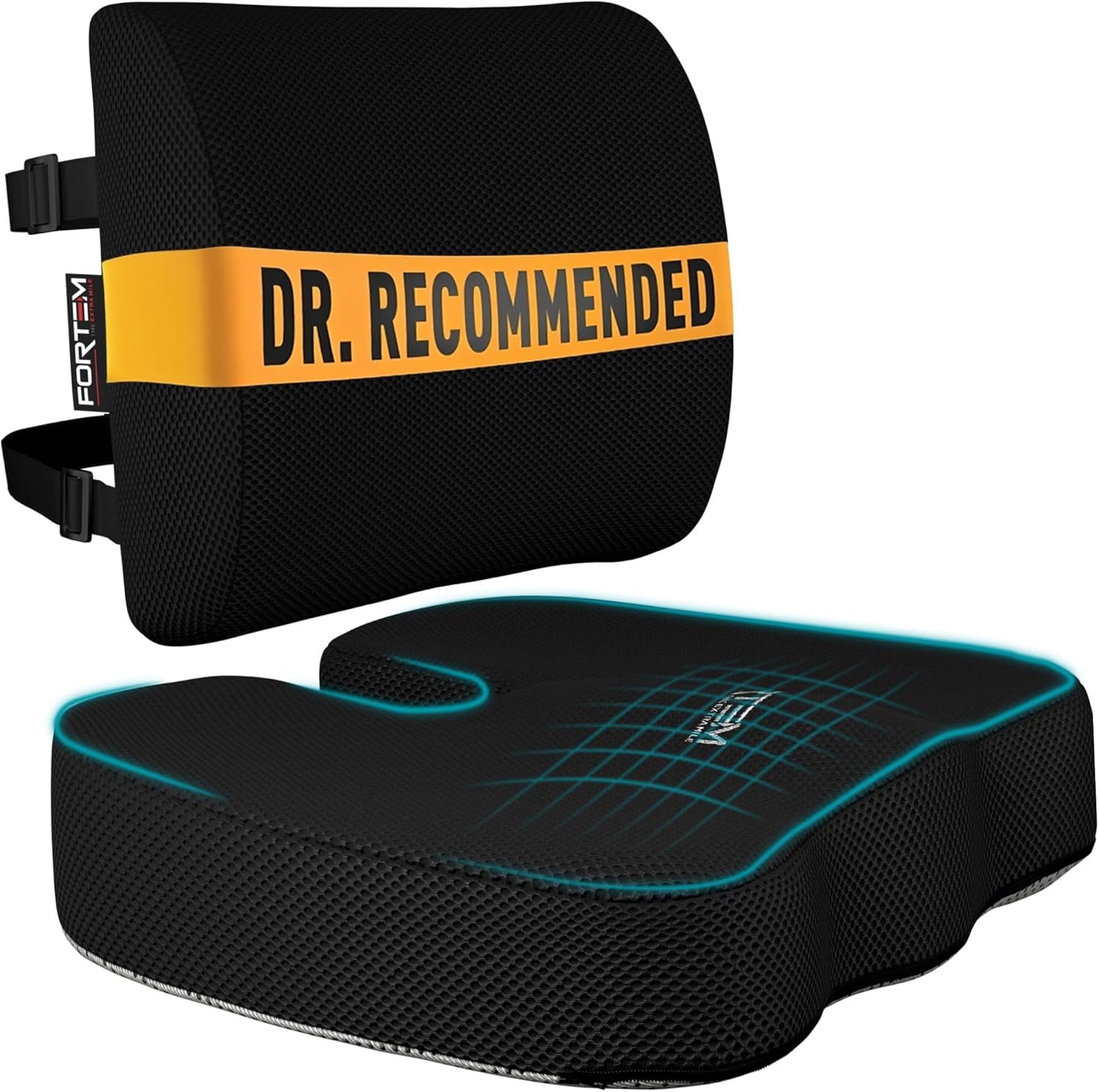
Lower back pain while driving is rarely caused by just one factor; it often stems from a combination of tailbone pressure AND a lack of lumbar support. Fixing one without the other is a half-measure. FORTEM offers a bundled solution that addresses the entire kinetic chain of the spine. You get a U-shaped seat cushion to support the hips and a contoured lumbar pillow to reinforce the lower back.
The lumbar pillow straps to the seat back, filling the gap between your spine and the car seat that usually exists in factory seats. This physical barrier forces you into a healthy, upright posture that prevents slouching and creates a neutral spine position. Because the lumbar support pushes you slightly forward, the seat cushion is designed to complement this position perfectly.
The bundle utilizes a 3D mesh cover that promotes extreme breathability, preventing the “sweaty back” syndrome often caused by leather seats. Both pieces are lightweight and portable, making them easy to transfer to an office chair or airplane seat. If you have chronic back issues or recover from injury, this dual-attack approach is highly recommended for comprehensive relief.
Pros
- Complete ergonomic solution (Seat + Back support).
- Lumbar pillow has adjustable straps to fit any seat height.
- Prevents slouching and promotes alertness.
- Great value compared to buying items separately.
Cons
- Two pieces to manage and adjust can be fiddly.
- Lumbar pillow pushes you slightly forward; legroom adjustment may be needed.
Buyer’s Guide: Choosing the Right Cushion
Not all cushions are created equal. Here are the critical factors to consider before hitting the “buy” button.
1. Material Matters
Memory Foam: The industry standard. It contours to your body, relieving pressure points. Look for high-density foam (measured in lbs/ft³) for longevity. Low-density foam feels good in the store but flattens in an hour.
Gel-Infused: Best for temperature regulation. It won’t freeze you, but it prevents heat retention.
Honeycomb Polymer: (Like Purple). Offers the best airflow and durability but has a unique, bouncy feel that isn’t for everyone.
2. Shape and Ergonomics
U-Cutout: Essential for coccyx/tailbone pain. It floats the bone so it doesn’t grind against the seat.
Wedge Shape: These are thicker at the back and thinner at the front. They help tilt the pelvis to maintain lumbar curvature and are great for correcting posture.
3. The “Non-Slip” Factor
In a car, safety is paramount. A cushion that slides every time you brake or turn is dangerous. Ensure the bottom has a rubberized, high-friction texture. Cushions with securing straps are even better.
Speaking of safety, modifying your driving environment always brings up questions. While cushions are legal, ensure they don’t impede your pedals. If you have other questions about driving legality, such as is it illegal to drive in flip flops, knowing the rules can save you a fine.
The Science of Driving Posture
Why do we hurt after driving? Unlike sitting in an office chair, driving involves active legs. You are pushing pedals, which engages the psoas muscles and destabilizes the pelvis. Vibrations from the road (Whole Body Vibration or WBV) travel up the spine, causing muscle fatigue.
A good cushion acts as a shock absorber. By dampening these vibrations before they reach your spine, you significantly reduce the micro-trauma to your intervertebral discs. Furthermore, by elevating the hips slightly above the knees, you open the hip angle, improving circulation to the lower extremities and reducing the risk of Deep Vein Thrombosis (DVT) on very long trips.
Cleaning & Maintenance
Your car is a trap for dust, crumbs, and spills. Hygiene is critical.
- Wash the Cover: Almost all recommended cushions have zippered covers. Wash them in cold water on a gentle cycle and air dry to prevent shrinking.
- Vacuum the Foam: Do NOT put memory foam in the washing machine. It will destroy the cellular structure. If the foam gets dirty, vacuum it carefully or spot clean with a damp cloth and mild detergent.
- Avoid Direct Sunlight: UV rays break down memory foam and gel over time. If parking in the sun for days, toss a jacket over your cushion or put it in the trunk.
Best Cushions for Truckers & Rideshare Drivers
Professional drivers face a category of physical stress that occasional commuters never encounter. A long-haul trucker might spend 10 to 14 hours a day in the cab, while an Uber or Lyft driver could log six or seven hours of near-continuous seat time across split shifts. For these drivers, a seat cushion isn’t a comfort accessory — it is occupational safety equipment, no different from steel-toe boots on a construction site.
The physics of professional driving are unforgiving. Sitting compresses the discs between your vertebrae, and every hour spent stationary reduces circulation to the glutes and hamstrings by a measurable margin. Add the whole-body vibration transmitted through a truck chassis — often at low frequencies between 4 and 12 Hz, which happens to be the resonant frequency range of the human spine — and you have a recipe for chronic lower back pain, herniated discs, and even long-term cardiovascular strain. Studies on occupational drivers have repeatedly linked prolonged vibration exposure to increased rates of lumbar disc degeneration.
For truckers, we recommend prioritizing durability and airflow over plush softness. A cushion that must survive daily use for a year or more needs a high-resilience foam core, not the low-density foam found in bargain-bin options. The Purple Royal’s honeycomb polymer grid is particularly well suited to this use case: its open-cell structure resists compression set (the permanent flattening that occurs when foam is loaded for extended periods) far better than traditional foam, and the airflow prevents the “hot seat” syndrome that plagues drivers who spend all day on vinyl or cloth bench seats.
Rideshare and delivery drivers have a slightly different profile — frequent stops, constant entry and exit, and shorter but more numerous seated intervals throughout the day. For this group, a cushion with a secure non-slip base and a low profile, such as TushGuard, tends to work best because it doesn’t interfere with quickly sliding in and out of the vehicle dozens of times per shift. Many rideshare drivers also pair a seat cushion with a lumbar support pillow, since the constant twisting to check mirrors and interact with passengers puts extra strain on the lower back.
One tip that professional drivers swear by: rotate between two cushions if your budget allows. Alternating cushions on different days gives each one time to fully decompress and regain its loft overnight, which can meaningfully extend the usable life of memory foam. Fleet managers who supply cushions to their drivers have also found that offering both a firm and a soft option improves compliance, since body types and personal preference vary widely across a driving workforce.
Seat Cushion vs. Seat Cover: What’s the Difference?
These two products are frequently confused, but they solve entirely different problems. A seat cover is a fabric or leather shell that stretches over your existing seat to protect the upholstery from stains, pet hair, UV fading, and general wear. It is a cosmetic and protective product. A seat cushion, on the other hand, is a standalone pad — typically foam, gel, or a polymer grid — placed on top of the seat to change the ergonomics of how your body sits.
Some products blur the line by combining a thin layer of padding with a cover-style design, but these hybrid products rarely offer the therapeutic benefit of a dedicated cushion because the padding is too thin to meaningfully redistribute pressure away from the tailbone. If your goal is purely aesthetic — matching your interior color scheme or protecting resale value — a seat cover is the right purchase. If your goal is reducing back pain, improving posture, or relieving sciatic pressure, you need a proper cushion with adequate loft, usually at least two inches of compressed thickness.
It’s also worth noting that the two products are not mutually exclusive. Many drivers layer a seat cushion on top of a seat cover for a complete solution: the cover protects the original upholstery, while the cushion handles the ergonomic work. If you go this route, make sure the cushion’s non-slip bottom still grips effectively; slick aftermarket seat covers can sometimes reduce the friction a cushion relies on to stay in place, so a cushion with an additional securing strap is the safer choice in that setup.
Best Cushions for Tailbone Injury and Coccyx Pain Recovery
Coccydynia — the clinical term for tailbone pain — can turn a routine commute into a genuinely miserable experience. Whether the injury stems from a fall, childbirth, prolonged sitting, or a direct blow, the tailbone is a small but heavily loaded structure when you’re seated, and driving is one of the worst environments for it because you’re pinned in one position for extended periods with constant vibration layered on top.
The single most important feature for coccyx recovery is a true U-shaped or horseshoe cutout that extends far enough back to fully suspend the tailbone in open air when you sit. A shallow cutout that only partially relieves pressure will still allow contact during braking or when you shift your weight forward, which can aggravate the injury. Look for cushions explicitly marketed for coccyx or hemorrhoid relief, as these tend to have deeper, more clinically-informed cutout geometry than general-purpose comfort cushions.
Firmness also matters more than most people expect during an active injury. A cushion that is too soft will allow the pelvis to sink until the tailbone bottoms out against the seat structure anyway, defeating the purpose of the cutout. This is why the Aylio Coccyx cushion, with its higher-density foam, is frequently recommended by physical therapists over softer, plush alternatives — it maintains the therapeutic gap even under sustained body weight.
If you are recovering from a specific injury such as a coccyx fracture or a recent childbirth, it’s worth combining a car cushion with the same style of cushion at your desk and any other chair where you spend significant time, since the healing process benefits from consistent pressure relief throughout the day, not just during your commute. As always, a seat cushion supports recovery but does not replace medical guidance — if tailbone pain persists for more than a few weeks or worsens, a conversation with a physician or physical therapist is warranted.
Driving Comfort During Pregnancy
Pregnancy changes the way the body interacts with a car seat in ways that catch many expectant parents off guard. As the pelvis widens and ligaments loosen in preparation for childbirth (a hormonal effect known as relaxin-induced laxity), the sacroiliac joints become more susceptible to irritation from uneven pressure. At the same time, the growing uterus shifts the center of gravity forward, which often causes pregnant drivers to unconsciously slump or arch to compensate, straining the lower back further.
A wedge-shaped or pelvis-tilting cushion can be particularly helpful in the second and third trimesters, as it encourages a more neutral pelvic position and reduces the tendency to slump. Cushions with a coccyx cutout are also valuable, since referred tailbone and sacral pain is extremely common during pregnancy due to the shifting center of mass and loosened pelvic ligaments.
Comfort aside, safety remains the top priority. Any cushion used during pregnancy should be low-profile enough that it does not change the angle at which the seatbelt lies across the body — the lap belt should still sit low across the hips, below the belly, and the shoulder belt should cross between the breasts, never over the abdomen. A cushion that is too thick or too soft can cause the body to sit higher and shift the belt’s position, which reduces its effectiveness in a collision. If you’re unsure whether a specific cushion changes your belt fit, do a test sit in your driveway before relying on it for daily driving.
Many pregnant drivers also find it helpful to pair a seat cushion with a small lumbar pillow and to adjust the seat to a slightly more reclined angle than usual, which reduces pressure on the lower spine and improves circulation to the legs — an important consideration given the increased risk of swelling and reduced venous return during pregnancy.
Sizing Guide: Matching a Cushion to Your Vehicle
Not every cushion fits every seat, and an ill-fitting cushion can actually make posture worse rather than better. Before buying, it helps to think about your vehicle in one of three broad categories.
Compact Cars and Sedans: Bucket seats in smaller vehicles tend to have pronounced side bolsters that can crowd out a wide cushion, bunching the edges upward uncomfortably. Look for a slimmer profile, such as TushGuard, or measure your seat’s usable flat width before ordering a bulkier option like Purple Royal.
SUVs and Crossovers: These typically have wider, flatter seat bases with more room to spare, making almost any cushion in this guide a good fit. Taller cushions like Dreamer Car also work particularly well here since SUV seats often already sit higher, and the added lift can further improve sightlines over the hood.
Trucks and Commercial Cabs: Bench-style or heavy-duty bucket seats in trucks are usually the widest and most accommodating, which is why professional-grade cushions like Purple Royal and Everlasting Comfort are popular among truckers — the seats have enough surface area to fully support the cushion’s larger footprint without hanging off the edges.
Regardless of vehicle type, always check that the cushion doesn’t reduce your legroom to the point where your knees rise uncomfortably close to the steering wheel or dashboard, and confirm your seatbelt still fastens and sits correctly with the cushion in place before committing to daily use.
Foam Safety and CertiPUR-US Certification Explained
Because a seat cushion sits in close, prolonged contact with your body inside an enclosed cabin, foam quality and chemical safety are worth understanding before you buy. In the United States, the CertiPUR-US certification program tests polyurethane foam for a specific set of concerns: it verifies the foam is made without ozone-depleting chemicals, without certain flame retardants, without heavy metals like lead and mercury, without formaldehyde, and without phthalates regulated under the Consumer Product Safety Improvement Act. Certified foam is also tested for low volatile organic compound (VOC) emissions, which is the main source of that “new foam smell.”
That new-product smell — often described as a plasticky or chemical odor — comes from residual VOCs off-gassing as the foam cures after manufacturing. It is generally considered a low-level, temporary nuisance rather than a serious health hazard in a well-ventilated space, but it can be more noticeable in the enclosed environment of a car cabin, especially when parked in the sun. If you’re sensitive to smells, unbox a new cushion and let it air out in a garage or well-ventilated room for 24 to 48 hours before installing it, and crack the windows for the first few drives.
When shopping, look for the CertiPUR-US label explicitly listed in the product description, particularly if you plan to use the cushion daily for years or if you have chemical sensitivities, are pregnant, or are shopping for a growing teen driver. Reputable brands in this guide, including Everlasting Comfort and ComfiLife, typically list this certification directly on their packaging and Amazon listings.
Are Car Seat Cushions HSA or FSA Eligible?
Health Savings Accounts (HSA) and Flexible Spending Accounts (FSA) can sometimes be used for ergonomic and pain-relief products, but eligibility for seat cushions specifically depends on how the purchase is documented. In many cases, a general-purpose comfort cushion is treated as a personal convenience item and is not automatically reimbursable. However, if a cushion is purchased to treat a diagnosed medical condition — such as coccydynia, sciatica, a herniated disc, or post-surgical recovery — a Letter of Medical Necessity (LMN) from a physician can often make the purchase eligible for HSA or FSA reimbursement.
The process typically works like this: your doctor documents the medical reason the cushion is needed, you keep that letter along with your itemized receipt, and you submit both to your HSA or FSA administrator for reimbursement or use a card linked to the account at checkout, later providing documentation if requested. Because rules vary by plan administrator and can change from year to year, it’s worth checking with your specific HSA or FSA provider before assuming a purchase qualifies, and keeping receipts regardless in case of an audit.
This is one more reason it can be worth mentioning persistent driving-related back or tailbone pain to your doctor rather than just toughing it out — beyond the obvious health benefit of proper diagnosis, it can also open the door to using pre-tax healthcare dollars toward a legitimate ergonomic solution.
Best Cushions for Elderly and Mobility-Limited Drivers
Age-related changes in bone density, joint cartilage, and muscle mass all affect how comfortably a person can sit for extended periods, and older drivers often deal with a combination of arthritis, reduced padding around the sit bones, and general spinal stiffness that makes factory car seats increasingly uncomfortable over time. A well-chosen cushion can meaningfully extend independence by making everyday errands and longer visits to family less physically taxing.
For older drivers, a slightly firmer cushion is often preferable to an ultra-plush one, since firmer support makes it easier to maintain an upright posture and reduces the effort needed to get in and out of the vehicle — sinking too deeply into soft foam can actually make exiting the car more difficult for someone with limited hip or knee mobility. A moderate lift, similar to what the Dreamer Car cushion provides, can also assist drivers with reduced hip flexibility by reducing how far they need to lower themselves to sit down.
Circulation is another key consideration. Reduced mobility and longer stationary periods increase the risk of swelling in the legs and feet, so a cushion that avoids constricting the back of the thighs — look for a cushion with a gently sloped or beveled front edge rather than a hard, squared-off lip — can help maintain healthier blood flow during drives to appointments or family visits. Pairing a seat cushion with a lumbar support pillow is also particularly beneficial for older drivers managing chronic lower back conditions, since it reduces the need to actively hold an upright posture using core muscles that may have weakened with age.
Finally, ease of maintenance matters. A cushion with a machine-washable, easy-to-remove cover is a practical advantage for anyone who may have difficulty with more involved cleaning routines, and a lightweight cushion is easier to move between vehicles if a caregiver or family member drives multiple cars.
How to Break In a New Memory Foam Cushion
Memory foam cushions ship compressed in vacuum-sealed packaging to reduce shipping volume, and they need a short adjustment period before they perform at their best. When you first unbox a cushion, it may feel unusually firm or slightly uneven — this is completely normal and typically resolves within a few days of regular use.
Start by letting the cushion fully expand for at least a few hours (ideally overnight) before sitting on it for the first time; unrolling it too early and immediately loading it with body weight can create slightly uneven density in the foam cells. Once it’s expanded, sit on it normally for progressively longer stretches over the first week rather than immediately committing to an eight-hour road trip. The foam cells need repeated compression cycles to fully “remember” the contours of your body, and heat-responsive foams in particular perform better once they’ve absorbed a few sessions of your body heat.
If the cushion feels too firm in its first week, especially in colder weather, try warming it slightly before sitting — some drivers place it in a sunny spot or run the car’s heater on the seat for a few minutes before a cold-weather drive. Over the following two to three weeks, most memory foam cushions soften into their intended feel and reach their full supportive potential, at which point the U-shaped cutout will noticeably float your tailbone rather than requiring you to consciously position yourself over it.
Common Mistakes When Using a Seat Cushion
Even a high-quality cushion can fail to deliver results if it’s used incorrectly. Here are the mistakes we see most often.
Sitting too far forward or backward on the cutout. The U-shaped cutout only works if your tailbone is actually centered over the open gap. Sitting slightly too far forward defeats the entire purpose and can even concentrate pressure on the front edge of the cutout, which is uncomfortable in its own way.
Skipping the securing strap. Many drivers treat the strap as optional, but on cushions designed with one, skipping it allows the cushion to creep forward over time, especially with frequent braking. A cushion that has shifted out of position no longer aligns its cutout with your tailbone.
Using a cushion that’s too thick for the vehicle. Headroom and legroom vary significantly between vehicles. A 4-inch cushion that works beautifully in an SUV might leave a driver in a low-roof sports coupe with their head brushing the headliner or their knees crowding the steering column.
Neglecting the lumbar region. A seat cushion addresses the bottom half of the postural chain, but many drivers still slouch in the upper back and shoulders. Pairing a seat cushion with a lumbar support pillow, as in the FORTEM combo, closes this gap and produces noticeably better results than a seat cushion alone.
Ignoring seatbelt fit. As mentioned in the pregnancy section above, any cushion that raises your seated height changes how the seatbelt lies across your body. Always double-check belt position after installing a new cushion, particularly a taller one.
Waiting too long to replace a worn-out cushion. Once foam has permanently lost its rebound — meaning it stays visibly compressed even after you get up — it is no longer doing its job and may actually be worse than sitting directly on the factory seat, since a flattened cushion still elevates you without providing any of the pressure-relief benefit.
Frequently Asked Questions
For most drivers, 2.5 to 3 inches is the sweet spot. This provides enough depth for the foam to compress and support you without raising your head into the roofliner or your legs into the steering wheel.
Thick memory foam is an insulator, so it will block a significant amount of heat from your car’s built-in warmers. If heated seats are a must, look for thinner gel grid options or cushions specifically designed with heat-transfer perforations.
While a cushion can drastically reduce pain by correcting posture and relieving pressure, it is not a medical cure. For severe chronic conditions, it should be part of a broader strategy including stretching and physical therapy.
Absolutely. In fact, many people buy one for the car and end up bringing it into the office. The ergonomic principles—tailbone relief and posture support—apply exactly the same way at a desk.
Understanding your vehicle and how to maintain comfort is part of being a seasoned driver. Sometimes, odd noises can indicate issues beyond just a bad seat. If you’re wondering why does my car shake when I drive, it might be mechanical rather than the road surface.
Final Thoughts
Ignoring back pain while driving isn’t tough; it’s dangerous. Pain is a distraction that slows your reaction times and sours the joy of travel. Investing in a high-quality seat cushion is one of the most affordable and effective upgrades you can make to your vehicle.
For most people, the Everlasting Comfort offers the best balance of features and price. If you run hot, the ComfiLife Gel is your best bet. And for those needing serious medical-grade support, the Aylio is the clear winner. Choose the one that fits your body and your budget, and enjoy the road ahead.