Can Passengers Drink Alcohol in a Car? The 50-State Guide
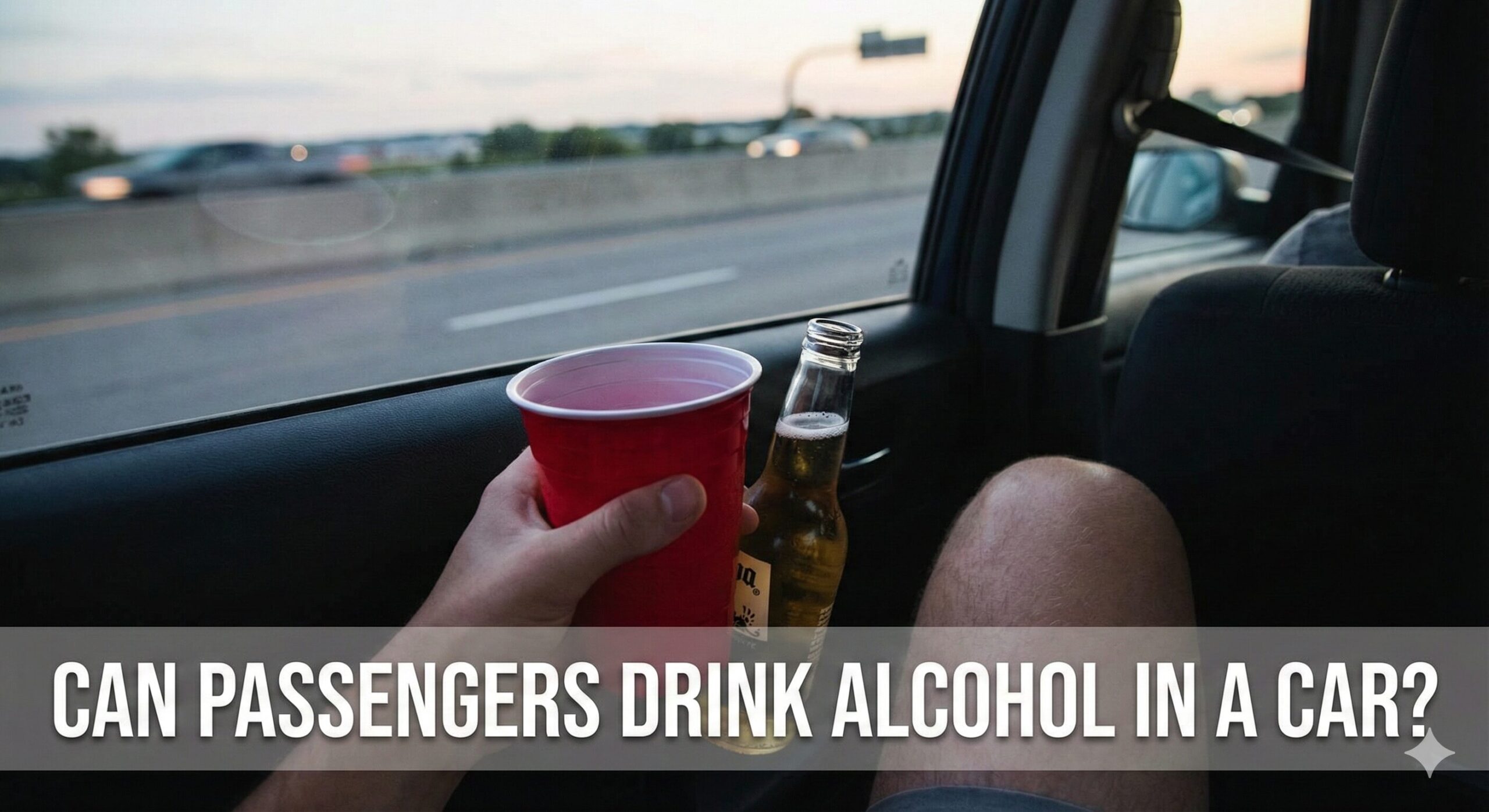
It’s a classic movie scene: a group of friends pile into a convertible for a road trip, the music blasts, and someone in the backseat cracks open a cold beer. It looks like freedom. It looks like fun. But in the real world, that simple “psshhh” sound of a can opening is often the sound of a crime being committed.
For decades, the United States has cracked down hard on drunk driving. Part of that crackdown includes Open Container Laws, which restrict not just the driver, but everyone in the vehicle from possessing an open bottle of alcohol.
However, the laws are not uniform. While 40+ states strictly forbid it, there are a handful of “outlier” states and very specific vehicle types where passengers can legally sip a cocktail while the car is in motion. This guide cuts through the confusion to keep you on the right side of the law.

The Federal Hammer: TEA-21
Why do almost all states have the same strict laws? You can thank the federal government. In 1998, Congress passed the Transportation Equity Act for the 21st Century (TEA-21).
This act didn’t make open containers illegal federally. Instead, it used bribery. The government told states: “If you want full federal highway funding, you must pass a law prohibiting the possession of any open alcoholic beverage container in the passenger area of any motor vehicle.”
To be compliant with TEA-21, a state’s law must:
- Prohibit possession of any open alcohol container.
- Apply to the entire passenger area (including the glove box).
- Apply to all vehicle occupants (driver and passengers).
- Apply to all open public roads (and shoulders).
Because most states want that highway money, they fell in line. But a few resisted. The relationship between state autonomy and federal highway funding has been a battleground for decades, dating back to the National Minimum Drinking Age Act of 1984, which similarly threatened to withhold funds from states that did not raise the drinking age to 21. This carrot-and-stick approach remains controversial, but it has undeniably shaped the legal landscape of American road travel. When you look at the statistics, the federal pressure has correlated with a significant decline in alcohol-related traffic fatalities, though it is difficult to separate the effect of open container laws from other safety improvements like airbags and anti-lock brakes.
Understanding TEA-21 requires a look at its legislative history. The act was a massive omnibus bill that funded everything from new highway construction to bike paths and transit systems. Tucked inside this sprawling legislation was Section 304(b), the “Open Container Requirements.” The penalty for non-compliance was initially set at a 1.5% transfer of a state’s federal highway construction funds to its hazard mitigation programs, a clever mechanism that effectively stripped cash from state road budgets. Over time, this penalty has been modified and, in some cases, states have negotiated temporary waivers or alternative compliance paths, creating a complex patchwork of rules that can trip up even well-informed drivers.
The Constitutional Question: Federal Overreach or Life-Saving Mandate?
The TEA-21 funding mechanism has faced numerous constitutional challenges over the years, primarily centered on the Tenth Amendment and the anti-commandeering doctrine established in cases like New York v. United States (1992) and Printz v. United States (1997). The Supreme Court has drawn a distinction between “commandeeing” state legislatures (which is unconstitutional) and using the Spending Clause to “encourage” state action through conditional funding (which is generally permissible). In South Dakota v. Dole (1987), the Court upheld the National Minimum Drinking Age Act’s similar funding mechanism, establishing a five-part test for conditional federal spending: it must be in pursuit of the general welfare, unambiguous, related to the federal interest, not violate other constitutional provisions, and not be coercive. The 1.5% highway fund penalty in TEA-21 was explicitly modeled after the Dole framework, and lower courts have consistently upheld it as a “relatively mild encouragement” rather than unconstitutional coercion. However, legal scholars continue to debate whether the cumulative effect of multiple conditional funding statutes (drinking age, open container, seat belt laws, ignition interlock requirements) crosses the line from encouragement to compulsion, effectively leaving states with no meaningful choice.
The Enforcement Gap: Federal Law vs. State Reality
Despite TEA-21’s broad reach, there is a significant gap between federal compliance certification and actual on-the-ground enforcement. The National Highway Traffic Safety Administration (NHTSA) is responsible for certifying state compliance, but the certification process relies heavily on state self-reporting. A 2019 Government Accountability Office (GAO) audit found that NHTSA had never decertified a state for open container non-compliance, despite multiple states having laws that arguably fall short of the TEA-21 standard. This creates a paradoxical situation where states like Mississippi maintain their full federal highway funding while openly acknowledging that their laws do not prohibit passenger possession of open containers. The practical reality is that the federal government has prioritized other enforcement mechanisms—such as incentivizing ignition interlock laws and high-visibility DUI checkpoints—over strict open container enforcement. This policy choice reflects a data-driven assessment that open container laws, while symbolically important, have a smaller impact on alcohol-related fatalities than direct impairment countermeasures. However, this enforcement gap also creates confusion for drivers who cross state lines, as they may be unknowingly violating laws that are technically on the books but rarely enforced.
The “Exceptions”: States Where Passengers *Might* Be Able to Drink
There are a few states that do not fully comply with the strict federal TEA-21 standards. In these jurisdictions, state law does not explicitly ban passengers from consuming alcohol, although the driver remains strictly prohibited.
Note: This list is subject to change and local interpretation.
| State | The Legal Nuance |
|---|---|
| Mississippi | The most famous exception. Mississippi has no state law against open containers for drivers or passengers, as long as the driver remains under the legal BAC limit (.08%). However, many counties and “dry” towns enforce their own bans. |
| Connecticut | State law prohibits drinking while driving, but technically does not explicitly ban passengers from possessing an open container. However, police often cite drivers for “distracted driving” if passengers are rowdy. |
| Delaware | Similar to CT, the statutes focus on the driver consuming, but carrying an open container can still lead to legal headaches. |
| Missouri | Passengers are generally permitted to possess open containers, but the driver is strictly forbidden. |
| Rhode Island | Historically allowed passenger consumption, but enforcement has tightened significantly in recent years. |
| Tennessee | State law bans the driver from consuming, but arguably permits passengers to possess alcohol. Local municipalities often close this loophole. |
| Virginia | Creates a rebuttable presumption that if an open container is in the car, the driver has been drinking. While passengers “can” drink, it puts the driver at massive risk of a DUI investigation. |
Just because you are in these states doesn’t mean you are immune to consequences. A rowdy passenger can still be cited for public intoxication or causing a disturbance. It’s similar to the risks of eating while driving—legal, but potentially dangerous.
The Mississippi Anomaly: A Deeper Look
Mississippi’s status as the nation’s most permissive state for open containers deserves special attention. The Magnolia State’s refusal to pass a comprehensive open container law is rooted in a complex mix of cultural libertarianism, rural geography, and political resistance to federal mandates. Mississippi has the highest rate of alcohol-related traffic fatalities per capita in the United States, a statistic that safety advocates attribute in part to the absence of open container restrictions. However, defenders of the state’s approach point out that Mississippi’s DUI enforcement is aggressive, with sobriety checkpoints and saturation patrols that target impaired drivers rather than passengers. The state’s “local option” alcohol laws add another layer of complexity: 36 of Mississippi’s 82 counties are completely “dry” for liquor sales, and many municipalities within wet counties have their own open container ordinances. This creates a checkerboard legal landscape where a passenger could be legal on one stretch of highway and illegal five miles later after crossing a municipal boundary. The Mississippi Highway Patrol has publicly stated that while they cannot cite passengers for open containers under state law, they will use the presence of open containers as probable cause to investigate the driver for impairment. This practical reality means that even in America’s most permissive state, the “road soda” comes with significant legal risk.
The Missouri Experience: Passenger Rights and Driver Responsibility
Missouri’s open container law presents a unique legal framework that attempts to balance passenger freedom with driver accountability. Under Missouri Revised Statutes Section 577.078, it is explicitly unlawful for a driver to consume an alcoholic beverage or possess an open container while operating a motor vehicle. However, the statute is notably silent on passenger possession and consumption. This legislative silence has been interpreted by Missouri courts as a deliberate choice to permit passenger drinking, a decision rooted in the state’s strong tavern culture and the tourism economy of destinations like the Lake of the Ozarks and Branson. The Missouri Department of Transportation has repeatedly proposed expanding the law to cover passengers, citing federal TEA-21 compliance concerns, but these efforts have stalled in the legislature. Law enforcement officers in Missouri have developed a pragmatic approach: while they will not cite passengers for open containers, they will carefully document the location and number of containers in the vehicle as part of any DUI investigation. If a driver is found to be over the .08% BAC limit, the presence of passenger open containers can be used as evidence that the driver was participating in a drinking environment, potentially supporting more severe charges like aggravated DUI. Some Missouri municipalities, including St. Louis and Kansas City, have enacted their own ordinances banning passenger open containers, creating islands of strict enforcement within the permissive state framework.

The Big Exceptions: Limos, Buses, and RVs
Even in the strictest states (like California or New York), there are carved-out exceptions for vehicles “for hire” or vehicles designed for living.
1. Vehicles for Hire (Limos and Party Buses)
If you hire a chauffeur, you are generally allowed to drink in the passenger compartment. The logic is that professional drivers are less likely to be influenced by the passengers.
- The Barrier Rule: In many states, there must be a physical partition separating the driver from the passengers.
- The License Requirement: The vehicle must be properly licensed as a limousine or bus carrier. A friend driving a rented minivan does not count.
The legal definition of a “limousine” varies wildly. In some states, any luxury sedan used for hire qualifies, while others require a stretch vehicle with a permanent divider. This distinction is critical. Party bus companies operate in a heavily regulated space; they carry special insurance and their drivers often hold Commercial Driver’s Licenses (CDLs) with passenger endorsements, even though driving a busload of intoxicated people presents unique challenges for the person behind the wheel. The driver’s compartment in these vehicles is treated almost like a separate legal entity from the party happening just a few feet behind them. This legal fiction is what allows the consumption to occur without the driver being legally “in possession” of an open container. The rental contract you sign for a party bus often includes a “no underage drinking” clause and a liability waiver, putting the onus back on the renter.
The Party Bus Regulatory Crackdown
The party bus industry has faced increasing regulatory scrutiny in recent years, particularly following several high-profile incidents involving underage drinking and alcohol poisoning on party buses. States like California, Illinois, and Washington have passed “party bus safety laws” that impose additional requirements beyond standard limousine regulations. These laws typically mandate that any vehicle carrying passengers under the age of 21 who are consuming alcohol must have a chaperone over 25 present, require breathalyzer testing before passengers board, and impose strict liability on the operating company for any alcohol-related injuries or deaths. California’s 2020 party bus law (AB 1945) went so far as to require party bus operators to verify the age of every passenger and refuse service to anyone under 21 unless accompanied by a parent or guardian. These regulations have blurred the line between party buses and traditional limousines, creating a hybrid regulatory category that treats party buses more like mobile bars than transportation services. The insurance implications are significant: a standard limousine policy may not cover incidents involving underage drinking or over-service on a party bus, leaving operators exposed to massive civil liability. Some insurers have stopped writing party bus policies altogether, creating an insurance crisis in the industry that is driving smaller operators out of business.
2. Motorhomes and RVs
Can you drink in an RV while it’s moving? Yes, but only in the living quarters.
Most states define the “passenger area” as the area designed for seating while traveling. In a motorhome, the back “living room” area is often exempt from open container laws. However, bringing a beer up to the passenger seat in the cockpit is definitely illegal.
The RV exception is a fascinating piece of legal engineering. It relies on a distinction between a “vehicle” and a “dwelling.” While in motion, an RV is unquestionably a motor vehicle subject to traffic laws. However, statutory definitions of the “passenger compartment” in open container laws often explicitly exclude living quarters in a motorhome, defined as areas with sleeping, cooking, or toilet facilities. This means a glass of wine at the dinette table as you roll down the highway could be perfectly legal in one state, but crossing an invisible state line could instantly transform that same act into a ticketable offense. The physical configuration of the RV matters—a Class B camper van with no fixed toilet or galley may not meet the legal threshold for the exception, making it just a van with an open container. For Class A and Class C motorhomes, the line between the cockpit and the living quarters is typically drawn at the front seats. Many full-time RVers mistakenly believe they are always protected, not realizing that driving through a strict state like Utah or Pennsylvania without researching their specific vehicle’s classification could lead to a costly interaction with law enforcement.
The RV Drinking Interstate Compact Problem
For full-time RVers and snowbirds who travel across multiple states, the legal patchwork of open container laws creates a near-impossible compliance challenge. A person legally enjoying a glass of wine in their RV’s living quarters in Missouri could cross into Kansas (a strict TEA-21 compliant state) and instantly become a criminal. The Full Faith and Credit Clause of the Constitution does not apply to this situation because open container laws are criminal statutes, not civil judgments. Similarly, the Interstate Commerce Clause does not protect RV travelers because they are engaged in personal travel, not commerce. Some RV advocacy groups, including the Family Motor Coach Association (FMCA) and Escapees RV Club, have lobbied for a federal “RV Safe Passage” law that would create uniform national standards for RV living quarters exceptions. These proposals would establish a clear definition of “living quarters” based on the presence of fixed sleeping, cooking, and sanitation facilities, and would preempt state laws for vehicles meeting this definition. However, these efforts have gained little traction in Congress, largely because they would require amending TEA-21 and reopening the politically contentious debate over federal highway funding conditions. In the meantime, RV owners are advised to research the specific laws of each state on their route and to exercise extreme caution, particularly when passing through states known for aggressive enforcement like Utah, Pennsylvania, and North Carolina.
Uber and Lyft: Can I Drink in the Backseat?
This is a common question on Friday nights. You are paying for a ride, so it feels like a limo, right? Wrong.
While state laws regarding “vehicles for hire” might technically cover ride-shares in some jurisdictions, Uber and Lyft company policies strictly ban alcohol consumption by passengers.
- The Policy: Both major platforms prohibit open containers.
- The Consequence: If a driver catches you, they can end the ride immediately and ban you from the app.
- The Driver’s Risk: Most Uber drivers use their personal vehicles. If they get pulled over with an open container, they personally face the fines and potential license suspension. Don’t put your driver in that position.
The classification of Transportation Network Companies (TNCs) like Uber and Lyft remains a legal grey area in many states. They are not quite taxis and not quite private vehicles. Early in their rise, some passengers argued that paying for a ride transformed a driver’s personal car into a hired limousine. State legislatures and courts have largely rejected this argument, codifying TNCs as a distinct category that does not inherit the liquor license and partition exemptions of traditional limousines. The interior cameras many drivers now use for safety are also documenting potential open container violations, providing direct evidence that could be sent to Uber’s safety team or even law enforcement. The social contract is clear: the back of an Uber is an extension of the driver’s workplace and personal property, not a nightclub.
The TNC Insurance Gap and Alcohol Incidents
One of the most overlooked aspects of drinking in a ride-share vehicle is the insurance implications. Uber and Lyft provide contingent liability coverage for their drivers, but this coverage has specific exclusions for illegal activity. If a passenger spills alcohol in the vehicle, causing damage, or if an open container violation leads to a traffic stop and subsequent accident, the driver’s personal auto insurance will almost certainly deny coverage (most personal policies exclude commercial activity). The TNC’s contingent coverage may also deny the claim if the incident involved illegal activity, which open container possession certainly qualifies as in most jurisdictions. This leaves the driver personally liable for damages that could easily run into tens of thousands of dollars. This is why Uber and Lyft drivers are so vigilant about enforcing the no-alcohol policy—it’s not just about company rules, it’s about protecting their personal financial well-being. Some rideshare drivers have begun posting visible signs in their vehicles stating “No Open Containers – Violators Will Be Reported,” both as a deterrent and as documentation that passengers were warned. In the event of a dispute, these signs can be crucial evidence showing that the passenger knowingly violated the driver’s stated policies.

Penalties: What Happens if You Get Caught?
If you are in a standard passenger car and get stopped with an open beer, the consequences vary by state but are universally unpleasant.
- The Passenger: Usually faces a fine (infraction) ranging from $100 to $500. It typically does not add points to a driver’s license, but it is a mark on your record.
- The Driver: This is where it gets bad. In many states, the driver is held responsible for the car. A driver can be cited for allowing an open container, which can lead to points on their license and higher insurance rates.
- Probable Cause: An open container gives the officer probable cause to search the vehicle and administer a field sobriety test to the driver. Even if the driver is sober, this is a stressful and time-consuming ordeal.
The collateral consequences of an open container citation extend far beyond the initial fine. Your auto insurance provider views any alcohol-related infraction, even a non-moving violation like an open container, as a major risk factor. A single passenger’s sloppy mistake can increase the vehicle owner’s premium by hundreds of dollars per year for three to five years. For commercial drivers or those with a CDL, the stakes are even higher. An open container violation in a personal vehicle is considered a serious offense and can lead to a CDL disqualification. If an accident occurs, even a minor fender-bender where the other party is clearly at fault, the presence of an open container in your vehicle can shift the liability assessment. Insurance adjusters and civil courts may apportion blame based on the mere presence of alcohol, arguing it could have distracted the driver or contributed to a negligent atmosphere. It’s a classic case of an act that might seem like a $150 harmless ticket actually carrying a $5,000 ripple effect.
Avoiding these penalties is part of general road safety, just like using safe driving apps to minimize risks.
Enhanced Penalties in “Zero Tolerance” States
While every state has some form of open container prohibition, a subset of states have enacted what safety advocates call “zero tolerance” enhancements that dramatically increase penalties for open container violations. These states—including Arizona, Georgia, Illinois, and Washington—treat an open container violation as a misdemeanor criminal offense rather than a civil infraction. This distinction is crucial because misdemeanors create a permanent criminal record, can result in jail time (typically up to 30 days for a first offense), and must be disclosed on job applications and professional license renewals. Arizona’s law (ARS 28-1381) is particularly severe: an open container violation is a Class 2 misdemeanor carrying up to four months in jail and a $750 fine plus surcharges. More importantly, in Arizona, an open container violation can be used as evidence of impairment in a parallel DUI prosecution, even if the driver’s BAC is below .08%. This “stacking” of charges is a common prosecutorial tactic that can turn a simple ticket into a life-altering criminal case.
How to Transport Alcohol Legally
You can obviously bring alcohol home from the store. The key is that it cannot be “open” and it cannot be “accessible.”
1. The “Sealed” Rule
If the factory seal is unbroken (the cap hasn’t cracked, the cork is in), it can usually be anywhere in the car. However, some states still prefer it to be out of reach.
The definition of “unbroken seal” is strictly literal. A twist-off cap that has been slightly loosened, even if still covering the mouth of the bottle, is considered an open container in many jurisdictions. The click of the seal breaking is the legal tripwire. When exiting a liquor store, inspect every bottle for even minor damage to caps or corks. A wine bottle with a pushed-up foil capsule from heat expansion could be misinterpreted by an officer. The safest practice is to request a bag at checkout and ensure bottles remain upright and visibly pristine if placed anywhere but the trunk. Some states, like Utah, have even stricter rules requiring alcohol purchased at state-run stores to be placed completely out of the passenger’s reach, effectively mandating trunk transport for anything other than a brief trip directly home from the point of sale.
2. The “Trunk” Rule
If a bottle has been opened (e.g., a re-corked wine bottle from dinner), it must go in the trunk. If you have an SUV or hatchback without a trunk, it must be placed behind the last row of seats—basically, as far away from the driver as possible.
The “lack of a trunk” loophole is rapidly closing. Courts in states like California have ruled that the rear cargo area of an SUV, even if it is an open space connected to the passenger cabin, is not the trunk. In these cases, the “not readily accessible” standard is interpreted strictly. An officer might deem a corkscrew, wine glasses, or a picnic blanket found alongside the re-corked bottle as evidence that it was intended for consumption within the vehicle. The only truly safe legal transport for an opened bottle is a locked compartment, like a glove box or a lockable hard-sided cooler placed in the far rear, and even then, the key must not be in the ignition or easily accessible to the driver. Some drivers go so far as to use sealed, tamper-evident bags with a receipt to prove the bottle was opened elsewhere and is being transported solely for storage, though this is not a statutory defense in most states.
3. Flasks and Cups
Pouring alcohol into a Stanley cup or a coffee mug does not fool the police. If it smells like alcohol, it is an open container. The “red solo cup” is a magnet for law enforcement attention.
This is the most common and most foolish mistake. The myth persists that a travel mug provides “plausible deniability.” In reality, an officer’s probable cause for a search is easily established by the scent of alcohol or the behavior of the occupants. A Yeti cup filled with tequila at a DUI checkpoint is not clever; it’s a guaranteed ticket. Police departments specifically train officers on “disguised container” detection, looking for condensation, careful sipping, and the absence of the steam or coffee aroma that should accompany a hot beverage. Furthermore, pouring a distilled spirit into a different container on the premises of a licensed establishment is often illegal in itself, meaning you committed an infraction just by “batching up” a roadie in the bar’s parking lot.
Blood Alcohol Concentration (BAC): The Science Behind the Legal Limit
Understanding Blood Alcohol Concentration is fundamental to understanding why open container laws exist. BAC is a measure of the amount of alcohol present in a person’s bloodstream, expressed as grams of alcohol per 100 milliliters of blood. The national legal limit for drivers over 21 is 0.08%, a standard that was established through a combination of scientific research and political compromise. However, this number is not a bright line between “safe” and “impaired”—significant impairment begins at much lower BAC levels.
The Pharmacology of Alcohol Absorption
Alcohol absorption is a complex physiological process that varies dramatically between individuals. When you consume alcohol, approximately 20% is absorbed through the stomach lining and 80% through the small intestine. From there, it enters the bloodstream and is distributed throughout the body’s water-containing tissues. The liver metabolizes alcohol at a relatively constant rate of about 0.015% BAC per hour—roughly one standard drink per hour. However, this rate can be affected by numerous factors including liver health, genetics, medications, and whether food is present in the stomach. A fatty meal before drinking can slow absorption and reduce peak BAC by up to 30%, while carbonated mixers like tonic water or energy drinks can accelerate absorption and produce a faster, higher BAC spike. The phenomenon of “drink and drive” passengers is particularly dangerous because the passenger compartment of a moving vehicle can exacerbate the effects of alcohol through motion, vibration, and sensory stimulation that masks the subjective feeling of intoxication. This is why many people feel “fine to drive” after drinking as a passenger, only to discover their BAC is well above the legal limit when tested.
Gender, Body Composition, and BAC Variability
One of the most misunderstood aspects of BAC is the profound difference between male and female alcohol metabolism. Women typically have a higher percentage of body fat and lower percentage of body water than men of the same weight, meaning that the same amount of alcohol will produce a higher BAC in a woman. Additionally, women have lower levels of the enzyme alcohol dehydrogenase in their stomach lining, which means more alcohol passes directly into the bloodstream without being metabolized first. Hormonal fluctuations during the menstrual cycle can also affect alcohol metabolism, with some studies suggesting that BAC rises faster during the pre-menstrual phase. These biological differences have significant legal implications: a 130-pound woman who shares a bottle of wine with a 180-pound man as passengers in a car will likely have a BAC 30-40% higher than her companion, even though they consumed identical amounts. This disparity is rarely considered in the casual “we drank the same amount” calculus that often precedes a DUI arrest. Understanding this biological reality is crucial for anyone who plans to serve as a designated driver after drinking as a passenger earlier in the evening.
The “Rising BAC” Defense and Its Limitations
A common legal defense in DUI cases is the “rising BAC” argument: the claim that although the driver’s BAC was above .08% at the time of the chemical test (usually conducted 30-90 minutes after the traffic stop), it was below .08% at the time of actual driving because alcohol was still being absorbed into the bloodstream. This defense is based on sound science—BAC does indeed follow a curve, rising during absorption and falling during elimination. However, courts have become increasingly skeptical of this defense in cases involving passengers who have been drinking. The presence of open containers in the vehicle, testimony about the timing of consumption, and expert toxicology witnesses can all be used to reconstruct the likely BAC at the time of driving. Some states have enacted “per se” DUI laws that criminalize driving with a BAC above .08% within two hours of operating the vehicle, effectively closing the rising BAC loophole. For passengers who are considering becoming drivers after a drinking session, the only truly safe approach is to wait far longer than they think necessary, use a personal breathalyzer to verify their BAC, and understand that the legal system is designed to close the gaps that once allowed impaired drivers to escape conviction.
DUI vs DWI: Understanding the Critical Distinctions
The terms DUI (Driving Under the Influence) and DWI (Driving While Intoxicated or Driving While Impaired) are often used interchangeably, but they represent distinct legal concepts that vary significantly by state. Understanding these distinctions is crucial for passengers who may later become drivers, as the presence of open containers can elevate a DUI charge to a more serious offense.
The Traditional DUI/DWI Distinction
Historically, states that use both terms have drawn a distinction based on the level of impairment: DWI typically refers to the more serious charge of driving with a BAC above the legal limit (a “per se” violation), while DUI refers to driving while impaired by alcohol or drugs to any degree that affects safe operation, regardless of BAC. In this framework, a driver with a BAC of 0.06% could be charged with DUI if their driving was demonstrably impaired, while a driver with a BAC of 0.08% or above would face the more serious DWI charge regardless of driving performance. Other states use different terminology entirely: OUI (Operating Under the Influence) in Maine and Massachusetts, OVI (Operating a Vehicle Impaired) in Ohio, and DWAI (Driving While Ability Impaired) in Colorado and New York for lower-level impairment. This terminological chaos creates significant confusion for drivers crossing state lines, particularly when combined with the open container patchwork.
How Open Containers Elevate DUI/DWI Charges
In many states, the presence of an open container in the vehicle acts as a statutory aggravating factor that can elevate a standard DUI to an “aggravated” or “extreme” DUI. Arizona’s aggravated DUI statute (ARS 28-1383) is a prime example: a DUI committed with an open container in the vehicle is a Class 4 felony punishable by a minimum of four months in prison, even for a first offense. Similarly, New York’s “Aggravated DWI” charge applies when a driver’s BAC is above 0.18% (more than twice the legal limit) or when a child under 16 is in the vehicle, but prosecutors can also cite the presence of open containers as evidence supporting the charge. Illinois has a “super drunk driving” law for BAC above 0.16% that carries enhanced penalties, and open containers in the vehicle are used as evidence of the driver’s reckless disregard for safety. The practical lesson for passengers is clear: even if you are legally permitted to drink in the car under your state’s laws, you are creating a legal minefield for your driver. If the driver is pulled over for any reason—a broken taillight, a rolling stop, or even a random checkpoint—the combination of an open container and the driver’s BAC (which could be below .08% but still detectable) can transform a simple traffic stop into a career-ending criminal charge.
The “Actual Physical Control” Trap
One of the most dangerous legal traps in DUI/DWI law is the concept of “actual physical control” of a vehicle. In most states, you do not need to be driving to be convicted of DUI—you merely need to be in a position to control the vehicle. Courts have found “actual physical control” in cases where the defendant was asleep in the driver’s seat with the engine running, sitting in the passenger seat with keys in the ignition, or even standing next to the vehicle with the engine off but the keys accessible. The presence of an open container dramatically worsens these situations because it eliminates any argument that the defendant was merely using the car as shelter rather than preparing to drive. This “actual physical control” doctrine creates a particular risk for passengers who have been drinking and decide to “sleep it off” in the car. If you are in the driver’s seat, have the keys accessible (even in your pocket), and there are open containers in the vehicle, you are at extreme risk of a DUI conviction even if the car never moved. The only safe way to sleep in a car after drinking is to be in the back seat (or passenger seat if it reclines fully), with the keys locked in the trunk or otherwise completely inaccessible, and absolutely no open containers anywhere in the vehicle.
Underage Drinking in Vehicles: Zero Tolerance and Its Consequences
The intersection of underage drinking laws and open container laws creates a particularly severe legal regime for anyone under 21. While adult passengers might face fines for open container violations, underage passengers face a completely different—and much more serious—legal framework.
Zero Tolerance Laws and Vehicle-Specific Provisions
All 50 states have “zero tolerance” laws that make it illegal for drivers under 21 to operate a vehicle with any measurable amount of alcohol in their system. The BAC threshold for underage drivers is typically 0.02% or lower—essentially, any alcohol at all. But what many young people don’t realize is that zero tolerance laws often extend beyond the driver. In states like Michigan, Pennsylvania, and Texas, it is illegal for any person under 21 to possess, consume, or transport alcohol in a motor vehicle, regardless of who is driving. This means an underage passenger holding an open beer can face charges including Minor in Possession (MIP), underage drinking, and open container violations simultaneously. These are not just traffic tickets—they are criminal misdemeanors that can result in license suspension (even though the person wasn’t driving), mandatory alcohol education classes, community service, and a permanent criminal record that can affect college admissions and employment opportunities.
The “Party Car” Doctrine and Constructive Possession
Prosecutors have developed a legal theory called the “party car doctrine” to charge all underage occupants of a vehicle with alcohol violations, even if only one person was holding the open container. Under this theory, the presence of alcohol in a vehicle with multiple underage occupants creates a presumption that all were in “constructive possession” of the alcohol, meaning they had the ability and intent to exercise control over it. This doctrine has been upheld by courts in multiple states on the grounds that the close quarters of a vehicle make it reasonable to infer that all occupants knew about and had access to the alcohol. The party car doctrine is particularly dangerous because it can result in every underage person in the vehicle being charged, not just the one who bought the alcohol or was holding it when the police arrived. Some states have specifically codified this doctrine: California Vehicle Code 23224 makes it an infraction for any person under 21 to be in a vehicle with an open container, with a fine of up to $250 and 24-32 hours of community service. The only defenses are if the underage person was in a bus, taxi, limousine, or RV living quarters—the standard exceptions—or if they were accompanied by a parent or legal guardian.
Parental Liability for Underage Drinking in Vehicles
Many states have enacted social host liability laws that hold parents or adults criminally and civilly responsible for underage drinking that occurs on their property. The question of whether a vehicle constitutes “property” for social host liability purposes has been litigated with mixed results, but several states—including California, Colorado, and Minnesota—have explicitly extended social host liability to vehicles. Under these laws, a parent who provides alcohol to minors in a vehicle, or allows a minor to consume alcohol in their vehicle, can face criminal charges, civil liability for any resulting injuries, and even wrongful death liability if an accident occurs. Some parents mistakenly believe that allowing their teenagers to drink “safely” in a parked car is a responsible approach to preventing drunk driving, but this practice exposes the parents to massive legal risk. If an underage drinker leaves the parked car and is injured, or injures someone else, the parents who provided the alcohol or allowed the gathering can be held liable. Insurance companies have successfully denied coverage in these cases on the grounds that the parents’ actions constituted an intentional illegal act, leaving them personally responsible for judgments that can run into millions of dollars.
Commercial Vehicle Regulations: CDL Drivers and Open Container Zero Tolerance
For drivers holding a Commercial Driver’s License (CDL), the rules regarding alcohol in vehicles are dramatically stricter than for ordinary drivers. The Federal Motor Carrier Safety Administration (FMCSA) imposes a uniform national standard that preempts state laws and creates a zero-tolerance environment for CDL holders.
The FMCSA Open Container Prohibition
Under 49 CFR Part 392, the FMCSA regulations prohibit any alcohol in the cab of a commercial motor vehicle, period. There are no exceptions for passengers, no exceptions for living quarters in sleeper cabs, and no exceptions for sealed containers. The regulation (49 CFR 392.5) states: “No driver shall… be on duty or operate a commercial motor vehicle while the driver possesses wine, beer, distilled spirits, or any other intoxicating beverage.” The term “possesses” has been interpreted broadly to include any alcohol that is accessible to the driver, even if it belongs to a passenger. Unlike passenger vehicle open container laws, which typically allow sealed containers and transport in the trunk, the FMCSA rule makes it a violation to have any alcohol—open or sealed—in the cab of a commercial vehicle. The penalty for violation is a one-year CDL disqualification for a first offense and a lifetime disqualification for a second offense. This disqualification applies even if the violation occurred in a personal vehicle, not a commercial vehicle—the CDL is treated as a unified privilege that can be revoked based on any alcohol-related offense.
The Passenger Vehicle Trap for CDL Holders
One of the most dangerous legal traps for CDL drivers is the application of commercial driver standards to their personal vehicles. Under FMCSA regulations, a CDL holder who is convicted of an open container violation in their personal car faces the same CDL disqualification as if they had committed the violation in a semi-truck. This means that a truck driver who allows a passenger to have an open beer in their personal pickup truck on a Saturday afternoon faces the loss of their commercial driving privileges and, effectively, their livelihood. Many CDL holders are unaware of this personal-vehicle consequence. The disqualification applies for one year for a first offense involving alcohol (including open container violations, DUI, and refusing a chemical test) and three years if the vehicle was placarded for hazardous materials. The disqualification is mandatory—state DMVs have no discretion to reduce or waive it. This draconian consequence reflects the FMCSA’s position that CDL holders are held to a higher standard of safety and responsibility, and any alcohol-related offense demonstrates a lack of judgment incompatible with commercial driving. For CDL holders, the rule is absolute: no open containers in any vehicle they are in, ever, period.
Boating Under the Influence: How Maritime Open Container Laws Differ
While this guide focuses primarily on motor vehicles, the question of drinking on boats is closely related and creates significant confusion because the legal framework is fundamentally different—and in many ways more permissive. Understanding these differences is important for anyone who assumes that car rules apply to boats (or vice versa).
The Federal Boating BAC Standard
In 1988, the federal government established a .08% BAC limit for boat operators through the Coast Guard Authorization Act, mirroring the motor vehicle standard. However, unlike motor vehicle open container laws, there is no federal prohibition on open containers on boats. The logic behind this distinction is rooted in the different nature of boating: boats are often used for multi-day trips where alcohol consumption is part of the recreational activity, and the “designated driver” concept is less practical when everyone remains on the same vessel. Federal law prohibits operating a vessel under the influence (BUI) and sets the .08% standard, but it does not regulate what passengers can consume. This creates a paradoxical situation where passengers on a pontoon boat can legally drink while the boat is underway, but passengers in a car on a parallel road cannot. The jurisdictional complexity is compounded by the fact that different bodies of water fall under different legal regimes: federal waters (navigable waterways, coastal waters), state waters (inland lakes and rivers), and even local jurisdictions (municipal reservoirs). Each can have its own rules regarding alcohol on vessels.
The Drunk Passenger Problem on Boats
While passengers may legally drink on boats in most jurisdictions, this permissiveness has created a significant public safety problem. According to U.S. Coast Guard statistics, alcohol is the leading contributing factor in fatal boating accidents, accounting for approximately 20% of all boating fatalities. A growing body of research suggests that intoxicated passengers are a major, underappreciated hazard. Drunk passengers fall overboard, distract the operator, create unsafe weight distributions, and in some cases, attempt to take over operation of the vessel. Several states have responded to this problem by enacting “BUI by passengers” laws that make it illegal for passengers to be so intoxicated that they pose a danger to themselves or others. These laws are controversial because they essentially criminalize being drunk in public (on a boat) rather than operating while impaired, and they raise civil liberties concerns about government regulation of private recreational activity. The boating community has pushed back against passenger intoxication laws, arguing that existing public intoxication and disorderly conduct statutes are sufficient to address genuinely dangerous behavior without criminalizing the traditional practice of having a beer while fishing.
The BUI-Open Container Intersection for Car Drivers
A scenario that creates significant legal confusion is when a person is cited for BUI on a boat and then attempts to drive home. Many people assume that because they were on a boat, different rules apply. This is dangerously wrong. A BUI conviction in most states carries the same driver’s license consequences as a DUI in a car—including license suspension, points, and mandatory alcohol education. Furthermore, the open containers that were legal on the boat become instantly illegal the moment they are transferred to a car for the drive home. A cooler of beer that was perfectly legal on the pontoon boat becomes a trunk full of potential open container violations in the parking lot. Law enforcement officers who patrol recreational lakes are trained to watch for the transition from boat to car and will cite drivers who transport open containers from their vessel to their vehicle. The safest practice is to treat the boat-to-car transition as a hard boundary: all alcohol stays on the boat or goes into locked storage in the vehicle’s trunk (if sealed) or is poured out and disposed of in marina receptacles. The “it was fine on the water” argument carries zero weight with a traffic court judge.
Marijuana Open Container Laws: The New Frontier
As cannabis legalization spreads across the United States, states are grappling with how to regulate marijuana in vehicles. Many have enacted “marijuana open container” laws modeled on alcohol open container laws, but the analogy is imperfect and creates unique legal problems.
The “Open Container” Concept Applied to Cannabis
At least 15 states have enacted specific laws prohibiting the possession of open containers of marijuana in vehicles. These laws generally define an “open container” as any package of cannabis that has been opened, has a broken seal, or from which the contents have been partially removed. The definition becomes complicated with cannabis because of the variety of product forms: flower in jars or bags, pre-rolled joints, vape cartridges, edibles in packaging, and concentrates in containers. A vape cartridge that has been attached to a battery is almost universally considered an open container. A jar of flower with a broken seal is an open container. Edibles are particularly tricky—a chocolate bar that has been opened and partially consumed is an open container, even though no one is actively “smoking” in the vehicle. The penalties for marijuana open container violations typically mirror alcohol open container fines ($100-$250), but some states have enhanced penalties based on the theory that cannabis impairment is harder to detect than alcohol impairment and therefore requires stricter preventative measures.
The Secondhand Smoke and Impairment Debate
Unlike alcohol, which cannot cause impairment through passive exposure, cannabis smoke in an enclosed vehicle can potentially expose all occupants to THC. While the concentrations achieved through secondhand smoke in a ventilated vehicle are unlikely to cause significant impairment, the mere possibility has been used by some states to justify absolute bans on passenger cannabis consumption. Law enforcement officers are trained to treat the odor of cannabis in a vehicle as probable cause for a DUI investigation of the driver, regardless of who was smoking. This creates a situation analogous to the “rebuttable presumption” in Virginia’s alcohol law—the presence of cannabis smoke or odor can support a DUI charge against the driver even if the driver was not consuming. Several studies have examined whether passive cannabis smoke exposure in vehicles can produce detectable THC levels in non-smokers. A 2016 study published in the Journal of Analytical Toxicology found that under extreme, unventilated conditions, passive exposure could produce THC-COOH levels above the 50 ng/mL confirmation threshold used in many drug tests. However, under realistic conditions with open windows or air conditioning, passive exposure produced levels well below detectable thresholds. Despite this scientific evidence, the legal trend is toward treating any cannabis use in a vehicle as per se illegal for all occupants, closing the passenger loophole that exists for alcohol in some states.
Interstate Transport and Federal Law Complications
Even in states where cannabis is legal for recreational or medical use, transporting cannabis across state lines remains a federal crime. The federal government classifies cannabis as a Schedule I controlled substance under the Controlled Substances Act, and interstate transport is a felony offense. This creates a particularly dangerous situation for drivers who legally purchase cannabis in one state and drive into another state—even if the destination state has legalized cannabis. The open container issue becomes secondary to the felony drug trafficking charge. Federal law enforcement, including the DEA and U.S. Border Patrol checkpoints, can and do enforce federal cannabis laws. Several high-profile cases have involved drivers who were stopped at internal checkpoints (not at international borders) and found to be transporting legally purchased cannabis from one legal state to another. While the Department of Justice under the Biden administration has generally followed the Cole Memorandum’s guidance of non-interference with state-legal cannabis operations, the memorandum is just guidance—not law—and can be revoked by any administration. The statutory federal penalties for transporting even small amounts of cannabis across state lines include up to five years in prison for a first offense involving less than 50 kilograms. This federal overlay means that any vehicle containing cannabis—even in a sealed, legal-state container—is technically subject to seizure and the occupants to federal arrest. The practical risk of this enforcement is low for casual users, but it is not zero, and drivers should be aware that state legalization does not provide any protection against federal law.
International Comparisons: How Other Countries Handle Passenger Drinking
The United States’ strict open container laws are among the most stringent in the world. Understanding how other countries approach this issue provides valuable context for evaluating American policy and highlights the cultural assumptions embedded in U.S. law.
Europe: The Patchwork of Tolerance
European nations take widely varying approaches to passenger alcohol consumption. Germany, despite its famous beer culture and Autobahn network, has no specific federal law prohibiting passengers from drinking in vehicles. However, German traffic law (Straßenverkehrsordnung) imposes a general duty on all road users to not create hazards, and a visibly intoxicated passenger could be cited under this catch-all provision. The United Kingdom has similarly permissive rules for passengers: there is no law against drinking as a passenger in a private vehicle, though public transport and licensed taxis have their own restrictions. France has a more restrictive approach, with a fine of up to €135 for open containers in vehicles, though enforcement is sporadic outside of major cities. Spain and Italy technically prohibit passenger drinking but rarely enforce the laws against adults. The European pattern is generally one of legal permissiveness for passengers combined with strict DUI enforcement for drivers, reflecting a cultural distinction between consumption and impairment that American law has largely collapsed.
Australia and New Zealand: Strict but Practical
Australia’s approach to open containers varies by state, but the general rule is that passengers may drink in vehicles unless specific local laws prohibit it. The state of Victoria, for example, has no open container law for passengers, while New South Wales bans drinking in vehicles on public roads but exempts passengers in buses, taxis, and limousines. New Zealand takes an interesting middle ground: passengers may drink in vehicles, but the driver is strictly liable for any open containers found in the vehicle. This creates a de facto ban because drivers refuse to allow passengers to drink. Both countries have strong “booze bus” (random breath testing) programs that have been credited with dramatic reductions in alcohol-related road fatalities. The Australian experience is particularly relevant to the U.S. debate because it demonstrates that strict DUI enforcement can be effective without the kind of blanket passenger prohibitions mandated by TEA-21.
Developing Nations: Different Roads, Different Risks
In many developing nations, open container laws are either nonexistent or widely ignored. Countries like Thailand, Vietnam, and Cambodia have no specific restrictions on passengers consuming alcohol in vehicles, though DUI laws exist on paper with varying degrees of enforcement. The Philippines has recently tightened its DUI laws (RA 10586) but does not prohibit passenger drinking. Brazil has a “Dry Law” (Lei Seca) that is strictly enforced with checkpoints and severe penalties for drivers, but passengers face no restrictions. The contrast between developed and developing nations highlights an important point: open container laws are a luxury of countries with strong enforcement capacity and high compliance with traffic regulations generally. In countries where basic traffic laws (lane discipline, speed limits, vehicle registration) are widely ignored, open container enforcement is simply not a priority. This does not mean the practice is safe—road traffic injuries are the leading cause of death for people aged 5-29 globally, and alcohol is a major contributing factor—but it illustrates that the American approach is not the only possible model.
Canada: Provincial Variations and the Designated Driver Culture
Canada offers an interesting comparison because, like the U.S., it has a federal system with provincial authority over traffic laws. However, Canada has not used federal highway funding to mandate open container laws, resulting in significant provincial variation. Ontario allows passengers to drink in vehicles unless the municipality has passed a specific bylaw (Toronto has such a bylaw). Quebec has no provincial open container law, though municipalities can regulate. British Columbia prohibits open containers in vehicles, with fines starting at $230. Alberta allows passengers to drink but has strong DUI laws that create a practical disincentive. The Canadian experience suggests that public safety can be maintained without the TEA-21 approach, and that designated driver programs, safe ride services, and public education may be more effective than blanket passenger prohibitions. Canada’s lower rate of alcohol-related traffic fatalities (approximately 34% of traffic deaths involve alcohol, compared to 29% in the U.S., though the methodologies differ) suggests that passenger drinking restrictions are not the primary determinant of traffic safety outcomes.
Insurance Implications Deep Dive: How Open Container Violations Impact Your Premiums
The relationship between open container violations and auto insurance is more complex and potentially more costly than most drivers realize. A single open container ticket can trigger a cascade of premium increases, policy cancellations, and coverage denials that extend far beyond the original fine.
The Underwriting Algorithm: How Insurers Categorize Open Container Risk
Auto insurance companies use sophisticated predictive modeling to assess risk and set premiums. These models analyze thousands of data points to identify patterns associated with future claims. Open container violations are a powerful predictor in these models—statistically, drivers with open container citations file claims at rates significantly higher than the general population, even when the citation was issued to a passenger. The reason is statistical guilt by association: people who ride in cars where open containers are present are statistically more likely to drive under the influence, speed, drive distracted, and engage in other risky behaviors. Insurers also consider open container violations as indicators of “moral hazard”—the tendency for insured individuals to take greater risks because they are protected from the consequences. A driver who allows open containers in their vehicle is viewed by underwriters as someone who tolerates risk, even if they personally were not drinking. This actuarial assessment translates into real premium increases: a single open container violation typically results in a 20-50% premium surcharge that lasts for 3-5 years, depending on the insurer and the state.
The SR-22 Requirement and High-Risk Pools
In many states, open container violations that accompany DUI charges trigger an SR-22 requirement—a certificate of financial responsibility that the insurer must file with the state DMV. The SR-22 is essentially a guarantee that the driver has the minimum required insurance coverage, and it must be maintained for a specified period (typically 3 years). The SR-22 itself is not insurance; it’s a monitoring mechanism that allows the state to verify continuous coverage. If the policy lapses, the insurer notifies the DMV, and the driver’s license is suspended. Not all insurance companies offer SR-22 filings, and those that do typically charge significantly higher premiums. Drivers who cannot find coverage in the standard market may be forced into the “non-standard” or “high-risk” insurance pool, where premiums can be 2-4 times the standard rate. The classification as high-risk follows the driver even if they change vehicles or move to a different state. The combination of an open container violation and any alcohol-related driving offense is one of the most expensive scenarios in auto insurance, potentially costing $10,000-$15,000 in additional premiums over the 3-5 year rating period.
Coverage Denials: When Open Containers Void Your Policy
Beyond premium increases, open containers can trigger coverage denials in certain circumstances. Most auto insurance policies contain exclusion clauses for illegal acts. While a simple open container violation by a passenger would rarely trigger a coverage denial on its own, an accident that occurs while the driver has any alcohol in their system—combined with the presence of open containers—can lead to a denial of collision and comprehensive coverage. The insurer’s argument is that the policyholder engaged in conduct that materially increased the risk beyond what was contemplated in the policy. This is particularly true for “named driver” exclusions and policies with alcohol-related endorsements. Some insurers have begun inserting specific “open container exclusions” into their policies, stating that coverage is void if an accident occurs while any open container is present in the vehicle. These exclusions have been upheld by courts in several states on the grounds that insurance contracts are governed by their plain language and that public policy supports the exclusion of coverage for illegal activity. The lesson is clear: an open container in your vehicle is not just a ticket risk—it’s a potential financial catastrophe if an accident occurs.
Constitutional Challenges to Open Container Laws
Open container laws have faced numerous constitutional challenges over the decades, primarily on Fourth Amendment (search and seizure), Fourteenth Amendment (due process and equal protection), and Eighth Amendment (excessive fines) grounds. Understanding these challenges and their outcomes helps clarify the legal boundaries of open container enforcement.
Fourth Amendment: The Automobile Exception and Probable Cause
The Fourth Amendment protects against unreasonable searches and seizures, but the Supreme Court has carved out a broad “automobile exception” that allows warrantless searches of vehicles based on probable cause. The presence of an open container in plain view provides exactly this probable cause. In Carroll v. United States (1925), the Court established that vehicles can be searched without a warrant due to their mobility and the reduced expectation of privacy in automobiles. Subsequent cases, including Wyoming v. Houghton (1999), extended this to allow searches of passengers’ belongings if the search is based on probable cause related to the vehicle. Open container laws create a particularly powerful search justification because the container itself is the evidence of the crime. Officers who see an open container in plain view have clear probable cause to search the entire passenger compartment, including closed containers that could contain additional open alcohol. This search authority extends to passengers’ personal items, including purses, backpacks, and jackets. Fourth Amendment challenges to this framework have consistently failed, with courts ruling that the government’s interest in preventing drunk driving outweighs the privacy interests of vehicle occupants. The practical effect is that an open container in a vehicle essentially waives the Fourth Amendment rights of everyone in the car for the duration of the traffic stop.
Due Process and the “Passenger Possession” Problem
Due process challenges to open container laws have focused on the fairness of holding drivers responsible for passengers’ actions. In many states, the driver is strictly liable for open containers in their vehicle, regardless of whether they knew about the container or consented to its presence. This strict liability framework has been challenged on the grounds that it criminalizes conduct without any showing of intent or knowledge. Courts have generally upheld these laws using a “public welfare offense” rationale, borrowed from cases involving food and drug regulations. The reasoning is that drunk driving is a serious enough threat that the government can impose strict liability on vehicle operators to prevent it. However, some state supreme courts have pushed back on this reasoning. The Alaska Supreme Court, in State v. Niedermeyer (2008), held that the state’s open container law required proof that the driver knowingly possessed or was aware of the open container, rejecting the strict liability interpretation. This remains a minority position, but it highlights the due process tension at the heart of open container enforcement.
Equal Protection: The Limousine Exception and Class Discrimination
Equal protection challenges have targeted the “vehicle for hire” exception, arguing that it discriminates based on wealth by allowing wealthy people to drink in limousines while prohibiting poor people from drinking in their own cars. This argument has been consistently rejected by courts on the grounds that the distinction is based on the commercial nature of the vehicle and the presence of a professional driver, not on the wealth of the occupants. The rational basis standard of review—the most deferential standard for laws that do not involve suspect classifications—only requires that the distinction be rationally related to a legitimate government interest. Courts have found that the limousine exception is rationally related to the government’s interest in road safety because professional drivers are less likely to be influenced by passengers and because limousines typically have physical partitions. While the class-based critique of open container enforcement is sociologically valid—low-income individuals are disproportionately cited for open container violations—it does not rise to the level of an equal protection violation under current Supreme Court precedent.
Tribal Lands and Federal Properties: Jurisdictional Complexities
Open container laws become significantly more complicated when driving through Native American reservations, national parks, military bases, and other federal properties. The jurisdictional patchwork creates traps for drivers who assume that state law governs everywhere.
Native American Reservations: Sovereign Jurisdictions
Native American reservations are sovereign nations with their own laws and law enforcement. State open container laws generally do not apply on tribal lands unless the state has entered into a specific compact with the tribe. Many tribes have adopted the federal TEA-21 standards or their own traffic codes that mirror state law, but not all have done so. Some reservations have no open container restrictions at all for passengers, while others have stricter rules than surrounding states. The jurisdictional complexity is compounded by the Indian Civil Rights Act of 1968, which limits tribal court authority over non-Indians. In Oliphant v. Suquamish Indian Tribe (1978), the Supreme Court held that tribal courts do not have criminal jurisdiction over non-Indians. This means that a non-Indian driver cited for an open container violation on tribal land by tribal police must be prosecuted in federal court under the Assimilative Crimes Act or referred to state authorities under a cross-deputization agreement. The practical effect is often that open container violations by non-Indians on reservations go unprosecuted because the jurisdictional hurdles are too high for a minor offense. However, this jurisdictional gap is closing as more tribes negotiate cross-deputization agreements with surrounding counties and states.
National Parks and Federal Lands
National parks, national forests, and other federal lands are governed by federal regulations, not state law. The Code of Federal Regulations (36 CFR 4.23) adopts state traffic laws for the state in which the federal land is located, including open container laws. However, this adoption is not automatic—it applies to “the state within whose exterior boundaries the federal land is located.” This means that an open container violation in Yellowstone National Park (which spans Wyoming, Montana, and Idaho) would be governed by the open container law of the state in which the specific road is located, a fact that is nearly impossible for the average driver to determine. Federal park rangers have discretion in enforcing these laws, and they often prioritize education over citation for minor violations, particularly for out-of-state visitors. However, the federal magistrate system handles these citations, and the fines are typically higher than state court fines for equivalent violations. Military bases present an even stricter regime: most bases have absolute bans on alcohol in vehicles, including sealed containers, and violations are handled through the military justice system (for service members) or federal magistrate court (for civilians). The military’s “zero tolerance” policy for alcohol and vehicles is stricter than any state law and applies uniformly regardless of the base’s geographic location.
Complete State-by-State Penalty Breakdown: Fines, Points, and Additional Consequences
While the general range for open container fines is $100-$500, the complete picture of penalties across all 50 states reveals significant variation. This comprehensive breakdown includes fines, driver’s license points, and additional consequences that may not be immediately apparent from the statutory fine amount.
| State | Fine Range | Points | Additional Consequences |
|---|---|---|---|
| Alabama | $100-$500 | 0 points (passenger); 2 points (driver) | Possible vehicle impoundment |
| Alaska | $100-$300 | 0 points | Proof of compliance required for reinstatement |
| Arizona | $250-$750 | 0 points | Class 2 misdemeanor; up to 4 months jail |
| Arkansas | $100-$500 | 0 points | Mandatory court appearance |
| California | $100-$250 | 0 points | Vehicle impoundment possible for repeat offenses |
| Colorado | $50-$150 | 0 points | Class B traffic infraction; no criminal record |
| Connecticut | $100-$200 | 0 points | Infraction; passenger drinking technically legal |
| Delaware | $100-$200 | 0 points | Civil violation; no criminal record |
| Florida | $100-$250 | 0 points | Moving violation; community service possible |
| Georgia | $200-$500 | 0 points | Misdemeanor; up to 12 months probation |
| Hawaii | $100-$500 | 0 points | Possible vehicle impoundment |
| Idaho | $50-$300 | 0 points | Infraction; no criminal record |
| Illinois | $250-$500 | 0 points | Class A misdemeanor for repeat offenses |
| Indiana | $100-$500 | 0 points | Class C infraction; no jail time |
| Iowa | $100-$250 | 0 points | Simple misdemeanor; no jail for first offense |
| Kansas | $100-$200 | 0 points | Traffic infraction; no criminal record |
| Kentucky | $100-$250 | 0 points | Violation; no criminal record |
| Louisiana | $100-$500 | 0 points | Possible community service |
| Maine | $100-$200 | 0 points | Civil violation; no criminal record |
| Maryland | $100-$500 | 0 points | Possible alcohol education program |
| Massachusetts | $100-$500 | 0 points | Civil infraction; no criminal record |
| Michigan | $100-$250 | 0 points | Civil infraction; passenger violation possible |
| Minnesota | $100-$300 | 0 points | Petty misdemeanor; no jail time |
| Mississippi | $0 (no state law) | N/A | Local ordinances may apply; DUI still enforced |
| Missouri | $50-$200 | 0 points | Passengers generally permitted; driver strictly liable |
| Montana | $100-$250 | 0 points | Civil infraction |
| Nebraska | $100-$500 | 0 points | Infraction; no criminal record |
| Nevada | $100-$500 | 0 points | Misdemeanor; possible jail for repeat offenses |
| New Hampshire | $100-$250 | 0 points | Violation; no criminal record |
| New Jersey | $200-$500 | 0 points | Moving violation; possible community service |
| New Mexico | $100-$300 | 0 points | Penalty assessment misdemeanor |
| New York | $100-$250 | 0 points | Traffic infraction; possible surcharges |
| North Carolina | $100-$500 | 0 points | Infraction; mandatory court costs |
| North Dakota | $50-$200 | 0 points | Noncriminal offense |
| Ohio | $100-$250 | 0 points | Minor misdemeanor; no jail time |
| Oklahoma | $100-$500 | 0 points | Misdemeanor; possible jail for third offense |
| Oregon | $100-$250 | 0 points | Class B traffic violation |
| Pennsylvania | $100-$300 | 0 points | Summary offense; no criminal record |
| Rhode Island | $100-$250 | 0 points | Passenger drinking historically tolerated |
| South Carolina | $100-$200 | 0 points | Misdemeanor; up to 30 days jail possible |
| South Dakota | $100-$500 | 0 points | Class 2 misdemeanor |
| Tennessee | $50-$200 | 0 points | Passenger drinking technically legal; local bans common |
| Texas | $100-$500 | 0 points | Class C misdemeanor; no jail for first offense |
| Utah | $100-$300 | 0 points | Infraction; strict enforcement |
| Vermont | $100-$250 | 0 points | Traffic violation; no criminal record |
| Virginia | $100-$250 | 0 points | Rebuttal presumption of driver impairment |
| Washington | $100-$500 | 0 points | Traffic infraction; possible alcohol assessment |
| West Virginia | $100-$500 | 0 points | Misdemeanor; possible community service |
| Wisconsin | $100-$250 | 0 points | Civil forfeiture; no criminal record |
| Wyoming | $100-$250 | 0 points | Misdemeanor; possible jail for repeat offenses |
Note: Fines listed do not include court costs, surcharges, and administrative fees, which can double or triple the actual amount paid. Points on a license typically apply only to the driver. This information is current as of 2025 but subject to legislative change. Always consult a local attorney for the most up-to-date information.
Designated Driver Legal Protections: What the Law Says
The designated driver concept is widely promoted as a harm reduction strategy, but the legal framework surrounding designated drivers is surprisingly complex. Designated drivers are not automatically protected from open container laws, and their legal obligations extend beyond simply staying sober.
The Designated Driver’s Open Container Dilemma
In most states, the designated driver is legally responsible for any open containers in their vehicle, regardless of who owns the container or who is consuming from it. This creates a paradox: the person who is doing the responsible thing by staying sober is also the person legally on the hook for their passengers’ drinking. This liability exposure has led some designated driver programs to recommend that drivers insist on a “no open containers in my car” policy as a condition of providing rides. The driver’s legal responsibility extends even to sealed containers if they are accessible—a passenger’s unopened beer in the cupholder is not an open container violation, but it creates exactly the kind of confusion and probable cause that designated drivers should avoid. The safest approach for designated drivers is to require all alcohol to go in the trunk, even if it is sealed. This eliminates any ambiguity and protects the driver from being swept up in enforcement that is targeted at the passengers.
“Good Samaritan” Protections and Their Limits
Some states have enacted “Good Samaritan” laws that provide limited immunity to designated drivers who are transporting intoxicated passengers. These laws typically protect the driver from civil liability if an intoxicated passenger causes injury to a third party—for example, if a drunk passenger opens the car door and hits a cyclist. The theory is that designated drivers should be encouraged, not punished, for their responsible behavior. However, these protections are narrow and do not extend to criminal violations like open container laws. A designated driver in a strict compliance state can still be cited for open containers even if they were acting as the sober driver for their friends. The Good Samaritan protections also do not apply if the driver themselves has consumed any alcohol—even an amount below the legal limit. This means a designated driver who had one beer with dinner and then drove their friends home could lose Good Samaritan protection while also potentially facing DUI investigation. The practical lesson is that designated driving requires zero alcohol consumption and zero tolerance for open containers, period.
Breathalyzer Technology and Law: What Every Driver Should Know
Personal breathalyzers have become widely available and increasingly sophisticated, but the legal framework governing their use is not well understood. Understanding how breathalyzers work, their limitations, and their legal status is essential for anyone who wants to make informed decisions about alcohol and driving.
How Breathalyzers Work: The Science of Breath Testing
Breathalyzers operate on the principle of Henry’s Law, which states that the concentration of a volatile substance in the air above a liquid is proportional to its concentration in the liquid. In practical terms, alcohol in the blood evaporates into the air in the lungs, and the concentration in exhaled breath correlates with the concentration in blood. Most consumer breathalyzers use semiconductor sensors that react to alcohol molecules, while law enforcement-grade devices use fuel cell technology that is more accurate and less susceptible to interference from other substances. The standard “partition ratio” used to convert breath alcohol to blood alcohol is 2100:1—meaning 2100 milliliters of breath contains the same amount of alcohol as 1 milliliter of blood. This ratio is an average, and individual variation can be significant. Factors including body temperature, hematocrit (red blood cell concentration), and breathing pattern can affect the breath-to-blood ratio, potentially causing a breathalyzer reading to be higher or lower than the actual BAC. Mouth alcohol—residual alcohol in the mouth from recent drinking, burping, or using alcohol-containing mouthwash—can dramatically inflate breathalyzer readings. Law enforcement protocols require a 15-20 minute observation period before testing to ensure mouth alcohol has dissipated, but personal breathalyzers cannot enforce this protocol. Users should wait at least 20 minutes after their last drink before testing to avoid false high readings.
The Legal Status of Personal Breathalyzers
Personal breathalyzers are legal to own and use in all 50 states, but their legal significance is limited. A personal breathalyzer reading is not admissible in court to prove that a driver was below the legal limit because the devices are not calibrated to the same standards as law enforcement instruments and cannot be verified by the state. Some courts have allowed personal breathalyzer readings as evidence that a defendant was attempting to comply with the law—for example, a defendant who tested themselves before driving and got a reading below .08% might use that to argue lack of criminal intent. However, this is a limited and unreliable defense. The more valuable use of personal breathalyzers is personal decision-making: testing yourself before deciding whether to drive can prevent DUI arrests, but only if the device is accurate and used correctly. The NHTSA maintains a “Conforming Products List” of breathalyzers that meet federal standards for accuracy, and consumers should look for devices on this list. Cheaper semiconductor-based devices sold on Amazon and at drugstores are significantly less accurate than fuel cell devices and should not be relied upon for decisions about driving. A quality personal breathalyzer costs $50-$200 and requires periodic recalibration to maintain accuracy. For anyone who regularly drinks and drives, a quality breathalyzer is a worthwhile investment—but it should be used as a backup to the primary strategy of simply not driving after drinking.
Ignition Interlock Devices and the Future of Breathalyzer Technology
Ignition interlock devices (IIDs) are breathalyzers connected to a vehicle’s ignition system that prevent the engine from starting if alcohol is detected. All 50 states have some form of ignition interlock law for DUI offenders, and 34 states require them for all convicted DUI offenders, including first-time offenders. IIDs use fuel cell technology and are calibrated to prevent starting at BAC levels between .02% and .025%—well below the .08% legal limit. The devices also require “rolling retests” while driving to prevent a sober person from starting the car and then an impaired person from driving. The data from IIDs—including BAC readings, test failures, and attempts to circumvent the device—is recorded and reported to the monitoring authority. The future of this technology points toward passive alcohol detection systems that can measure BAC through touch (touch-based sensors in steering wheels or start buttons) or through cabin air analysis. The Driver Alcohol Detection System for Safety (DADSS) program, a public-private partnership between NHTSA and the Automotive Coalition for Traffic Safety, is developing these technologies for potential deployment in all new vehicles. If passive detection becomes standard equipment, the open container debate will become moot—vehicles will simply refuse to move if any alcohol is detected in the cabin, regardless of who is consuming it.
Dram Shop Laws and Vehicle Incidents: Bar-to-Car Liability
Dram shop laws hold commercial alcohol vendors liable for injuries caused by their intoxicated patrons. The bar-to-car transition is a critical moment for dram shop liability, and understanding how these laws interact with open container and DUI laws is essential for both vendors and drivers.
The Bar-to-Car Liability Chain
Dram shop laws vary dramatically by state—approximately 43 states have some form of dram shop act, while a handful (including Delaware, Kansas, Maryland, and Virginia) have rejected dram shop liability entirely. In states with dram shop laws, a bar or restaurant that serves a visibly intoxicated person can be held liable if that person subsequently causes an accident. The critical question in vehicle cases is causation: was the bar’s service of alcohol a proximate cause of the accident? Courts have generally held that the bar-to-car transition does not break the chain of causation—the bar’s liability attaches at the moment of over-service and continues through the patron’s journey. Some states have specific provisions addressing the bar-to-car transition. Texas, for example, has a “safe harbor” provision that protects bars from liability if they ensure the patron has a safe ride home. This creates an incentive for bars to implement designated driver programs and to actively prevent intoxicated patrons from driving. Other states, like California, have narrower dram shop laws that only apply when the patron was obviously intoxicated and a reasonable person would have known that serving them further would create a danger.
Dram Shop Liability and the Passenger Drinking Problem
A largely unexplored area of dram shop law is the liability of bars for over-serving passengers who are not driving. If a bar serves a visibly intoxicated person who is a passenger in a car, and that passenger’s behavior distracts the driver and causes an accident, is the bar liable? This question has not been definitively answered by most state courts, but the logic of dram shop liability could extend to this scenario. The bar’s duty is to not serve visibly intoxicated persons—the duty does not distinguish between drivers and passengers. If the bar serves an intoxicated person, and that person’s intoxication contributes to an accident (even as a passenger), the bar could theoretically be held liable. The more common scenario is one where a bar over-serves someone who then becomes a passenger, and the driver (who may or may not have been drinking) later switches roles with the intoxicated passenger. This “driver swapping” scenario creates complex causation questions that courts have struggled to resolve. Some courts have held that the bar’s liability continues through the driver swap because the initial over-service set in motion the chain of events leading to the accident. Others have held that the intervening decision of the sober driver to allow the intoxicated passenger to take the wheel breaks the chain of causation, relieving the bar of liability.
Deep Dive: The Cultural War on “Road Sodas”
The phrase “road soda” evokes a certain nostalgia—an Americana of dusty highways, drive-in theaters, and a cold one in the passenger seat. This cultural mythology, perpetuated by songs like Tom Cochrane’s “Life Is a Highway” and a thousand outlaw country albums, is directly at odds with modern legal reality. The image persists despite decades of public safety campaigns, creating a dangerous cognitive dissonance for younger drivers and passengers who may romanticize the act without understanding the life-altering legal consequences.
This cultural divide is often geographic. In rural parts of the West and South, the tradition of the “road beer” for passengers on long drives between remote ranches or fishing spots died hard. Elders might still pass down stories of a time before MADD (Mothers Against Drunk Driving) and federal highway funding tied hands, and they might genuinely not know the law has changed. This generational knowledge gap is a major factor in continued open container violations. The legal system has systematically dismantled this cultural practice, but the memory remains. Law enforcement in these areas often walks a thin line, sometimes choosing to educate rather than cite, particularly with older, otherwise law-abiding citizens, though this discretionary leniency is fading fast as federal reporting requirements tighten.
The “party car” concept also intersects with tailgating culture. At football games and NASCAR races, thousands of fans consume alcohol in parking lots, and the line between “parked tailgate” and “vehicle in motion” blurs the moment someone hops in to move the car 50 feet to a better spot. Most states with strict stadium tailgating rules have specific DUI task forces patrolling these lots on ATVs and bicycles, looking for exactly this violation. The act of turning the ignition key with an open cup in the cupholder, even for a second, completes the legal elements of the offense. The entire subculture of “pre-gaming” in a car before a concert or club is a massive, targeted enforcement zone for alcohol-related violations. Police recognize that concert parking lots are high-risk areas, and an open container is the easiest tool to initiate a contact and subsequent DUI investigation.
Why No One Can Just “Keep It in the Back”
A common argument from passengers is that they are “just holding it” for someone else, or that the driver “didn’t even know” about the open bottle. These defenses are legally irrelevant under most state statutes. The driver is in constructive possession of everything inside their vehicle. The “I didn’t know” defense fails because the driver is responsible for maintaining a legal environment inside the cabin. In some states, this is an absolute liability offense, meaning the prosecution only has to prove the container was there and open, not that the driver had any knowledge or intent. This strict liability framework is the prosecution’s strongest weapon.
The Future of Open Container Enforcement
Technology is rapidly changing the enforcement landscape. Driver monitoring systems and interior cameras in new vehicles, designed for safety and ride-share accountability, are creating a panopticon effect. In the event of a crash, data from the vehicle’s Event Data Recorder (EDR) combined with interior footage can retroactively prove an open container was present. Insurance companies are pushing for access to this data. The future may hold passive alcohol detection systems built into vehicle push-start buttons that prevent a car from moving if any alcohol vapor is detected in the cabin, regardless of whether the source is the driver or a passenger. This would effectively end the debate entirely, shifting the issue from a legal battle about personal freedom to a purely technological lockout.
Frequently Asked Questions
While sharing a drink with friends is great, the car is rarely the place to do it. For more insights on passenger safety and comfort, check out our guide on common myths about car interior lights.
Social Host Liability in Vehicles: When Letting Someone Drink in Your Car Becomes a Lawsuit
Social host liability—the legal responsibility of a person who provides alcohol to guests—has traditionally applied to parties in homes. However, courts have increasingly extended this doctrine to vehicles, creating a new area of liability for drivers who allow passengers to drink in their cars.
The Extension of Social Host Liability to Vehicles
Social host liability laws vary widely by state, but the general principle is that a host who serves alcohol to a visibly intoxicated person can be held liable if that person subsequently causes injury to a third party. Historically, these laws applied to homeowners and party hosts, but several courts have extended them to vehicle owners who allow drinking in their cars. The reasoning is that a car is a “premises” over which the owner exercises control, and providing alcohol (or allowing its consumption) in that space creates the same kind of host-guest relationship as a home. In Estate of Goodwin v. Northwestern Michigan Fair Association (2019), a Michigan court held that a vehicle owner who allowed passengers to drink in his car could be liable when one of those passengers later caused a fatal accident after being dropped off. The court found that the vehicle owner had a duty to not facilitate the intoxication of his passengers, even though the accident occurred after the ride had ended. This case represents an expansion of social host liability that many drivers are unaware of—the liability does not necessarily end when the passenger leaves the vehicle.
The “Keys and Alcohol” Problem
A particularly dangerous scenario for social host liability is when a vehicle owner provides both alcohol and access to a vehicle. If you allow someone to drink in your car and they later take the wheel—either with your permission or by taking your keys—you may be liable for any damage they cause. This is sometimes called the “keys and alcohol” problem, and it has generated significant litigation. In Delfino v. Griffo (2011), the New Mexico Supreme Court held that a host who provided alcohol to a guest and then allowed the guest access to a vehicle could be held liable when the guest drove drunk and killed someone. The court found that the host had a duty to prevent the guest from driving after providing alcohol, and that failure to secure the keys constituted a breach of that duty. This case has been cited by courts in other states as persuasive authority for extending social host liability to vehicle owners. The practical lesson is clear: if you are hosting a gathering where alcohol is consumed, secure all vehicle keys in a locked location. If you are transporting passengers who have been drinking, take steps to ensure they do not subsequently drive—even if that means holding onto their keys or calling them a ride.