Driving in Flip Flops: Is It Illegal or Just Dangerous? (Complete Guide)
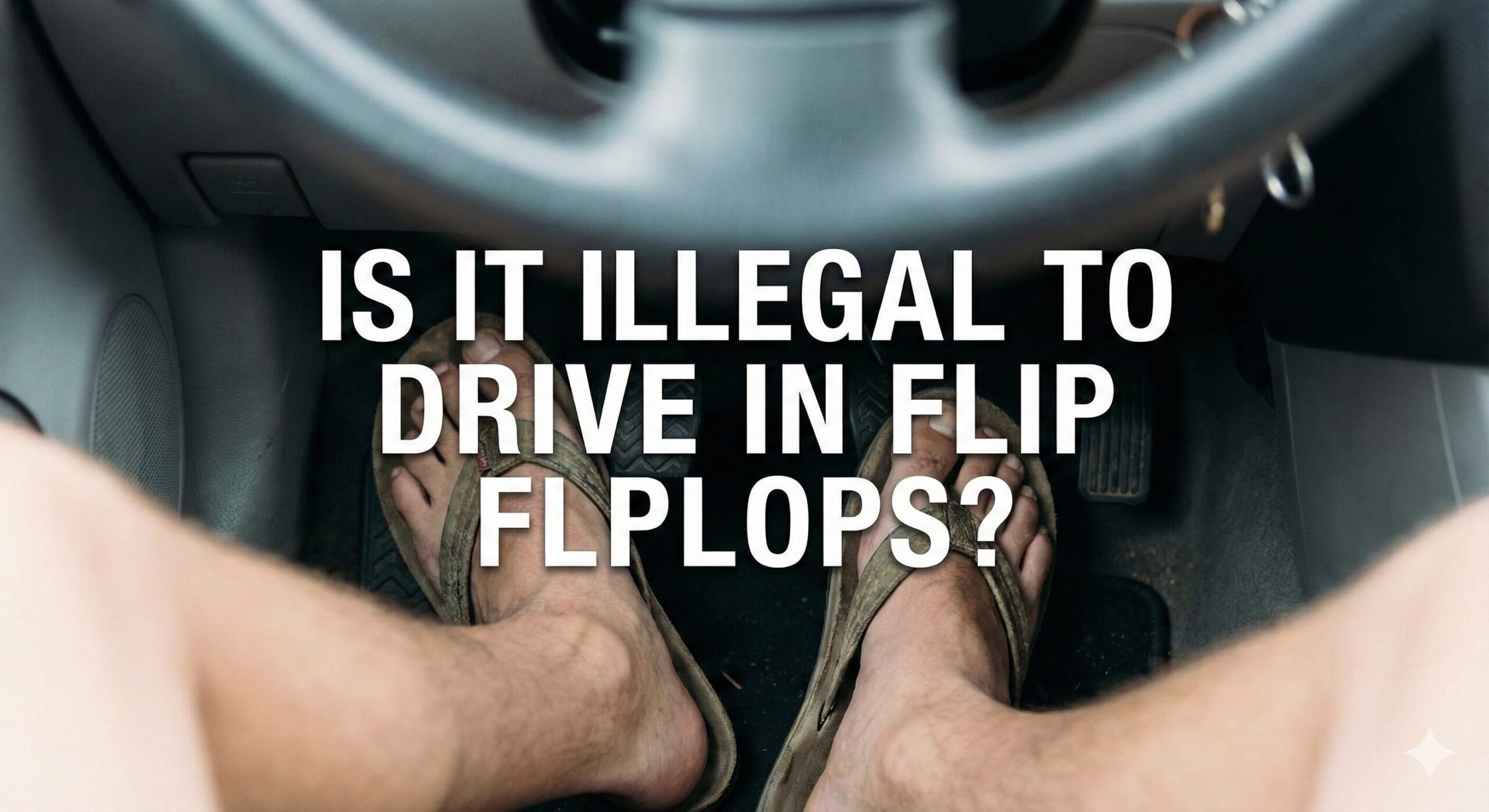
It’s a hot summer day. You’re heading to the beach, grabbing a quick coffee, or just running errands. You slide into the driver’s seat wearing your favorite pair of Havaianas, sandals, or slides. It feels natural, comfortable, and breezy. You turn the key, adjust the mirror, and start pulling out of your driveway. But then a friend in the passenger seat, or a nagging voice in the back of your head from your old high school driver’s ed class, asks: “Wait, isn’t it illegal to drive in flip flops?”
This is one of the most persistent, widely circulated myths in the automotive world. We are often told by driving instructors, concerned parents, anxious friends, and even well-meaning internet forums that driving in sandals, flip flops, or slides is strictly prohibited by law. We conjure up images of strict traffic cops handing out massive fines just for peering down at our toes during a routine traffic stop. The reality, however, is much more nuanced, legally complex, and highly dependent on exactly how those shoes impact your driving ability.
While the “fashion police” might let you slide for wearing socks with sandals, actual traffic police operate on an entirely different set of rules. The difference between a harmless summer drive and a catastrophic accident often hinges on fractions of a second—fractions that can be easily lost when a piece of loose foam gets wedged beneath a brake pedal.
In this comprehensive, exhaustive guide, we will strip away the urban legends and look closely at the actual statutes across all 50 states in the United States, as well as international laws. We will delve deep into the physics of pedal entrapment, evaluate how insurance companies view footwear in negligence claims, discuss the differences between manual and automatic transmissions, and explore why, even if it is technically legal, driving in flip flops might be one of the riskiest, most avoidable decisions you make behind the wheel.

The Law: Is It Actually Illegal in the US?
Let’s clear the air and address the core question with absolute clarity: No, it is not strictly illegal.
We have thoroughly analyzed traffic codes, Department of Motor Vehicle (DMV) handbooks, and state legislature databases from California to New York, and Florida to Texas. There is no federal mandate, nor is there a single state statute, that lists “specific footwear” as a legal requirement for operating a standard motor vehicle. You can legally drive your car in heavy work boots, towering six-inch stilettos, flimsy foam flip flops, or even barefoot. From a pure, black-and-white statutory perspective, the law does not care what is on your feet as long as you are obeying traffic signals and maintaining your lane.
The “Careless Driving” Catch-22 (How You Can Still Get a Ticket)
While the physical act of wearing the shoe isn’t illegal, the consequence of wearing that shoe most certainly can be. This is where the legal gray area traps many drivers. Police officers have broad, sweeping discretion to cite drivers for catch-all infractions such as “unsafe operation of a motor vehicle,” “failure to exercise due care,” “distracted driving,” or “reckless driving.”
Consider these two drastically different scenarios:
- Scenario A (The Harmless Stop): You get pulled over for a broken taillight or an expired registration tag. When the officer walks up to your window, they glance down and see you are wearing flip flops. Result: You will receive a citation or warning for the taillight, but absolutely no ticket for the shoes. The shoes are legally irrelevant here.
- Scenario B (The Entrapment Collision): You are approaching a red light. As you transition your foot from the gas to the brake, the toe of your flip flop folds under the brake pedal. You panic, push down, but the pedal won’t depress fully because the shoe is wedged beneath it. You rear-end the car in front of you. When the police arrive to take the accident report, you admit (or the officer discovers) that your shoe got stuck. Result: You will be ticketed for Careless Driving, At-Fault Collision, and Failure to Maintain Control. The flip flops directly caused the violation of the law.
This critical distinction is essential for new drivers who often spend hours worrying about common driving test mistakes. While a DMV examiner might not fail you the second you walk into the car with sandals on (though many will highly frown upon it and some may legally refuse to administer the test for safety reasons), they certainly will fail you instantly if those shoes cause you to brake harshly, miss a pedal, or stall a manual car.
State-by-State Breakdown of Footwear Driving Laws
To further dispel the myth, it is highly beneficial to look at how different regions and specific states handle the issue of driving in flip flops. Because traffic laws are governed at the state level rather than the federal level, nuances do exist in how highway patrols enforce “safe driving” statutes.
Florida: The Flip Flop Capital
In Florida, where beach attire is practically the state uniform year-round, driving in flip flops is incredibly common. The Florida Highway Patrol (FHP) has issued multiple public statements over the years confirming that it is 100% legal to drive in sandals, flip flops, or barefoot. However, the FHP routinely warns against it, noting that a massive percentage of minor rear-end collisions in beach towns (like Miami, Fort Lauderdale, and Daytona) are attributed to drivers whose wet, sandy flip flops slipped off the brake pedal.
California: Coastal Cruising Rules
The California Vehicle Code (CVC) contains thousands of rules, but not a single one dictates footwear. Driving down the Pacific Coast Highway in your slides is perfectly legal. However, the California Highway Patrol (CHP) is notoriously strict about distracted and reckless driving. If an officer observes you swerving because you were struggling to adjust a slipped sandal, you can be pulled over and cited under CVC Section 22350 (Basic Speed Law, failing to drive at a safe speed for conditions, which includes vehicle control) or reckless driving statutes.
New York & New Jersey: Urban Congestion
In densely packed areas like Manhattan, Brooklyn, or the busy turnpikes of New Jersey, split-second braking is a matter of life and death. Pedestrians, cyclists, and aggressive taxi drivers require motorists to have absolute control. While the NYPD and NJ State Police confirm that wearing flip flops is legal, driving instructors in these states aggressively train against it. The stop-and-go nature of urban traffic exponentially increases the number of pedal transitions (gas to brake, brake to gas) you make per mile, thereby exponentially increasing the mathematical probability of a flip flop getting caught.
Texas: Wide Open Roads and Heavy Vehicles
Texas law is completely silent on the issue of driver footwear. Whether you are in cowboy boots, barefoot, or in flip flops, the Texas Department of Public Safety (DPS) only cares that you are driving safely. However, Texas has a high proportion of large pickup trucks and SUVs. Operating a heavy-duty vehicle with increased stopping distances while wearing loose footwear compounds the physical dangers of pedal slippage.
Virginia, Ohio, and Pennsylvania
Similarly, states in the Midwest and East Coast have no explicit bans. State Police in Virginia, Ohio, and Pennsylvania have all utilized social media campaigns during the summer months to remind drivers that while they won’t get a specific “shoe ticket,” they are opening themselves up to massive civil liability and careless driving charges if their summer footwear leads to property damage or injury.
International Perspective: Are Flip Flops Illegal Abroad?
If you are planning a road trip internationally, you cannot assume that US legal standards apply. While the US relies heavily on “catch-all” reckless driving laws, other countries have taken a more stringent approach to driver attire.
The United Kingdom (UK)
The UK presents one of the most interesting legal frameworks regarding driving footwear. Under Rule 97 of the highly respected UK Highway Code, drivers are explicitly instructed that the clothing and footwear they choose to wear must “not prevent you using the controls in the correct manner.” While there is no specific law that says the word “flip flops are banned,” driving in them straddles a very dangerous legal line. If you are pulled over for erratic driving and a British police officer determines your flip flops are the root cause, you can be hit with a “driving without due care and attention” charge. This can carry a staggering on-the-spot fine of £100 and three penalty points on your license. If the case escalates to court, the fine can skyrocket to a maximum of £5,000, nine penalty points, and even a temporary driving ban.
Spain: Strict Enforcement
If you are renting a car for a holiday in Spain, take note: Spain has some of the strictest enforcement regarding driving attire in Europe. The Guardia Civil routinely issues fines (often around €80 to €200) to drivers caught operating a vehicle in flip flops, backless sandals, or barefoot. They argue that these types of footwear significantly diminish the driver’s ability to control the vehicle safely, violating Spanish traffic regulations that demand absolute freedom of movement and control at all times.
France and Germany
In France, a 2015 law modification led to widespread confusion, with many believing flip flops were banned. The reality is similar to the UK: it is left to the discretion of the police officer. If an officer believes your shoes restrict your movement or control, you can be fined €90. In Germany, the law is slightly more lenient for private drivers (barefoot and flip flops are technically allowed), but if you are involved in an accident, your insurance company can—and legally will—refuse to pay out your comprehensive or collision claim if it is proven that improper footwear contributed to the crash.
Australia
Australia treats the issue much like the United States. It is not strictly illegal in any state (New South Wales, Victoria, Queensland, etc.) to drive in thongs (the Australian term for flip flops) or barefoot. However, police authorities strongly advise against it and will issue negligent driving citations if the footwear causes an accident.
The Real Danger: The Physics of Pedal Entrapment
Why do automotive safety experts, driving instructors, and law enforcement officers universally hate flip flops so much? It all comes down to basic physics, mechanics, and the anatomical limitations of the human foot interacting with vehicle pedals. Unlike a properly tied sneaker or a secure boot, a flip flop is not secured to the heel of your foot. This creates a “floppy” sole that can move independently of your actual foot’s movement.
1. The “Under-Pedal” Jam (The Nightmare Scenario)
This is the absolute nightmare scenario that causes thousands of accidents every year. Modern vehicle pedals are suspended from above (hanging pedals) or hinged at the floor. They have specific clearances underneath them. When you are wearing a flip flop and you lift your foot from the gas pedal to quickly pivot and strike the brake, gravity and air resistance cause the loose front half of the flip flop sole to drop down away from your toes.
As you slide your foot laterally toward the brake, that drooping sole slides directly *underneath* the brake pedal. When you press down, you aren’t pressing the pedal; you are pressing the top of the pedal into the top of your shoe, which is jammed against the floorboard. This prevents you from depressing the brake entirely, leading to a total loss of stopping power. This creates a sheer panic situation that is remarkably similar to what to do if your brakes fail, but in this tragic case, the mechanical failure isn’t the car’s hydraulic system—it is your shoe.
2. The “Over-Pedal” Snag
Conversely, the strap (the “thong” part between your toes) or the thick side of the sole can get caught on the edge of the brake pedal as you lift your foot off the accelerator. This snag delays your foot’s travel time to the center of the brake pedal. In a panic stop, you need to transition your foot in fractions of a second. A snagged shoe can delay your braking by a full second or more.
3. Reduced Braking Force and Increased Stopping Distance
Extensive simulator studies and closed-track tests have shown that braking forcefully in flip flops is measurably slower and less effective than in regular shoes. On average, the transition time between the accelerator and the brake is roughly 0.13 to 0.15 seconds slower in flip flops. Furthermore, the overall braking force applied is roughly 3% to 5% weaker because the driver lacks a solid foundation and subconsciously fears the strap will break or the shoe will slip.
That 0.15-second delay might sound entirely negligible in everyday life, but in the realm of vehicular physics, it is massive. If you are traveling on the highway at 60 mph, you are covering 88 feet per second. A 0.15-second delay means your car travels an additional 13.2 feet before the brakes are even applied. That 13 feet is often the exact difference between a terrifying close call and a devastating rear-end collision.
4. Slippage Issues (Wet Weather and Sweat)
Flip flops are generally made of cheap foam, rubber, or smooth synthetic materials. They rarely have the aggressive tread patterns found on driving shoes or sneakers. If you are coming back from the pool, the beach, or if it is raining, your flip flops are likely wet. Furthermore, in the heat of summer, feet sweat. The combination of a wet, smooth foam bottom and a smooth rubber pedal cover is a recipe for disaster. When you attempt to apply hard pressure to the brake, your foot can easily slide directly off the side of the pedal, causing you to inadvertently slam on the accelerator or simply fail to stop.

Manual vs. Automatic Transmissions: Does It Make a Difference?
The dangers of driving in flip flops are exponentially magnified depending on the type of transmission your vehicle utilizes. While driving an automatic in sandals is risky, driving a manual (stick shift) in flip flops is widely considered an advanced level of vehicular recklessness.
The Danger of the Clutch Pedal
In a manual transmission vehicle, the driver must operate three pedals: the clutch, the brake, and the accelerator. The clutch pedal requires a highly specific type of interaction. You don’t just mash it to the floor; you must carefully release it, finding the precise “bite point” or “friction zone” to smoothly engage the gears without stalling the engine.
Operating a clutch requires nuanced foot articulation, ankle rotation, and sensory feedback through the sole of the foot. Flip flops ruin all of this.
- Stalling in Traffic: Because the thick, loose foam of a flip flop mutes tactile feedback, drivers often struggle to feel the clutch’s bite point. This leads to abrupt releases, causing the car to stall violently in the middle of busy intersections or on steep hills.
- The Fold-Over: As you lift your foot off the heavy clutch pedal, the edge of the flip flop frequently catches the bottom edge of the pedal. As the pedal rises, it folds the front of the shoe completely backwards, pinning the driver’s toes and causing intense pain, panic, and loss of control.
- Heel Floating: Proper clutch control usually involves resting the heel on the floorboard and pivoting the ankle. Flip flops offer zero heel support, forcing the driver to hover their entire leg in the air to operate the clutch, leading to leg fatigue and jerky, unpredictable driving.
If you drive a manual transmission car, the rule should be absolute: never, under any circumstances, drive in flip flops. The risk of stalling in an intersection and being T-boned is simply too high.
Commercial Driving: CDL Rules, Truckers, and Ride-Share (Uber/Lyft)
The rules change dramatically when you step out of a private passenger vehicle and into the realm of commercial driving. While state laws might be lenient for the average commuter, federal regulations, corporate policies, and OSHA standards take over for professionals.
Commercial Driver’s Licenses (CDL) and Truck Drivers
If you operate an 18-wheeler, a dump truck, or a commercial bus, the Federal Motor Carrier Safety Administration (FMCSA) and the Department of Transportation (DOT) heavily regulate your safety standards. While the FMCSA does not have a specific line-item regulation stating “no flip flops,” they do require that drivers operate their vehicles safely and have proper, slip-resistant footing when entering and exiting the cab (to prevent falls, which is a massive source of trucker injury).
More importantly, almost every major trucking company in the United States has strict internal policies regarding uniform and safety gear. Truck drivers are almost universally required by their employers to wear closed-toe shoes with non-slip soles, often steel-toed boots. If a DOT inspector pulls over a commercial truck and finds the driver operating an 80,000-pound vehicle in beach sandals, they can, and will, cite the driver for unsafe operation, and the driver will likely face disciplinary action or termination from their employer.
Ride-Share Drivers: Uber and Lyft Policies
What if you drive for Uber, Lyft, DoorDash, or Amazon Flex? As independent contractors, you use your own personal vehicle, meaning state laws (which allow flip flops) apply to you. However, Uber and Lyft both have community guidelines and terms of service that expect drivers to maintain a professional and safe environment.
While an Uber driver won’t be deactivated solely for wearing sandals, if a passenger feels unsafe because the driver is fumbling with their flip flops and reports it to the app, that driver risks losing their account. Furthermore, ride-share drivers spend 8 to 12 hours a day navigating dense urban traffic. The statistical probability of a pedal-entrapment accident increases with every hour on the road. For anyone driving professionally, investing in proper, closed-toe driving shoes is an absolute necessity, both for safety and for professional liability.
Motorcycles and Flip Flops: A Death Wish
This guide primarily focuses on passenger cars, but the topic of riding a motorcycle in flip flops demands immediate attention. In some states, such as Florida, it is shockingly common to see riders cruising down the highway on a sportbike or cruiser wearing shorts, a t-shirt, and flip flops.
Is it illegal? In most US states, surprisingly, no. There is no law requiring motorcycle riders to wear boots. However, doing so is universally condemned by every motorcycle safety organization on the planet.
Motorcycles require the rider to shift gears using a foot lever (usually pushing up with the toes) and operate the rear brake with the other foot. Shifting a heavy metal motorcycle peg upward with the exposed skin of a toe or a thin piece of foam is not only painful but incredibly imprecise, leading to missed shifts and sudden engine braking.
Worse, in the event of an accident—even a low-speed tip-over at a stoplight—a 500-pound motorcycle will instantly crush an unprotected foot. In a sliding crash at speed, flip flops will fly off instantly, leaving the rider’s bare feet exposed to the asphalt. This results in horrific, life-altering injuries, severe road rash, and degloving incidents. The motorcycle community follows a strict ethos known as ATGATT (All The Gear, All The Time), which firmly mandates heavy, over-the-ankle leather boots. Riding a motorcycle in flip flops is an absolute, unequivocal recipe for disaster.
Insurance, Liability & Negligence Claims
Let’s step away from traffic tickets for a moment and look at the financial devastation that can occur even if the police don’t ticket you. Your insurance company—and the lawyers representing the people you hit—might punish you far worse than a traffic cop ever could.
In the event of an accident, insurance adjusters and accident reconstruction experts look for any possible reason to assign fault (known legally as negligence). They are tasked with determining exactly why the accident occurred, and minimizing the payout for their company.
Contributory and Comparative Negligence
If a forensic analysis of the crash scene (such as analyzing skid marks, dash cam footage, and electronic data recorders in the car) shows that “pedal misapplication” or a delayed braking response caused the crash, the investigation will deepen. If it is noted in the official police report that you were wearing loose, unsecured flip flops at the time of the crash, the other driver’s personal injury lawyer will seize upon that detail immediately.
They will argue in court or during settlement negotiations that choosing to drive in inherently unsafe footwear constitutes a breach of your duty of care to other motorists. They will argue that you were negligent. This legal strategy can lead to devastating financial consequences:
- Denial of Collision Claims: In some strict jurisdictions or under specific policy clauses, your insurance company might argue that your gross negligence voids certain coverages, refusing to pay for the repairs to your own vehicle.
- Increased Liability for Personal Injury: If you are deemed at fault because your shoe slipped, you are financially responsible for the medical bills, lost wages, and pain and suffering of the people in the car you hit. If these costs exceed your policy limits, you can be sued personally for the difference, putting your savings and assets at risk.
- Long-Term Premium Hikes: An at-fault accident caused by reckless behavior (like improper footwear) will cause your insurance premiums to skyrocket for three to five years, costing you thousands of dollars in the long run.
It is always vastly better and cheaper to follow best driving practices rather than handing a hostile insurance company or an aggressive personal injury lawyer a golden excuse to ruin you financially.
Emergency Situations: What To Do If Your Shoe Gets Stuck
Despite all the warnings, human nature dictates that people will still occasionally hop into their car wearing flip flops for a “quick trip to the corner store.” If you find yourself in a terrifying situation where your flip flop has just folded under the brake pedal while you are moving, you need to act immediately to avoid a crash. Panic is your worst enemy.
- Do Not Pump the Brake Frantically: If the shoe is wedged under the pedal, mashing your foot down harder will only compress the shoe tighter against the floorboard, locking the pedal in place.
- Kick the Shoe Off (Slide Backward): Instantly slide your heel backward toward the seat, pulling your foot completely out of the flip flop. Do not try to fish it out with your toes. Just abandon the shoe. Once your foot is bare, you can place your bare foot *over* the trapped shoe and press down. Bare feet can often apply enough direct pressure to overcome the jammed foam.
- Shift into Neutral: If you are accelerating or cannot stop, immediately slap your gear shifter into Neutral (N). This disconnects the engine’s power from the wheels. The engine might rev loudly, but the car will stop accelerating. This is a crucial emergency step.
- Use the Emergency/Parking Brake (Carefully): If you absolutely cannot clear the pedal obstruction and you are approaching a collision, slowly and smoothly apply the emergency brake (handbrake or electronic parking button). Do NOT yank it forcefully, as this will lock the rear wheels and cause the car to spin out of control. Apply it gradually to scrub off speed safely.
- Pull Over and Secure the Area: Once you have safely stopped the vehicle, put it in Park, turn on your hazard lights, and physically reach down with your hands to remove the jammed footwear. Do not attempt to put the flip flop back on your foot until you have reached your final destination.
Flip Flops vs. Barefoot Driving: Which is Actually Safer?
If flip flops are so highly dangerous, what should you do if you are at the beach and that is the only pair of shoes you brought? Should you just take them off? Surprisingly, the answer from safety experts is a resounding yes.
While many people strongly believe that driving barefoot is highly illegal—a myth perpetuated even more strongly than the flip flop myth—we have firmly established in our comprehensive guide on driving barefoot laws that it is perfectly legal to drive without shoes in all 50 US states. More importantly, from a physical and mechanical standpoint, it is significantly safer than driving in flip flops or slides.
Why Barefoot Driving Wins:
- Tactile Feedback and Sensory Input: The human foot is packed with nerve endings. When you drive barefoot, you can feel the exact texture, temperature, and placement of the pedal. You know instantly if your foot is centered or slipping off the edge, allowing for micro-adjustments that are impossible when wearing thick foam.
- Superior Grip: Your toes and the pad of your foot can actually grip the rubber surface of the brake pedal far better than a wet, smooth piece of synthetic foam.
- Zero Risk of Entrapment: The biggest advantage is the total elimination of the entrapment risk. There is no loose sole to fold over, no strap to catch, and nothing to wedge beneath the brake. Your foot occupies only its exact anatomical volume.
- Improved Transition Time: Without a heavy, floppy shoe weighing down your foot, the pivot time from the gas to the brake is faster and more precise.
The Golden Rule of Barefoot Driving: If you choose to remove your flip flops and drive barefoot, you must never leave the discarded shoes in the driver’s footwell. The vibrations of the car, braking forces, and cornering can cause the loose shoes to roll directly under the pedals while you are driving, recreating the exact danger you were trying to avoid. Always toss the shoes into the passenger side floorboard, into the backseat, or securely into a storage organizer.

Comparing Other Types of Dangerous Footwear
Flip flops are not the only culprits when it comes to unsafe driving footwear. Many other popular shoe styles pose severe risks to drivers. Let’s compare how they stack up against the dangers of the flip flop.
High Heels, Stilettos, and Wedges
High heels are arguably just as dangerous as flip flops, but for entirely different mechanical reasons. A high heel forces the foot into an unnatural, elevated angle. To operate a pedal correctly, your heel needs to rest firmly on the floor to act as a pivot point. With stilettos, the heel is resting on a tiny, unstable spike that can easily snap or slide sideways. Furthermore, thick wedge heels completely numb the tactile feedback from the pedal, making it impossible to judge how much pressure you are applying. The long heel can also get caught in the floor mat, preventing the driver from lifting their foot in time to brake.
Heavy Work Boots and Snow Boots
While heavy boots are great for construction sites or deep snow, they are terrible for driving passenger cars. They are often incredibly wide, which creates a massive risk of “two-pedal overlap.” This is a terrifying scenario where the driver attempts to press the brake, but because the boot is so wide, they accidentally press the brake and the accelerator at the exact same time. Depending on the car’s horsepower, the engine can easily overpower the brakes, propelling the car forward when the driver is trying to stop. Additionally, the thick rubber soles numb all pedal feel.
Crocs and Slides (Sliders)
Slides are essentially flip flops without the toe strap. They are equally, if not more, dangerous because there is absolutely nothing securing the front of the foot to the shoe. A slide can fly off the foot with a simple flick of the ankle. Crocs, while they do have a heel strap (often referred to jokingly as “sport mode”), are incredibly bulky and wide, creating the same two-pedal overlap risks as heavy boots, while also lacking the structural rigidity needed for firm braking.
Safe Footwear Alternatives for Daily Driving
You don’t have to sacrifice style or comfort, nor do you have to wear heavy industrial boots to drive safely. The ideal, optimal driving shoe has three core characteristics: a thin sole (for maximum pedal feel and tactile feedback), a closed and rounded heel (for smooth pivoting on the floorboard), and excellent traction on the bottom to prevent slipping off wet pedals.
- Classic Sneakers and Tennis Shoes: These are the gold standard for daily commuting. They offer a secure fit, good grip, and enough flexibility to maneuver easily between pedals. Brands like Vans or Converse, which have relatively flat soles, are excellent for driving.
- Driving Loafers and Moccasins: These are specifically designed for the task. They are stylish, easy to slip on (making them a great alternative to keep in the car for summer), and feature a rounded, wrapped rubber heel that allows for perfectly smooth pivoting between the gas and brake.
- Sandals with Secure Ankle and Heel Straps: If you absolutely must wear open-toed shoes in the summer, opt for athletic sandals (like Tevas, Chacos, or secure hiking sandals) that strap firmly around the ankle and over the top of the foot. Unlike flip flops, these sandals stay securely attached to your foot at all times, eliminating the “flop” and drastically reducing the risk of pedal entrapment.
- Racing Shoes: For high-performance driving or track days, professional racing shoes are ultra-narrow, fire-resistant, and feature incredibly thin soles to allow for advanced heel-toe downshifting techniques. While overkill for a trip to the grocery store, they represent the pinnacle of footwear safety.