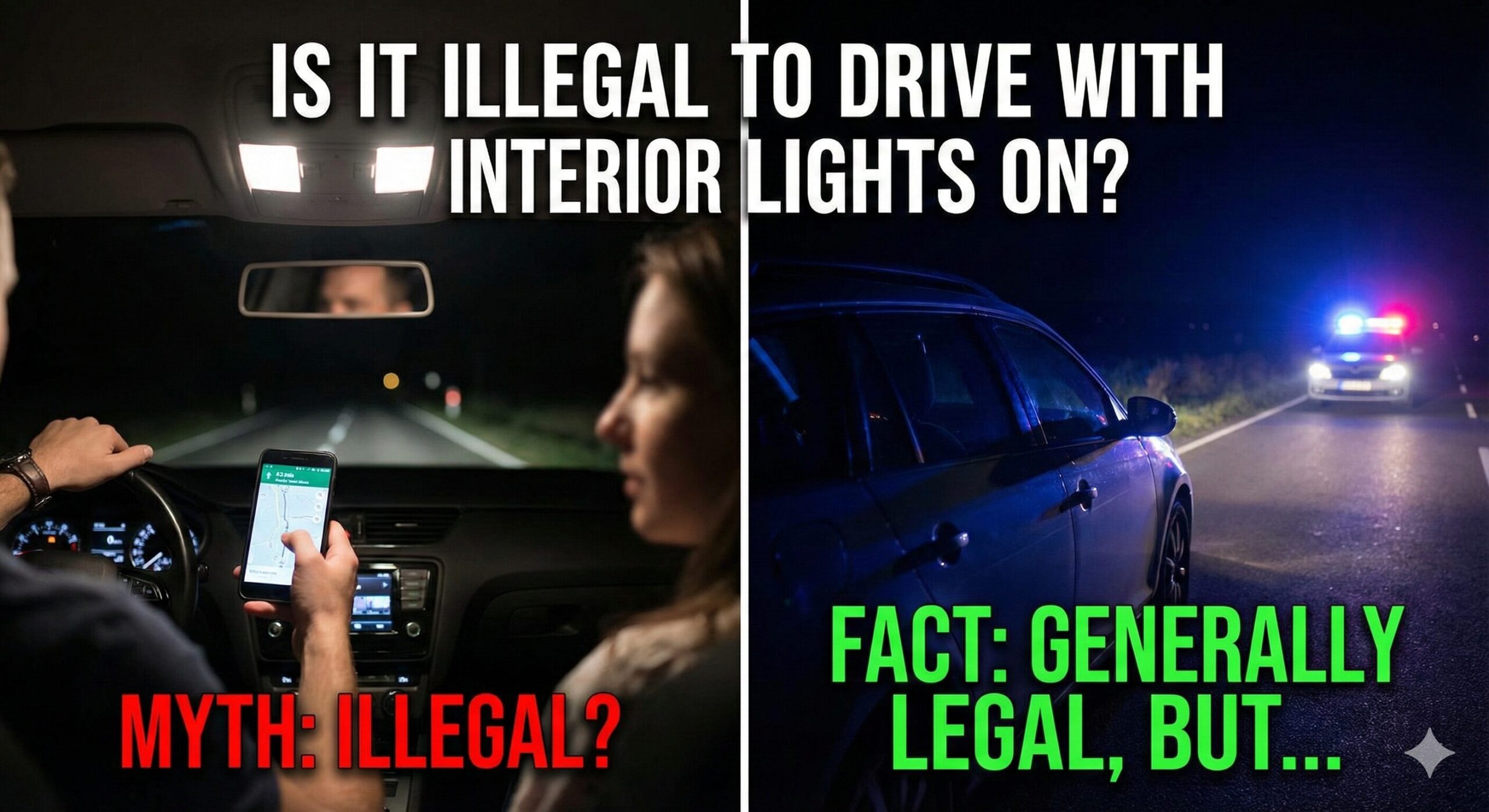
Driving with Interior Lights On: Laws, Myths, and Safety Facts
We have all heard it. You are sitting in the backseat as a child, you click on the overhead dome light to find a dropped toy or read a comic book, and suddenly, the driver snaps:
“Turn that off! It’s illegal to drive with the interior lights on! Do you want us to get arrested?”
It is one of the most pervasive myths in automotive history, passed down from generation to generation. But is there any truth to it? If a police officer drives by and sees your dome light illuminated, are you going to get a ticket?
The short answer is: No. In the vast majority of jurisdictions in the United States, Canada, and the UK, there is no specific law that explicitly forbids driving with your interior dome light on.
However, the long answer is far more complicated. While the act itself isn’t illegal, the consequences of using the light—such as distracted driving or reduced visibility—can land you in legal trouble. This comprehensive guide will break down the laws, the science of night vision, and the safety best practices you need to know.
According to the National Highway Traffic Safety Administration (NHTSA), nighttime driving accounts for approximately 49% of all fatal car accidents despite only 25% of driving occurring during nighttime hours. Any factor that compromises night visibility—including interior lighting glare—contributes to this disproportionate statistic. The Federal Motor Carrier Safety Administration (FMCSA) has extensively documented how cabin lighting affects driver perception and reaction times, particularly in commercial vehicle operations where split-second decisions can mean the difference between a safe journey and a catastrophic collision.

Is It Actually Illegal? A Detailed Breakdown of State Laws
To provide a definitive answer, we analyzed traffic codes across all 50 United States. The consensus is surprisingly consistent: There is no specific statute in any of the 50 states that says, “It is unlawful to operate a motor vehicle with the interior dome light illuminated.”
However, that doesn’t mean you are completely immune to prosecution. Police officers operate based on “articulated suspicion” and safety statutes. The legal framework surrounding interior lighting falls into three distinct categories: direct prohibition (nonexistent), indirect regulation through distracted driving statutes, and equipment violation laws that address aftermarket lighting modifications.
The “Distracted Driving” Loophole
Most states have broad laws covering “Distracted Driving” or “Careless Driving.” These laws are written vaguely on purpose to cover any activity that prevents a driver from operating the vehicle safely. Legal scholars refer to these as “catch-all provisions” designed to give law enforcement flexibility in addressing emerging safety concerns that specific legislation hasn’t yet addressed.
- Scenario A: You turn on the light for 10 seconds to find a dropped wallet. You maintain your lane and speed. Legal, though not recommended.
- Scenario B: The light is on, causing a reflection on the windshield. You fail to see a pedestrian or drift out of your lane because of the glare. Illegal under Careless Driving statutes.
- Scenario C: You have aftermarket interior lights so bright they’re visible from outside the vehicle, potentially impersonating emergency vehicle lighting. Illegal in most states under equipment violation codes.
Specific State Code References
While no state explicitly bans interior light usage, several have relevant statutes that could apply. California Vehicle Code Section 23103 defines reckless driving as driving “in willful or wanton disregard for the safety of persons or property.” New York’s Vehicle and Traffic Law Section 1212 addresses reckless driving similarly. In Texas, Transportation Code Section 545.401 defines reckless driving as operating a vehicle with “willful or wanton disregard for the safety of persons or property.” All of these statutes could theoretically be applied if interior lighting contributes to dangerous driving behavior.
For more on how distractions can lead to legal issues, check out our guide on other common driving myths and legalities.
State-by-State Legal Status Overview
Understanding the legal landscape requires examining how different states approach interior vehicle lighting. While no state explicitly bans dome light usage while driving, several have specific restrictions on aftermarket interior lighting, particularly colored lights that could be confused with emergency vehicles. The following breakdown provides clarity on regional variations in enforcement and regulation.
CVC 23123.5 covers distracted driving broadly. Interior light glare causing lane deviation can result in citations.
Transportation Code silent on interior lights. Enforcement only under general reckless driving provisions.
VTL 375 addresses lighting equipment. Aftermarket colored interior lights visible externally prohibited.
Statutes silent on interior lighting. Careless driving statute (316.1925) provides enforcement mechanism.
MCL 257.698 prohibits red/blue lights visible from front. Interior LEDs must not project prohibited colors.
Vehicle Code Title 75 has no specific interior light restrictions for standard factory equipment.
ORC 4513.17 restricts flashing lights. Constant interior illumination not addressed but distraction laws apply.
OCGA 40-6-241 distracted driving statute provides enforcement vehicle for visibility impairment cases.
The Science: Why Driving with Interior Lights is Dangerous
If it’s not strictly illegal, why were our parents so angry about it? It turns out, they had science on their side. Driving with the dome light on creates two distinct optical hazards for the driver, both of which have been extensively studied by vision scientists and automotive safety researchers.
1. The Reflection Problem
Car windshields are angled, typically between 25 and 35 degrees from vertical. At night, the outside environment is dark, and the inside of your car is (usually) dark. This allows you to see through the glass with minimal interference. The optical principle at work is called the “reflectance ratio”—the difference between light transmission through the glass and light reflection from the interior surface.
When you turn on a bright interior light, the cabin becomes brighter than the outside world. The windshield acts like a semi-transparent mirror. Instead of seeing the road, the driver sees a reflection of the dashboard, the passengers, and the light itself. This phenomenon effectively blinds the driver to hazards on the road ahead. At 65 miles per hour, a vehicle travels approximately 95 feet per second. Even two seconds of compromised vision means traveling nearly 200 feet with impaired hazard recognition.
2. The Purkinje Effect (Night Vision)
Your eyes adapt to darkness by dilating the pupils and increasing the concentration of rhodopsin (visual purple) in the rod cells of your retina. This process, known as scotopic vision, takes time—often 20 to 30 minutes for full dark adaptation. The human eye can detect a single photon of light when fully dark-adapted, representing an incredible 10-million-fold increase in sensitivity compared to daytime vision.
When a bright dome light is switched on, your pupils constrict rapidly (in approximately 0.3 to 0.5 seconds) to handle the brightness. However, the chemical process of rhodopsin bleaching occurs almost instantaneously. When the light is turned off, you are temporarily “blind” to the darkness outside until your eyes re-adapt—a process that takes 5 to 15 minutes for meaningful recovery and up to 30 minutes for full restoration. During these critical moments of re-adjustment, you are driving a multi-ton vehicle essentially blindfolded against low-contrast hazards like deer, unlit cyclists, or pedestrians in dark clothing.
If you struggle with visibility at night, consider reading our essential tips for driving at night.
The Complete Science of Night Vision and Driving
Understanding why interior lights pose such a significant hazard requires a deeper exploration of human visual physiology and how it interacts with the driving environment. The human visual system represents an evolutionary compromise between acuity, sensitivity, and adaptability—and nighttime driving pushes every aspect of this system to its limits.
Rod Cells vs. Cone Cells: The Dual Visual System
The human retina contains approximately 120 million rod cells and 6 million cone cells. Rod cells, concentrated in the peripheral retina, are exquisitely sensitive to light but cannot distinguish colors. Cone cells, concentrated in the fovea (central vision), provide color vision and sharp detail but require much higher light levels to function. During nighttime driving, your visual system relies almost exclusively on rod cells for hazard detection, particularly in your peripheral vision where pedestrians, animals, and vehicles approaching from side streets appear.
Rhodopsin, the photopigment in rod cells, bleaches when exposed to light and regenerates slowly in darkness. A single brief exposure to bright interior light can bleach significant amounts of rhodopsin, temporarily disabling your most sensitive visual system exactly when you need it most. Research published in the Journal of Vision indicates that even 0.5 seconds of exposure to a standard dome light (approximately 10-15 lux at eye level) can increase scotopic visual thresholds by 200-300% for several minutes afterward.
Contrast Sensitivity and Hazard Detection
Contrast sensitivity—the ability to distinguish objects from their background—declines dramatically in low-light conditions. The presence of interior light reflections on the windshield further reduces contrast sensitivity by superimposing a bright image over the already-dim exterior scene. Studies conducted by the University of Michigan Transportation Research Institute demonstrated that windshield reflections from interior lights can reduce contrast sensitivity by 40-60%, making it functionally impossible to detect low-contrast hazards such as pedestrians wearing dark clothing or animals at the roadside.
Age-Related Factors
The impact of interior lighting on night driving becomes progressively more severe with age. By age 60, the human pupil’s maximum dilation decreases by approximately 30%, reducing the total light reaching the retina. Additionally, the ocular media (lens and vitreous humor) becomes less transparent, scattering more light internally. This increased intraocular light scatter makes older drivers significantly more susceptible to glare from interior sources. A 65-year-old driver may require 3-4 times more light to see as clearly as a 25-year-old driver, yet they are more adversely affected by the glare that interior lights produce. This creates a dangerous double-bind situation that makes interior lighting particularly hazardous for older drivers.
The 20-30-20 Rule for Night Driving Safety
Vision scientists and driving safety experts often reference the “20-30-20 Rule” for nighttime driving. This guideline states that it takes approximately 20 minutes for the eyes to achieve meaningful dark adaptation, 30 minutes for full scotopic sensitivity, and that a 20-second exposure to bright light can undo all of that adaptation. When a passenger turns on the dome light even briefly, they reset the driver’s dark adaptation clock to zero. This physiological reality explains why experienced drivers instinctively react negatively to interior light activation—their body’s own visual system is sending danger signals that conscious awareness may not fully articulate.
Accident Statistics and Research Data
The relationship between interior vehicle lighting and accident rates has been the subject of numerous studies by transportation safety organizations worldwide. While isolating interior light usage as a specific variable presents methodological challenges, the broader data on nighttime driving impairment provides compelling evidence for the risks involved.
NHTSA Findings on Nighttime Driving
The National Highway Traffic Safety Administration’s comprehensive analysis of fatal crashes reveals persistent patterns in nighttime driving dangers. Their 2023 data indicates that 20,158 fatal crashes occurred during nighttime hours (defined as 6:00 PM to 5:59 AM), compared to 16,552 during daylight hours. When adjusted for vehicle miles traveled, the nighttime fatal crash rate is approximately three times higher than the daytime rate. While interior lighting represents just one factor among many (including alcohol impairment, fatigue, and reduced visibility), it contributes to the broader category of “driver-related factors” that includes distraction and visibility obstruction.
University Research on In-Vehicle Distractions
A landmark study conducted by the Virginia Tech Transportation Institute examined the effects of various in-vehicle distractions on driving performance. Their research, which involved instrumented vehicles and eye-tracking technology, found that any visual distraction lasting longer than 2 seconds significantly increases crash risk. Interior light glare on windshields creates a form of visual distraction that, while not always classified as such in accident reports, produces comparable degradation in driving performance metrics such as lane position maintenance and speed variability.
European Research Consortium Findings
The European Commission’s Horizon 2020 research program included extensive investigation into nighttime driving safety factors. Researchers at the Dutch Institute for Road Safety Research (SWOV) found that interior lighting glare ranked among the top five nighttime-specific risk factors identified by drivers themselves, alongside oncoming headlight glare, wet road reflections, and poorly marked road edges. Their survey of 12,000 European drivers revealed that 67% had experienced a “momentary loss of road visibility” due to interior light reflections at some point in their driving history, with 8% reporting that such an incident nearly resulted in a collision.

Police Stops & Probable Cause
Even if you know you aren’t breaking a specific law, driving with your interior light on creates a beacon that attracts law enforcement. Understanding the legal framework of police stops and probable cause helps drivers navigate potential interactions with law enforcement.
Why Officers Notice Interior Lights
Police officers are trained to look for anomalies in traffic patterns and vehicle behavior. A car driving down a dark highway with the cabin fully illuminated represents a statistical anomaly—a deviation from normal nighttime driving behavior that warrants closer observation. This training stems from decades of law enforcement experience correlating interior light usage with specific types of violations and safety concerns.
The specific concerns that interior illumination raises for officers include:
- Potential Distracted Driving: The driver may be searching for items, reading, or engaging with electronic devices—all behaviors associated with impaired vehicle control.
- Possible Impairment Indicators: Individuals under the influence of alcohol or drugs often exhibit unusual behaviors including unnecessary light activation, difficulty locating items, or general confusion about vehicle controls.
- Equipment Violations: Aftermarket interior lighting, particularly colored LEDs visible from outside the vehicle, may violate state equipment codes that reserve certain colors (red, blue, amber) for emergency and service vehicles.
- Occupant Distress: In rare cases, interior light activation while driving may signal an emergency situation, such as a medical crisis or a victim attempting to attract attention.
The Legal Standard for Traffic Stops
Under the Fourth Amendment, police officers need “reasonable suspicion” to initiate a traffic stop—a lower standard than the “probable cause” required for arrest. Reasonable suspicion means that an officer can articulate specific facts that, combined with rational inferences from those facts, warrant the stop. While an illuminated interior light alone does not constitute reasonable suspicion in most jurisdictions, it provides the officer with a reason to observe the vehicle more closely. If the officer then observes any additional indicators—a slight weave within the lane, a delayed reaction to a traffic signal, or speed variations—the combination of factors may establish the necessary reasonable suspicion for a stop.
Practical Advice for Police Encounters
If you are stopped by law enforcement while your interior light is illuminated or shortly after you’ve turned it off, certain practices can help ensure the interaction proceeds smoothly. Pull over safely and promptly, turn off the engine if practical, and keep your hands visible on the steering wheel. If it is nighttime, turning the interior light ON after you have stopped allows the officer to see inside your vehicle clearly, which most officers appreciate as a courtesy and safety measure. Be prepared to explain why the light was on if asked, and answer honestly without volunteering unnecessary information.
The Real Ticket: Distracted Driving Statutes
In modern driving, the interior light is the least of our worries compared to smartphones and infotainment systems, but the legal principles apply identically. States including California, New York, Florida, Texas, and Illinois have enacted broad distracted driving statutes that give officers wide discretion in enforcement.
Code of Virginia § 46.2-818.2: While this specifically mentions handheld personal communications devices, the overarching reckless driving statutes cover any behavior that endangers life, limb, or property. If an officer testifies that your interior light washed out your windshield and caused you to miss a stop sign or fail to maintain your lane, the judge will likely uphold the ticket.
The Three Categories of Distracted Driving
Safety researchers classify distracted driving into three categories: visual (taking eyes off the road), manual (taking hands off the wheel), and cognitive (taking mind off driving). Interior light usage while driving can involve all three simultaneously. The visual distraction comes from looking at the illuminated area or the reflection it creates. The manual distraction may occur when reaching for the light switch or searching for items in the illuminated area. The cognitive distraction arises from the surprise of sudden brightness, the concern about passengers, and the anxiety about potential police attention—all mental processes that divert attention from the primary task of driving safely.
For a deeper dive into safety gear that keeps you compliant and safe, review our list of best car safety tools.
Commercial Driving and CDL Regulations
For commercial vehicle operators holding a Commercial Driver’s License (CDL), the standards for vehicle operation are significantly more stringent than those for private passenger vehicles. The Federal Motor Carrier Safety Administration (FMCSA) establishes regulations that govern virtually every aspect of commercial vehicle operation, including interior lighting and visibility requirements.
FMCSA Standards for Interior Lighting
While the FMCSA does not explicitly prohibit the use of interior lights while driving, its regulations create a framework that effectively discourages the practice. Title 49 CFR Part 392.3 states that no driver shall operate a commercial motor vehicle while their ability or alertness is so impaired through fatigue, illness, or any other cause as to make it unsafe to operate the vehicle. A driver who deliberately reduces their night vision capability by using interior lighting could be found in violation of this standard.
Hours of Service and Night Driving
Commercial drivers operating under Hours of Service regulations often find themselves driving during nighttime hours, when the risks associated with interior lighting are most acute. The FMCSA’s Compliance, Safety, Accountability (CSA) program tracks safety violations, and incidents related to visibility impairment—including those potentially caused by interior glare—can affect a carrier’s safety rating. Many commercial fleet operators have internal policies that strictly prohibit unnecessary interior light usage while the vehicle is in motion, and violation of these policies can result in disciplinary action up to and including termination.
Sleeper Berth Regulations
For trucks equipped with sleeper berths, interior lighting presents unique regulatory considerations. The FMCSA requires that sleeper berths be equipped with lighting that allows occupants to read and perform other tasks without disturbing the driver. However, this lighting must be designed and positioned to prevent glare from reaching the driver’s position. Modern sleeper berth designs incorporate curtain systems and directional lighting to isolate the sleeping compartment from the driving position, allowing off-duty team drivers to use light without compromising the active driver’s vision.
Insurance Implications and Claims
The relationship between interior light usage and auto insurance may not be immediately obvious, but it has significant implications for both premium rates and claims processing. Insurance companies rely on actuarial data and risk assessment to determine premiums, and any factor that increases accident risk—including the behaviors associated with interior light usage—can affect insurance outcomes.
At-Fault Determination in Accidents
If you are involved in a nighttime accident and evidence suggests that your interior light was illuminated at the time of the collision, this fact may be used to establish fault. Insurance adjusters and accident reconstruction specialists consider multiple factors when determining liability, including visibility conditions and potential distractions. If an investigation reveals that the driver’s night vision was compromised by interior glare, this may weigh heavily in the fault determination process, potentially resulting in higher premiums, policy non-renewal, or even denial of coverage in extreme cases.
Comparative and Contributory Negligence
Insurance claims operate under state-specific negligence frameworks. In states that follow comparative negligence principles, a driver found partially at fault for an accident—for instance, by operating with compromised visibility—may have their compensation reduced by their percentage of fault. In the few states that still follow contributory negligence rules (Alabama, Maryland, North Carolina, Virginia, and Washington D.C.), a driver found even 1% at fault may be barred from recovering any damages. Interior light usage that contributes to an accident could theoretically trigger these provisions, with severe financial consequences for the driver.
Premium Impact Analysis
Even without an accident, certain driving behaviors can affect insurance premiums. While no insurance company currently asks specifically about interior light usage on applications, the broader category of “distracted driving” has become a significant rating factor. A citation for distracted driving related to interior glare would be classified as a moving violation, which typically increases premiums by 20-30% on average and remains on the driving record for three to five years depending on state regulations. Over this period, a single distracted driving citation can cost a driver thousands of dollars in additional premiums.

Modern Vehicle Lighting Technology
The technology of automotive interior lighting has evolved dramatically from the simple incandescent dome lights of previous generations. Understanding the differences between lighting technologies helps drivers make informed decisions about when and how to use interior illumination safely.
Incandescent vs. LED Interior Lighting
Traditional incandescent dome lights produce a warm, yellowish light through a heated filament. These bulbs typically emit light in all directions, creating significant glare and reflection on windshield surfaces. Their power consumption ranges from 5 to 15 watts, and they generate noticeable heat during extended use. In contrast, modern LED interior lights offer several advantages: they produce directional light that can be focused away from the windshield, consume 80-90% less power, generate minimal heat, and allow for adjustable brightness and color temperature.
Ambient Lighting Systems
Luxury vehicles increasingly feature sophisticated ambient lighting systems that provide gentle, indirect illumination throughout the cabin. These systems, pioneered by brands like Mercedes-Benz, BMW, and Audi, use fiber optic guides and strategically placed LEDs to create a subtle glow that improves cabin aesthetics and functionality without creating windshield glare. The key design principle is indirect illumination—light that reflects off surfaces before reaching the driver’s eyes, rather than direct point sources that create sharp reflections on glass surfaces.
Adaptive Interior Lighting
The newest generation of vehicles incorporates adaptive interior lighting that automatically adjusts based on ambient conditions. When the vehicle’s exterior light sensor detects darkness, the interior lighting system may automatically dim display screens, reduce ambient lighting intensity, and shift color temperature toward redder hues that preserve night vision. Some systems even integrate with navigation data to anticipate conditions—for example, automatically dimming interior lights when approaching an unlit rural road or tunnel.
| Lighting Type | Glare Risk | Night Vision Impact | Power Draw | Typical Lifespan |
|---|---|---|---|---|
| Incandescent Dome Light | High | Severe – Full rhodopsin bleaching | 8-15 watts | 1,000-2,000 hours |
| LED Map Light (White) | Medium | Moderate – Directional reduces impact | 1-3 watts | 25,000-50,000 hours |
| LED Map Light (Red) | Very Low | Minimal – Preserves rhodopsin | 0.5-1 watt | 25,000-50,000 hours |
| Ambient Footwell Lighting | Very Low | Minimal – Indirect illumination | 1-5 watts (full system) | 50,000+ hours |
| Aftermarket LED Strips | Variable | Depends on placement and brightness | 3-15 watts (full system) | 30,000-50,000 hours |
Child Safety and Family Considerations
For parents traveling with children, the question of interior lighting takes on additional dimensions. Children frequently need attention during car journeys—dropped toys, lost pacifiers, spilled drinks, and general restlessness all create situations where interior lighting seems necessary. Balancing child safety needs against driver visibility requirements requires thoughtful planning and appropriate equipment.
Car Seat Visibility and Safety Checks
Parents often activate interior lights to check on children in rear-facing car seats, particularly infants who cannot communicate their needs verbally. While this parental instinct is understandable and appropriate, it should be managed strategically. Rather than using the overhead dome light, parents can install dedicated child-monitoring solutions that provide visibility without compromising the driver’s night vision. Clip-on mirrors that attach to the rear headrest allow the driver to glance at the child using the rearview mirror without additional lighting. Some advanced models incorporate gentle LED illumination directed solely at the child’s seating position.
Managing Children’s Requests for Light
Children accustomed to using personal electronic devices, reading books, or playing with toys during car journeys often request interior lighting. While the parental instinct to say “no” is scientifically justified, the manner of refusal matters for long-term compliance and family harmony. Explaining the safety reasoning in age-appropriate terms helps children understand that the restriction isn’t arbitrary. For older children, explaining that “the light makes it harder for me to see the road, which could cause an accident” provides concrete rationale. For younger children, providing alternative entertainment that doesn’t require light—audio books, music, or glow-in-the-dark toys—addresses the underlying need while maintaining safety.
Family Road Trip Planning
For extended family road trips that involve nighttime driving, advance planning can prevent most situations where interior lighting seems necessary. Organizing the vehicle so that frequently needed items (snacks, water bottles, entertainment devices) are accessible without searching reduces the impulse to turn on lights. Pre-loading tablets and devices with content before departure eliminates the need to navigate menus in the dark. Packing a dedicated “night kit” with glow sticks, chemical light sticks, or red-filtered flashlights provides illumination options that don’t compromise the driver’s vision.
International Law Comparison
The legal treatment of interior vehicle lighting varies significantly across international jurisdictions. Understanding these differences proves valuable for travelers renting vehicles abroad and provides comparative perspective on U.S. regulations.
United Kingdom
In the United Kingdom, the Highway Code does not specifically address interior lighting while driving. However, Rule 148 of the Highway Code states that drivers must avoid distractions, including those from within the vehicle. The broader offense of “driving without due care and attention” (Section 3 of the Road Traffic Act 1988) could apply if interior lighting contributes to dangerous driving. UK police officers have discretion to issue fixed penalty notices (typically £100 and 3 penalty points) for careless driving, though prosecution specifically for interior light usage remains extremely rare.
European Union
EU member states operate under various national traffic codes, but a common framework emerges. Germany’s Straßenverkehrsordnung (StVO) Section 23 requires drivers to ensure their vehicle’s lighting does not impair their own vision or distract other road users. France’s Code de la Route Article R412-6 addresses driver distractions broadly. The Netherlands has specific regulations regarding interior lighting in commercial vehicles, requiring that any lighting in sleeper cabs be shielded from the driver’s position. Across the EU, the principle is consistent: interior lighting is not explicitly prohibited but becomes illegal when it impairs safe operation.
Australia
Australian Road Rules, which serve as the model legislation for all Australian states and territories, do not contain specific provisions addressing interior vehicle lighting. However, Rule 297 (Driver to have proper control of vehicle) provides a general requirement that could encompass interior light-related distractions. Additionally, Australian Design Rules for vehicle manufacturing specify requirements for interior lighting placement and intensity that minimize driver distraction in new vehicles.
Japan
Japan’s Road Traffic Act takes a notably strict approach to anything that could impair driver visibility. Article 71 of the Act broadly prohibits actions that interfere with safe driving, and Japanese traffic enforcement has been known to cite drivers for interior lighting that creates windshield glare, particularly in urban areas where ambient lighting already creates challenging visual conditions. Japan’s vehicle inspection system (shaken) also evaluates interior lighting placement as part of the comprehensive safety inspection required every two years.
Psychological Factors of Night Driving
The psychological dimensions of nighttime driving extend well beyond the physiological effects of reduced visibility. Understanding how the human brain processes the driving task in darkness helps explain why interior lighting triggers such strong reactions from experienced drivers and why the “dad myth” has persisted across generations.
Situational Awareness and Cognitive Load
Nighttime driving imposes a significantly higher cognitive load than daytime driving. The brain must work harder to interpret limited visual information, predict the movement of poorly visible objects, and maintain spatial orientation with fewer visual reference points. Adding interior light to this already-taxed cognitive system creates additional processing demands—the brain must simultaneously interpret the dim external scene AND filter out the bright internal reflection. This divided attention reduces situational awareness precisely when it is most needed. Research using functional MRI scanning has demonstrated that the prefrontal cortex, responsible for executive function and decision-making, shows increased activation during nighttime driving tasks, leaving fewer cognitive resources available for managing unexpected events.
The Anxiety-Vigilance Cycle
Many drivers experience heightened anxiety during nighttime driving, particularly on unfamiliar roads or in adverse weather. This anxiety triggers a state of hypervigilance—an elevated state of sensory sensitivity accompanied by exaggerated scanning behavior. Paradoxically, hypervigilance can be counterproductive for driving safety because it narrows attentional focus and increases susceptibility to distraction. The sudden illumination of the interior cabin during this state of hypervigilance can trigger a startle response, momentarily overwhelming the driver’s information processing capacity. This psychological mechanism may explain why even brief interior light activation feels subjectively alarming to nighttime drivers.
Social Dynamics and Passenger Behavior
The “dad myth” about interior lighting being illegal serves an important social function beyond simple safety concerns. By invoking legal authority rather than explaining complex visual physiology, the driver (typically a parent) achieves immediate behavioral compliance without engaging in a negotiation that itself constitutes a cognitive distraction. This parenting strategy, while technically inaccurate, represents an efficient solution to a real safety problem. Understanding this dynamic helps adult children appreciate the legitimate safety concerns underlying the well-intentioned deception and helps current parents develop more accurate but equally effective communication strategies for managing in-car behavior.
Advanced Driver Assistance Systems and Interior Lighting
The proliferation of Advanced Driver Assistance Systems (ADAS) in modern vehicles introduces new considerations for interior lighting usage. These systems, which include automatic emergency braking, lane departure warning, and adaptive cruise control, rely on various sensors and cameras that can be affected by interior lighting conditions.
Camera-Based Systems and Interior Glare
Many ADAS features depend on forward-facing cameras mounted behind the windshield, typically near the rearview mirror. These cameras are designed to function in a wide range of lighting conditions, but they share the same optical challenges as human drivers when it comes to windshield reflections. Bright interior lighting that creates reflections on the windshield can degrade camera performance by reducing contrast, creating false edges in the image analysis algorithm, or temporarily blinding the sensor with saturation. While manufacturers design these systems with robustness to varying conditions, interior light glare represents an edge case that may reduce system effectiveness at critical moments.
Driver Monitoring Systems
Newer vehicles increasingly feature driver monitoring systems that use infrared cameras to track eye movement, head position, and blink rate to detect drowsiness or distraction. These systems typically operate in the infrared spectrum, which is invisible to the human eye and therefore does not affect night vision. However, bright interior lighting in the visible spectrum can interfere with these systems by altering pupil size and eye movement patterns in ways that may generate false alerts or mask genuine fatigue indicators. Some driver monitoring systems explicitly instruct users to avoid bright interior lighting during nighttime operation.
Heads-Up Displays (HUD)
Heads-up displays project information onto the windshield, allowing drivers to access speed, navigation, and safety alerts without looking away from the road. These systems are carefully calibrated for brightness and position, but interior dome light activation can wash out HUD projections or create competing reflections that confuse the driver’s visual processing. If your vehicle is equipped with HUD technology, be particularly cautious about interior lighting usage, as the combination of HUD imagery and interior light reflections can create especially confusing visual conditions.
Professional Driving Instructor Insights
Professional driving instructors occupy a unique position between regulatory knowledge and practical experience. Their perspectives on interior lighting reflect decades of cumulative experience teaching new drivers how to navigate nighttime conditions safely.
What Driving Schools Teach
We surveyed curriculum materials from major driving schools across the United States, including AAA Driving School, DriversEd.com, and state-approved programs in California, Texas, Florida, and New York. The consensus among professional instructors is clear: interior lighting should be minimized during nighttime driving, and students are explicitly taught that dome lights create dangerous windshield reflections. While instructors generally acknowledge that the “illegal” claim is technically incorrect, most support the message behind it and encourage new drivers to develop habits that prevent interior light usage while the vehicle is in motion.
Common Student Mistakes
Driving instructors consistently report that new drivers underestimate the impact of interior lighting on visibility. Common mistakes include adjusting climate controls with dome lights on, allowing passengers to use reading lights that reflect in the rearview mirror, and failing to dim dashboard instrumentation adequately. Instructors emphasize that dashboard brightness should be reduced to the minimum level that still allows reading of essential instruments—typically much dimmer than the factory default setting. This practice, combined with avoiding dome light usage, forms the foundation of proper nighttime driving technique.
Defensive Driving Course Recommendations
Defensive driving courses, often required for ticket dismissal or insurance discounts, universally address the importance of maintaining optimal visibility. The National Safety Council’s Defensive Driving Course explicitly recommends against any interior lighting that could create windshield reflections, categorizing this as a “self-imposed visibility hazard.” Similarly, the American Safety Council’s curriculum includes modules on nighttime hazard recognition that address interior lighting as a controllable risk factor. These courses emphasize that professional drivers treat the vehicle cabin as a “dark cockpit” at night, minimizing all light sources to preserve maximum visual sensitivity.
Vehicle Electrical System and Maintenance
Beyond safety considerations, interior lighting connects to broader vehicle electrical system health. Understanding these relationships helps drivers maintain their vehicles properly and avoid issues that could compromise safety or reliability.
Battery and Alternator Impact
A frequently asked question concerns whether interior light usage while driving affects the vehicle’s electrical system. The answer is straightforward: when the engine is running, the alternator supplies all electrical power, and interior lighting draws a negligible amount of current relative to the alternator’s output capacity. A typical dome light draws 0.5 to 1.0 amps, while modern alternators produce 80 to 200 amps at highway speeds. However, if the vehicle is idling for extended periods with multiple electrical accessories active (headlights, heater fan, defroster, audio system, AND interior lights), the combined draw could exceed the alternator’s output at idle speed, slowly discharging the battery. This scenario is unlikely under normal driving conditions but worth considering during extended idling situations like waiting at railroad crossings or drive-through lines.
Dome Light Malfunctions
Dome lights that fail to turn off when doors close, flicker intermittently, or activate without apparent cause indicate electrical system issues that require attention. Common causes include faulty door switches (pin switches mounted in the door frame), damaged wiring harnesses in door hinges, malfunctioning body control modules, or aftermarket alarm system installations that interfere with the factory lighting circuit. These issues should be addressed promptly not only because they create nighttime driving hazards but because they can drain the battery when the vehicle is parked, potentially leaving you stranded.
Aftermarket Installation Considerations
If you choose to install aftermarket interior lighting—ambient LED strips, upgraded map lights, or child-monitoring illumination—professional installation or careful DIY attention to electrical principles is essential. Improperly installed lighting can create short circuits, overload factory wiring, interfere with vehicle computer systems, or create electromagnetic interference that affects radio reception or ADAS sensor operation. Always use fused circuits, avoid tapping into safety-critical wiring (airbag systems, ABS sensors), and ensure that any lighting installed near the windshield is positioned to direct light away from the glass surface.

Safe Alternatives for Night Driving
There are valid reasons to need light in the car: kids dropping pacifiers, passengers reading maps, or finding a toll pass. Here is how to do it without blinding the driver. The key principle across all these alternatives is directional control—keeping light where it’s needed while preventing it from reaching the windshield or the driver’s eyes.
1. Use Map Lights, Not Dome Lights
Most modern cars have focused “map lights” for the passenger and driver. These are directional and typically shielded to direct light downward into the lap area. If the passenger uses their specific map light, it illuminates their lap without flooding the windshield with glare. Drivers should never use their own map light while the vehicle is in motion—if you need to see something, pull over safely first.
2. Red Light Flashlights
Astronomers, military pilots, and naval personnel have used red light for decades because it preserves night vision. The rod cells in the human retina are insensitive to red wavelengths (above approximately 650 nanometers), meaning red light does not trigger rhodopsin bleaching. Keeping a small tactical flashlight with a red filter or dedicated red LED in your center console provides illumination for finding dropped items, reading maps, or checking directions without compromising dark adaptation. Many quality models offer multiple brightness levels and a dedicated red mode specifically for night use.
3. Ambient Lighting
Many luxury cars now come with soft ambient lighting in the footwells, door panels, and center console areas. This provides enough orientation light to find dropped items without creating windshield glare. The principle is indirect illumination—light that reflects off surfaces before reaching the eyes, eliminating the sharp reflections that direct light sources create on glass. You can add this to any car using aftermarket kits found in our must-have car gadgets guide. When installing, position LED strips under the dashboard, under the front seats (facing rearward for backseat passengers), and in door pockets—never on the headliner or anywhere that could directly illuminate the windshield.
4. Glow-in-the-Dark and Phosphorescent Solutions
For items that frequently need locating in the dark—toll passes, parking garage cards, emergency contact information—consider phosphorescent or glow-in-the-dark accessories. Small glow-in-the-dark stickers applied to essential items charge during daylight exposure and provide sufficient luminescence for locating them without any electrical lighting. While the glow is too dim to read by, it’s perfect for identifying the location of objects, after which a brief, focused red light can be used if detailed examination is necessary.
5. Pre-Departure Organization
The single most effective strategy for avoiding interior light usage is preventing the situations that seem to require it. Before beginning any nighttime drive, take two minutes to organize the cabin: ensure all passengers have water, snacks, entertainment devices, and comfort items within easy reach. Place toll money or passes in an accessible but secure location. Set navigation destinations and adjust climate controls before shifting into drive. This simple pre-departure ritual eliminates most scenarios that would otherwise require fumbling in the dark.