The Ultimate Winter Car Emergency Kit Checklist (Be Prepared for Anything)
It’s a scenario no one wants to think about. You’re driving in a snowstorm, the world outside is a white-out, and the GPS shows you’re miles from the next exit. Suddenly, your car sputters. You feel that dreaded car shake, and then… silence. You’re stranded.
In summer, this is an inconvenience. In winter, it’s a life-threatening emergency. A winter car emergency kit isn’t just a “nice-to-have” or one of those budget-friendly car gadgets; it is a critical piece of survival gear. Having the right items in your trunk can be the difference between a few uncomfortable hours and a genuine tragedy.
Building a kit can feel overwhelming, but we’ve broken it down into a comprehensive, no-nonsense checklist. This isn’t just a list; it’s a strategy. We’ll cover what you need to get unstuck, stay alive, be seen, and get moving again. We’ll even review our top Amazon picks for the most critical items. This is just as important as knowing tips for driving in fog or other low-visibility conditions.
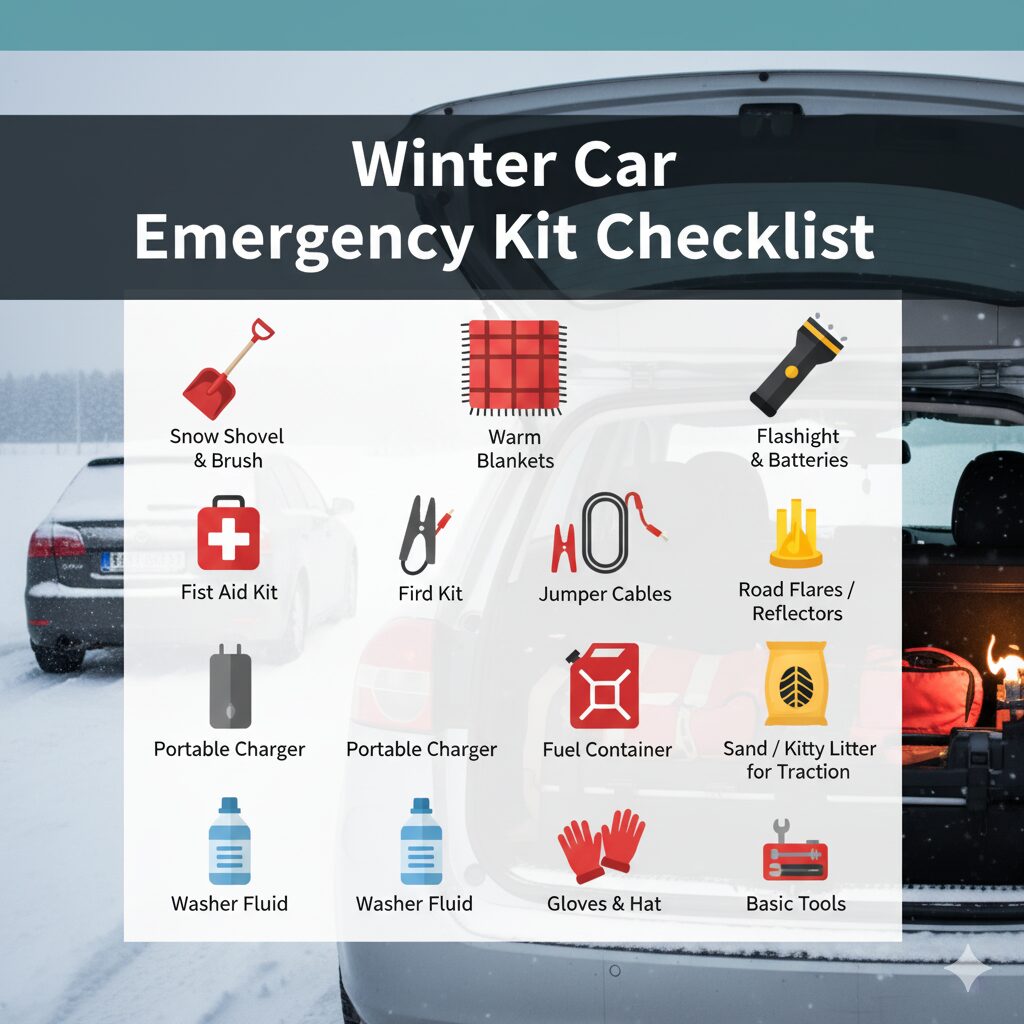
Category 1: “Get Unstuck” Gear (Self-Recovery)
Your first priority is to get moving again. If you’ve just slid into a shallow ditch or are stuck in a snowdrift, a few minutes of work can save you hours of waiting. This gear is all about *self-rescue*.
- ✅ Collapsible Shovel
- ✅ Traction Mats (A MUST-HAVE)
- ✅ Cat Litter or Sand
- ✅ Tow Strap (for a Good Samaritan)
In-Depth Product Showcase: Recovery Gear
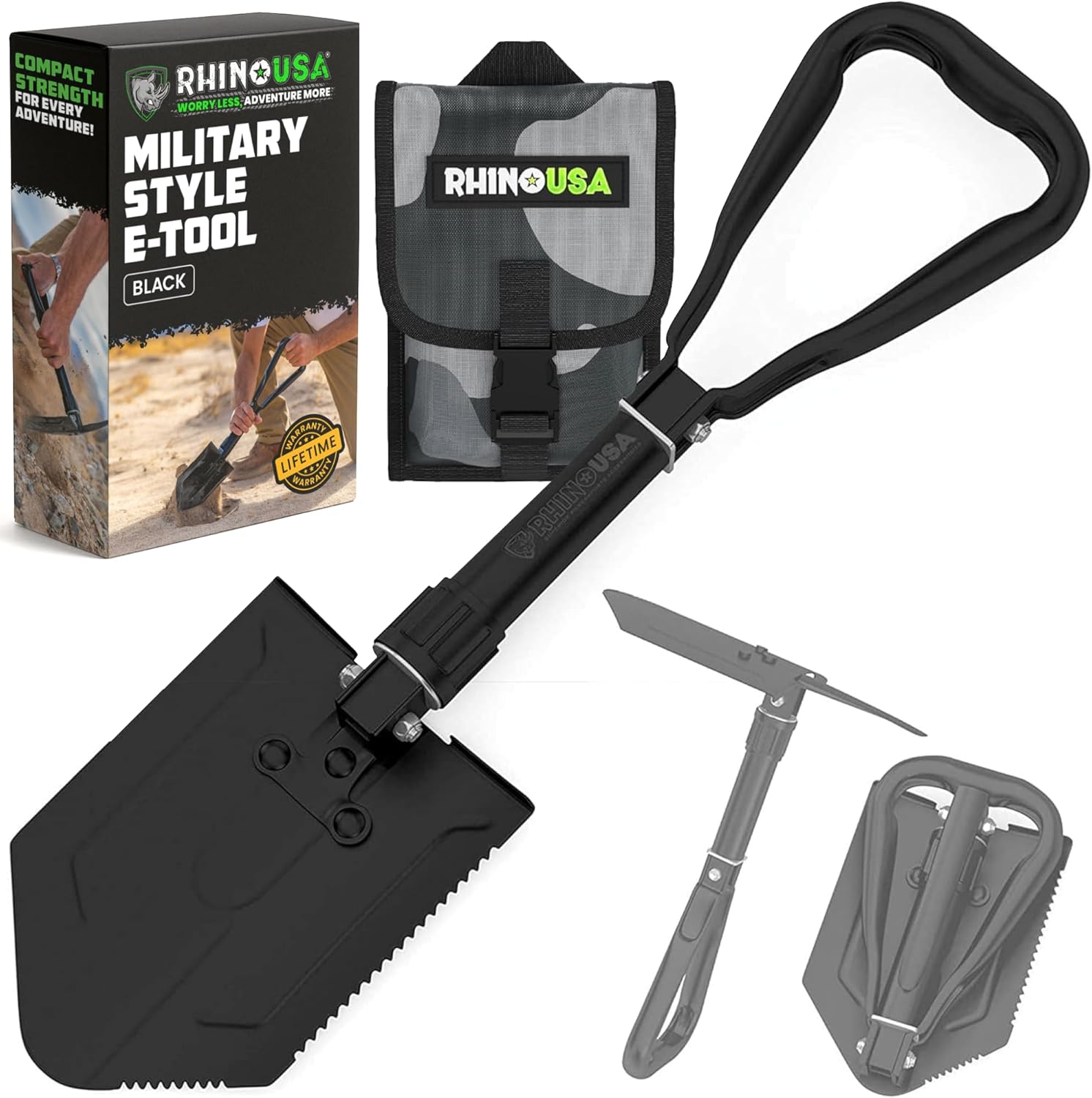
1. Rhino USA Collapsible Snow Shovel
A full-size snow shovel is too bulky to keep in your trunk, and a garden trowel is useless. The solution is a heavy-duty collapsible shovel. The Rhino USA model is a favorite for its durable, all-metal construction.
Why It’s Essential
If you’re stuck, you need to do two things: dig out the snow from under your car’s chassis (so it’s not “beached”) and clear a path for your tires. This shovel breaks down into three small pieces that fit into a compact carry bag, but when assembled, it’s a 3-foot-long, sturdy aluminum tool.
The serrated edges on the shovel blade are designed to chip away at ice and hard-packed snow, which a simple plastic shovel can’t handle. It’s a true recovery tool and one of the most critical car safety tools you can own.
Pros
- Heavy-duty aluminum construction
- Breaks down into a compact carry bag
- Serrated edge for ice and hard-pack
- Lightweight yet strong
Cons
- Shorter handle than a residential shovel

2. MAXSA Escaper Buddy Traction Mats
If we could recommend only *one* self-recovery item, this would be it. Traction mats are game-changers. If your wheels are spinning on ice or snow, these are your “get out of jail free” card.
How They Work
You simply wedge the end of these bright orange, heavy-duty plastic boards under your drive wheels (your front wheels, if front-wheel drive is good in snow, which it is!). The aggressive cleats on the top grip your tire’s tread, and the cleats on the bottom dig into the snow, ice, or even mud.
Instead of spinning uselessly, your tire “bites” the mat, which pulls the car forward onto the mat, and then propels it back onto solid ground. They are far more effective and less messy than cat litter or floor mats. These can save you from a multi-hour wait for a tow truck.
Pros
- Incredibly effective on snow, ice, and mud
- Durable, high-impact plastic
- Brightly colored and easy to find
- Stackable for easy storage
Cons
- Bulky, but they lay flat in a trunk
- Can be damaged if you spin your tires on them
Category 2: “Stay Alive” Gear (Personal Survival)
This is the most important category. If you can’t get unstuck, your mission changes from *recovery* to *survival*. A car’s cabin is just a thin metal box; it loses heat almost instantly. This gear is what will keep your body temperature up and your spirits high.
- ✅ Emergency Mylar Thermal Blankets
- ✅ Wool Blanket (a better primary blanket)
- ✅ High-Calorie, Non-Perishable Food (e.g., granola bars)
- ✅ Water (in a non-freezing container if possible)
- ✅ Chemical Hand Warmers (a cheap luxury)
- ✅ Complete First-Aid Kit
- ✅ Extra Winter Hat, Gloves, and Socks
In-Depth Product Showcase: Survival Gear

1. Don’t Die in the Woods’ Emergency Mylar Blankets
A wool blanket is great for warmth, but a mylar “space blanket” is what will save your life. They work by reflecting 90% of your body heat right back at you.
Why It’s Essential
Hypothermia is your #1 enemy. These blankets from “Don’t Die in the Woods” are individually wrapped, waterproof, and take up less space than a deck of cards. You can store a 4-pack in your glove box. In an emergency, you wrap yourself in one *under* your wool blanket. The mylar traps your body heat, and the wool blanket provides insulation and comfort. This layering system is a professional survival technique.
Pros
- Reflects 90% of body heat
- Incredibly compact and lightweight
- Waterproof and windproof
- Very inexpensive
Cons
- Noisy and can tear (they are for one-time use)

2. HotHands Hand Warmers (Bulk Box)
This might be the best $20 you’ll ever spend on your kit. These little air-activated packets are morale in a pouch.
Why It’s Essential
When you’re cold and stranded, your extremities (hands and feet) are the first to suffer. Cold hands mean you can’t use your phone, open a water bottle, or even zip your jacket. A 10-hour hand warmer packet is a small miracle. You can tuck them in your gloves, boots, or pockets. Buy a bulk box; they’re one of the best road trip essentials for any season, and you can give them to anyone who needs them.
Pros
- Provides 10+ hours of consistent heat
- Small, portable, and easy to use
- Inexpensive and can be bought in bulk
- Massive morale booster
Cons
- One-time use only
- Have an expiration date (check your kit yearly)
Category 3: “Be Seen & Signal” Gear (Visibility & Communication)
If you’re stranded, you need rescuers to find you. In a snowstorm or foggy white-out, you are invisible. This gear makes you visible.
- ✅ LED Road Flares (Safer than fire)
- ✅ High-Lumen Flashlight (and extra batteries)
- ✅ Portable Power Bank (for your phone)
- ✅ Whistle (louder than your voice)
- ✅ Brightly Colored Cloth (to tie to your antenna)
In-Depth Product Showcase: Visibility Gear

1. Vont LED Road Flares (4-Pack)
This is a modern, must-have replacement for old incendiary flares. They’re safe, reusable, and incredibly effective.
Why It’s Essential
If you pull over, you need to warn oncoming traffic. Traditional flares are a fire hazard, burn out, and don’t work in wet snow. These Vont LED flares are crush-proof (you can drive over them), waterproof, and have 9 different flash patterns. The flashing strobe is visible for up to a mile and cuts through snow and fog. They have a magnetic base to stick to your car and a hook to hang them. These are simply the best road flares for a modern kit.
Pros
- Ultra-bright and visible in all weather
- Reusable and battery-operated
- Safe (no fire) and crush-proof
- Magnetic base and hook
Cons
- Requires batteries (check them yearly)

2. Anker Portable Charger (Power Bank)
Your phone is your lifeline. It’s your map, your flashlight, and your call for help. But in the cold, your phone’s battery will die *shockingly* fast.
Why It’s Essential
A dead car means a dead charger. A portable power bank (like the Anker 20,000mAh) holds enough power to recharge your smartphone 4-5 times. This allows you to stay in contact with rescuers, use safe driving apps to check your location, and have a light source. Keep this in your kit, and remember to “top it off” every 3-4 months. It’s one of the must-have car gadgets for any drive, any time of year.
Pros
- Can recharge a smartphone multiple times
- Holds a charge for months
- Compact and durable
- Provides peace of mind
Cons
- You have to remember to keep it charged
- Can lose charge faster in extreme cold
Category 4: “Get Moving Again” Gear (Car Maintenance)
Sometimes the problem is mechanical. A dead battery or an ice-covered windshield. This gear helps you fix the problem and get back on your way.
- ✅ Portable Jump Starter (The modern essential)
- ✅ Jumper Cables (A reliable backup)
- ✅ Heavy-Duty Ice Scraper & Snow Brush
- ✅ Extra Winter Windshield Washer Fluid
- ✅ Windshield De-Icer Spray
In-Depth Product Showcase: Car Repair Gear
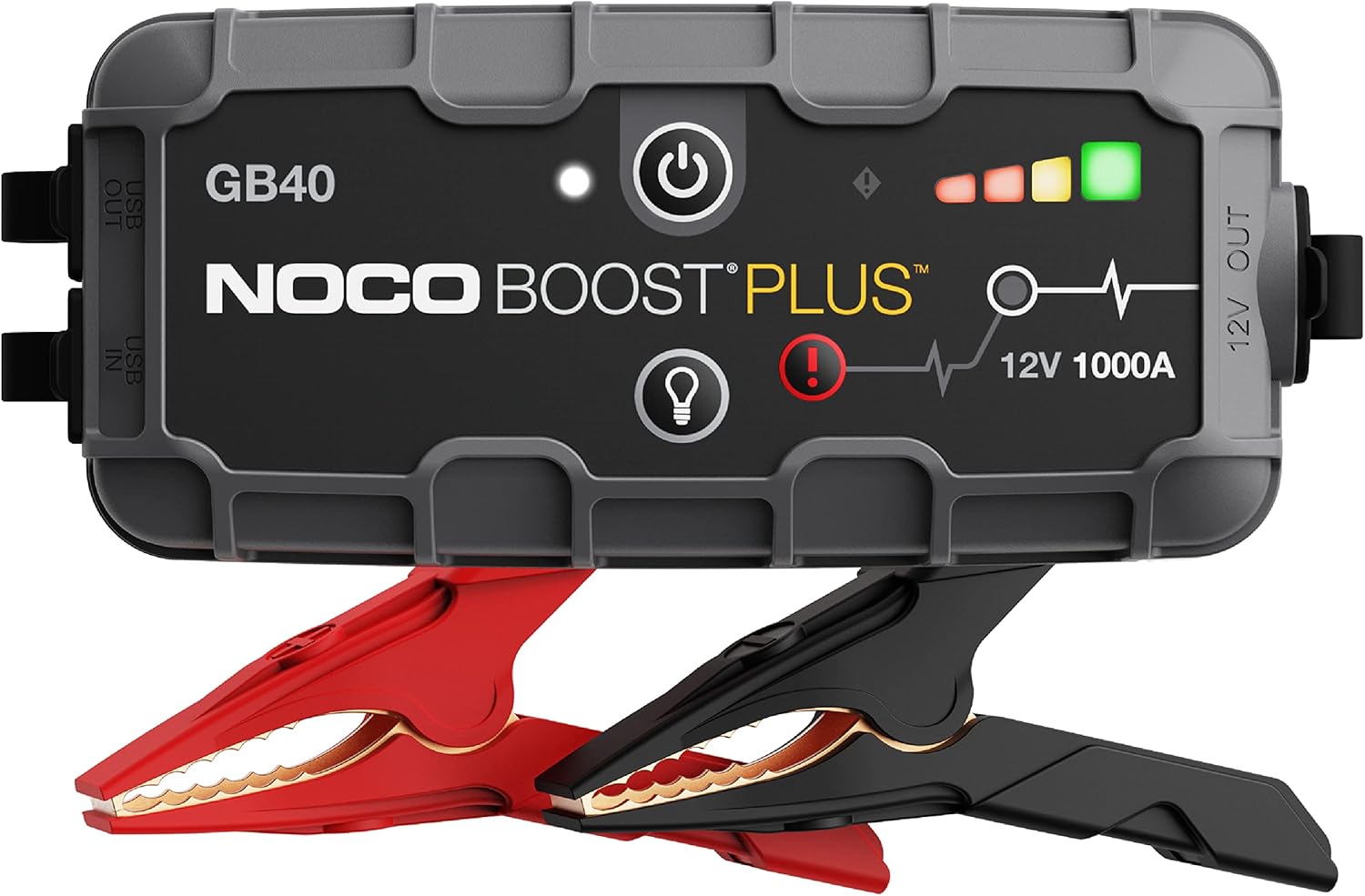
1. NOCO Boost Plus GB40 (Portable Jump Starter)
Jumper cables are great… if there’s another car. A portable jump starter *is* the other car. This is the single best tech upgrade for any car kit.
Why It’s Essential
Cold weather is the #1 killer of car batteries. The NOCO Boost is a lithium-ion battery pack so powerful it can jump-start a dead V6 engine (up to 20 times on one charge) all by itself. No second car needed. It’s foolproof, with spark-proof clamps that won’t let you hook it up wrong. It also doubles as another power bank and flashlight. If your battery dies from the cold, this tool is the difference between waiting 10 seconds or 2 hours.
Pros
- Jump-start your car *without* another vehicle
- Foolproof, spark-proof connections
- Works in extreme cold
- Doubles as a power bank and flashlight
Cons
- More expensive than jumper cables
- Must be kept charged (every 6-12 months)
What to Do If You’re Stranded: A Step-by-Step Guide
Having the kit is half the battle. Knowing what to do is the other half. If you are stuck and self-recovery has failed, follow these steps.
1. Stay With Your Vehicle
Do NOT leave your car to find help. Your car is a highly visible, waterproof, and windproof shelter. It is your single best survival tool. Disoriented in a white-out, you can get lost and succumb to hypothermia just a few hundred feet from safety. Stay put.
2. Be Visible
Make your car visible to rescuers. Turn on your 4-way hazard lights. Tie the brightly colored cloth to your antenna or window. If you have them, place your LED flares behind your car.
CRITICAL: Clear Your Exhaust Pipe
This is the most dangerous, overlooked hazard. If you are running your car to stay warm, you MUST check your exhaust pipe (tailpipe). If it gets clogged with snow from a drift or new snowfall, the engine’s exhaust (containing *deadly*, odorless carbon monoxide) will back up into the cabin.
Every 30-60 minutes, go outside and clear the snow from your tailpipe. Do this *every single time* you run the engine.
3. Stay Warm (and Conserve Fuel)
Do not run your car continuously. You will run out of gas. Run the car for 10-15 minutes every hour to get the cabin heater going and charge your phone.
When the car is off, use your blankets. Huddle together if you have passengers. Put on your extra hat, gloves, and socks. Eat some of your high-calorie food; digesting food creates body heat.
4. Call for Help
Call 911 or emergency roadside assistance immediately. Tell them your *exact* location (mile marker, last exit, road name) and your situation. Even if you have no signal, a 911 call may still go through on a partner network.
Frequently Asked Questions
This seems like a lot. Do I really need all of it?
Think of it like insurance: you hope you never need it, but you’ll be thankful you have it. We recommend a “tiered” approach. Everyone should have the “Stay Alive” gear. If you live in a rural area, the “Get Unstuck” gear becomes essential. The “Get Moving Again” gear (like the NOCO) is a massive convenience and safety upgrade.
What’s better: cat litter, sand, or salt?
For traction (not melting), **non-clumping** cat litter is the best. It’s cheap, lightweight, and provides excellent grit. Sand is also good but heavy. Salt won’t work in very cold temperatures and is corrosive to your car.
This kit sounds like one of the best graduation gifts for new drivers.
You are absolutely right. Building this kit for a new driver (or any unique gift for car lovers) is one of the most thoughtful, caring gifts you can give. You’re giving them the gift of safety and self-reliance.
Winter Tires 101: Studded vs. Studless vs. All-Season
We mentioned earlier that winter tires are more important than all-wheel-drive, and it’s worth slowing down to explain exactly why, because this is one of the most misunderstood topics in cold-weather driving. Many drivers assume that “all-season” tires are built for winter. They are not. All-season tires are a compromise tire, engineered to perform reasonably in warm, dry, wet, and mildly cold conditions. Once the mercury drops below about 45°F, the rubber compound in an all-season tire begins to stiffen. A stiff tire cannot flex into the microscopic imperfections of the road surface, which means it cannot generate the friction needed to grip ice or hard-packed snow, no matter how aggressive the tread pattern looks.
Winter tires solve this with a completely different rubber compound, one that stays pliable even in sub-zero temperatures. That flexibility alone accounts for a huge percentage of the traction advantage. On top of the compound, winter tires use “sipes,” which are thousands of tiny zigzag slits cut into the tread blocks. These sipes act like a squeegee, biting into snow and expelling water from the contact patch so the rubber can touch the road surface directly instead of hydroplaning on a thin film of meltwater.
Studded vs. Studless Winter Tires
Within the winter tire category, you’ll find two main types. Studded tires have small metal pins embedded in the tread that physically dig into glare ice, offering unmatched grip on solid ice sheets. They are excellent for mountain passes, rural routes that never see a plow, and regions with frequent freeze-thaw cycles that leave roads glazed. The tradeoff is that studs are noisy on dry pavement, illegal or restricted in many states and provinces during certain months, and they slowly wear down the studs’ effectiveness over a season or two.
Studless winter tires (sometimes called “Nordic” tires) rely entirely on the soft rubber compound and aggressive sipe pattern rather than metal studs. Modern studless winter tires have closed most of the performance gap on ice and, in many independent tests, they actually out-brake studded tires on wet or merely snow-covered pavement, since a stud can’t grip pavement the way rubber can. For most drivers who live somewhere that gets plowed roads with occasional icy patches, rather than weeks of glare ice, a quality studless winter tire is the better all-around choice.
When Should You Switch to Winter Tires?
A simple rule of thumb used by tire engineers is the “7°C rule” (about 45°F). Once average daily temperatures are consistently below that threshold, it’s time to swap. Waiting for the first snowfall is too late, since the stiffening of all-season rubber happens well before snow actually falls, and a cold, dry road can still be dangerously slick when temperatures hover near freezing. Most drivers in snow-belt regions mount winter tires in late October or early November and swap back to all-seasons or summer tires in April, once nighttime lows stay reliably above freezing.
If you’re not ready to commit to a full second set of tires and wheels, it’s worth knowing that a proper winter tire setup, mounted on a dedicated set of steel wheels, actually saves money over time. You avoid the labor cost of re-mounting tires on the same rims twice a year, and your all-season or summer tires last longer because they’re only used half the year.
AWD vs. 4WD vs. FWD vs. RWD: What Actually Helps in Snow?
Drivetrain layout is one of the most heavily marketed, and most misunderstood, factors in winter safety. It’s worth breaking down what each system actually does, and just as importantly, what it doesn’t do.
Front-Wheel Drive (FWD)
Front-wheel drive puts the engine’s weight directly over the drive wheels, which improves traction when accelerating from a stop or climbing a gentle grade. It’s why front-wheel drive is good in snow for the average commuter, and it’s the most common layout on economical sedans and hatchbacks. The downside is that FWD cars can understeer, or “push,” through corners on slick surfaces, and they offer no traction advantage whatsoever when it comes to stopping or turning.
Rear-Wheel Drive (RWD)
Rear-wheel drive vehicles, common in pickup trucks and performance sedans, are generally the most challenging to drive in snow. With the drive wheels at the back and often less weight over them (especially in an unloaded pickup bed), RWD vehicles are prone to fishtailing under acceleration. If you own a RWD vehicle, extra ballast weight in the bed or trunk over the rear axle, combined with dedicated winter tires, is close to mandatory for confident winter driving.
All-Wheel Drive (AWD) and Four-Wheel Drive (4WD)
AWD and 4WD systems send power to all four wheels, which dramatically improves acceleration traction on snow-covered roads. This is where the confusion begins: AWD helps you *go*, but it does almost nothing to help you *stop* or *turn*. Braking and cornering depend almost entirely on tire grip, not drivetrain. This is exactly why so many AWD SUVs end up in ditches during winter storms; the driver feels confident accelerating away from a stoplight, builds speed, and then discovers that four driven wheels do nothing to shorten stopping distance on ice.
The Golden Rule of Winter Drivetrains
AWD or 4WD plus all-season tires is still a worse combination than FWD or even RWD paired with genuine winter tires. If you can only upgrade one thing this winter, upgrade your tires, not your drivetrain. The tire is the only part of the car actually touching the road.
Tire Chain and Traction Laws: What Drivers Need to Know
In mountainous regions and states that see heavy snowfall, transportation departments frequently enact traction laws or chain requirements during storms. These rules vary widely, and they change from season to season based on road conditions, so a hard-and-fast checklist quickly goes out of date. What stays constant is the general framework you should understand before a winter road trip through mountain passes.
- Traction Advisories: The lowest level, typically recommending (not requiring) winter tires, AWD/4WD, or chains.
- Traction Law in Effect: A mandatory tier where vehicles must have winter-rated tires, adequate tread depth, or chains/traction devices carried in the vehicle, even if not currently mounted.
- Chains Required: The most severe tier, where every vehicle regardless of drivetrain must have chains actually mounted, with limited exceptions for vehicles already fitted with dedicated winter tires on all four corners.
Because these designations are enforced with real fines, and because road crews can upgrade a route from an advisory to a mandatory chain law within an hour as a storm intensifies, the practical takeaway is simple: if you are planning a mountain drive in winter, check the current transportation department alerts for your route before you leave, and carry a set of properly fitted chains or cable-style traction devices in the trunk even if you don’t expect to need them. A set of chains that never leaves its box is far better than being turned back at a checkpoint, or worse, being stuck roadside without them when the storm arrives early.
Practicing With Chains Before You Need Them
The single biggest mistake drivers make with tire chains is opening the box for the first time on the side of a dark, snowy highway, with cold hands and no instructions. Practice installing your chains in your driveway, in daylight, before winter arrives. It takes most people two or three attempts to get comfortable with the process, and every extra minute spent kneeling in slush on a highway shoulder is a minute of exposure to passing traffic and cold.
Building a Winter Emergency Kit for Electric and Hybrid Vehicles
Electric vehicles introduce a few important twists to the standard winter emergency kit, and this is a gap that a lot of generic checklists never address. Cold weather can reduce an EV’s usable range by 20 to 40 percent, both because the battery chemistry is less efficient at low temperatures and because cabin heating draws directly from the same battery that powers the drivetrain (unlike a gas car, which uses waste engine heat for the cabin).
What Changes for EV Owners
First, range anxiety becomes a real safety consideration in winter. Always plan trips with a larger buffer than you would in summer, and treat any charging stop as an opportunity to top off, even if you don’t strictly need it yet, since a closed or occupied charger at the next stop can eat into your safety margin fast.
Second, if you become stranded in an EV, the good news is that most EVs can run their heater far longer, and far more efficiently, than idling a gas engine, since there’s no fuel being wasted on mechanical losses. The carbon monoxide danger from a blocked tailpipe simply doesn’t exist. However, you still need to actively manage your remaining battery percentage; running the heater continuously for hours will eventually drain the pack, and unlike a gas station, DC fast chargers may not be reachable if you’re stuck on a rural road.
Third, an EV’s 12-volt auxiliary battery, the small battery that runs your lights, locks, and infotainment, can still die in extreme cold exactly like a gas car’s battery. A portable jump starter like the NOCO Boost Plus reviewed above works for this 12-volt battery in most EVs too, so it’s still worth carrying, even though it obviously can’t recharge your main traction battery.
EV-Specific Kit Additions
- A paper map or offline navigation download of your route, since range-optimized routing apps can behave unpredictably with no signal.
- A Level 1 (120V) charging cable if your vehicle doesn’t already carry one, in case you can reach a standard household outlet.
- Extra layers instead of relying on heater time, so you can conserve battery percentage during a long wait for roadside assistance.
Winter Emergency Kits for Families With Kids and Pets
A winter kit built for a solo commuter looks very different from one built for a family car that regularly carries children or pets. Both groups are far more vulnerable to cold exposure than a healthy adult, since children lose body heat faster relative to their size, and pets can’t communicate discomfort the way a person can.
For Kids
Keep a dedicated soft-sided bin behind the back seat with an extra set of warm layers sized for your children, including hats, mittens, and wool socks, since kids often go out the door in the morning underdressed for how cold it will be by the time you’re actually stranded that evening. Pack shelf-stable snacks that kids will actually eat under stress, such as granola bars or fruit snacks, rather than assuming an adult’s emergency ration will appeal to a hungry, scared child. A few small comfort items, like a favorite stuffed animal duplicate or a deck of cards, do real psychological work in keeping a child calm during a stressful wait.
For Pets
If you regularly travel with a dog or cat, keep a small supply of pet food, a collapsible water bowl, and a spare leash in your winter kit. Pets can develop frostbite on their paws, ears, and tail surprisingly quickly, so a pet-safe blanket or even a spare fleece jacket sized for your animal is worth the trunk space. If your pet has any medical conditions requiring medication, keep a few days’ backup supply rotated into your kit alongside your own first-aid items.
Family Kit Tip
Rotate seasonal items into a single clearly labeled bin (“Winter Car Kit”) rather than scattering them loose in the trunk. In an actual emergency, with cold hands and a stressed child in the back seat, you don’t want to be digging through grocery bags and jumper cables to find mittens.
Hypothermia and Frostbite: What Every Driver Should Recognize
Understanding the general warning signs of cold-related injury helps you know when a stranded wait has crossed from “uncomfortable” into “urgent.” This is general safety awareness, not a substitute for professional medical care; if you or a passenger show serious symptoms, treat it as a medical emergency and get help as quickly as possible.
Hypothermia
Hypothermia occurs when the body loses heat faster than it can produce it, and it doesn’t require extreme cold to set in, especially if clothing is wet or the wind is strong. Early signs include uncontrollable shivering, feeling unusually tired, and clumsiness. As it progresses, shivering can actually stop (a dangerous sign, not a good one), speech can become slurred, and a person may seem confused or unusually drowsy. If someone in your vehicle shows these signs, prioritize getting them into dry layers, wrapped in the mylar and wool blanket combination described earlier, with skin-to-skin contact from another passenger if available, and seek emergency medical help.
Frostbite
Frostbite typically affects the extremities first: fingers, toes, ears, and the nose. Early frostnip presents as numbness and a pale or waxy look to the skin. This is exactly why hand warmers and spare gloves and socks are on the “Stay Alive” checklist; keeping extremities warm and dry is the single best prevention. Do not rub or massage skin that may be frostbitten, and avoid direct high heat, both of which can cause additional tissue damage; instead, warm the area gradually with body heat or lukewarm (never hot) contact, and seek medical attention.
DIY Kit vs. Store-Bought Kit: Which Should You Choose?
Pre-assembled winter car emergency kits are widely available and can be a reasonable starting point, but it’s worth understanding their tradeoffs against building your own.
The Case for Pre-Made Kits
A store-bought kit is fast, requires no research, and guarantees you won’t forget an obvious item. For a new driver, or as a gift, a pre-made kit removes the friction of getting started. Many bundle a first-aid kit, gloves, a small flashlight, and a mylar blanket into one compact bag.
The Case for Building Your Own
The drawback of most pre-made kits is that they optimize for compactness and price point over quality. The flashlight is often dim, the “blanket” may be a single thin mylar sheet with no wool backup, and there’s rarely a real traction solution or jump starter included, since those items are bulky and expensive relative to the kit’s overall price. Building your own kit, item by item, using the category breakdown in this guide, lets you prioritize the components that matter most for your specific climate, vehicle, and driving habits, and it usually results in genuinely higher-quality gear for a similar total spend, just purchased individually rather than bundled.
A practical middle ground: buy a basic pre-made first-aid kit as your foundation (first-aid kits are hard to assemble well from scratch), then supplement it with the higher-value individual items from each category above: real traction mats, a proper jump starter, LED flares, and a wool blanket.
Rural Backroads Kit vs. Urban Commuter Kit
Not every driver faces the same level of winter risk, and it’s worth tailoring your kit’s depth to your actual exposure.
The Urban or Suburban Commuter
If your winter driving is mostly short trips on plowed, salted city streets with cell coverage the entire way, your risk profile is lower, but not zero; a fender-bender or a dead battery can still strand you for an hour or more in freezing temperatures. A lean kit covering the “Stay Alive” essentials, a power bank, and basic recovery gear like a small shovel and traction mats is usually sufficient.
The Rural or Mountain Driver
If your commute or road trips take you through areas with spotty cell coverage, infrequent plowing, or long stretches between towns, treat your kit as a genuine wilderness survival kit on wheels. This means the full recovery category (shovel, traction mats, tow strap, and chains), a more substantial food and water reserve sized for a potential overnight wait, and consideration of a satellite communicator or personal locator beacon, since a dead cell zone removes your ability to call 911 entirely. Rural drivers should also tell someone their planned route and expected arrival time before setting out, so that a search can be narrowed down quickly if you don’t check in.
Organizing and Storing Your Kit for Fast Access
A perfectly assembled kit is useless if it’s buried under luggage, or if items are loose and rattling around, making a mess and getting damaged over a season of use. A little organization goes a long way.
- Use a rigid, lidded bin rather than a soft duffel bag; it protects contents from crushing and keeps everything upright and searchable even with cold, gloved hands.
- Separate “immediate need” items from “extended wait” items. Keep flares, gloves, and a flashlight in an easily grabbed top layer, with food, blankets, and recovery tools underneath.
- Secure the bin with a cargo strap or place it against the seatback so it doesn’t become a projectile in a sudden stop or collision.
- Label the bin clearly so any driver of the vehicle, including a teenager borrowing the car, knows it’s there and what it contains.
- Do a seasonal inventory check every fall: verify battery levels in flashlights and flares, replace expired hand warmers, and confirm food items haven’t passed their shelf life.
Winter Driving Techniques: Black Ice, Skids, and Following Distance
A great emergency kit is your backup plan; good driving technique is what prevents you from needing it in the first place.
Spotting Black Ice
Black ice is a thin, transparent layer of ice that lets the dark road surface show through, making it nearly invisible until you’re on it. It forms most often on bridges and overpasses (which cool faster than ground-level roads because cold air circulates both above and below the deck), in shaded areas that don’t get direct sun, and near the exact spots where daytime meltwater refreezes overnight. A sudden increase in road noise disappearing, tires suddenly feeling unusually quiet, is a subtle but real warning sign that you may have transitioned onto ice.
What to Do If You Start to Skid
The universal advice for any skid is to stay calm, ease off the accelerator, and steer smoothly in the direction you want the front of the car to go, without overcorrecting. Avoid slamming the brakes, which can lock the wheels and make the skid worse on ice or snow; if your vehicle has anti-lock brakes (nearly all modern cars do), apply firm, steady pressure and let the system pulse the brakes for you rather than pumping them yourself.
Following Distance and Speed
Stopping distances on packed snow can be three to ten times longer than on dry pavement, and on ice they can be effectively unpredictable. Increase your following distance well beyond the usual “three-second rule,” and reduce your speed below the posted limit whenever conditions warrant it; posted speed limits assume dry, clear pavement and are not a target to maintain in a storm. Accelerate and brake more gently than you would on a dry road, since sudden inputs are far more likely to break traction.
Seasonal Car Maintenance Calendar for Winter Readiness
Spreading your winter prep across a simple calendar, rather than cramming it all into one weekend before the first storm, makes the whole process far less overwhelming.
- Early Fall (September–October): Schedule a battery test, inspect wiper blades and washer fluid reservoir, and book your winter tire mounting appointment before shops get backed up.
- Late Fall (November): Swap to winter tires, top off winter-rated washer fluid, and assemble or refresh your emergency kit using the checklist in this guide.
- Mid-Winter (December–February): Recheck tire pressure monthly, since cold snaps cause noticeable pressure drops, and keep your fuel or charge level above half a tank whenever possible, both for range security and, in a gas vehicle, to reduce the risk of moisture condensing in the fuel line.
- Early Spring (March–April): Swap back to all-season or summer tires once nighttime lows are reliably above freezing, and restock any single-use kit items (hand warmers, mylar blankets) that were used or expired over the season.
Roadside Assistance Programs and Insurance Considerations
Your physical kit is your first line of defense, but it’s worth pairing it with a plan for professional help. Roadside assistance coverage typically comes from three possible sources: a dedicated auto club membership, an add-on through your car insurance policy, or a manufacturer’s included coverage that came with your vehicle when new.
Before winter arrives, confirm which of these you actually have active, save the phone number somewhere you can access without a data connection (a note in your glovebox is more reliable than a phone app during a dead-zone emergency), and understand what’s covered: a jump-start, tire change, and tow to the nearest shop are standard, but towing distance limits and the number of free service calls per year vary significantly between plans. If you don’t currently have any roadside coverage, it’s a relatively inexpensive addition to most insurance policies and is worth strongly considering before winter, alongside the physical gear in this guide.
Common Mistakes People Make With Winter Emergency Kits
Even well-intentioned drivers fall into a handful of predictable traps when it comes to winter preparedness. Watching for these can save you from a false sense of security.
- Buying the kit but never opening it. Test your flashlight batteries, unfold your traction mats once, and practice your jump starter’s connections before you actually need them under stress.
- Storing the kit somewhere inaccessible. A kit buried under holiday luggage in the far reaches of an SUV cargo area does you no good; keep it within easy reach.
- Letting single-use items expire. Hand warmers, some first-aid supplies, and even flashlight batteries degrade over time; a yearly fall inventory check catches this.
- Assuming a full tank or full charge means you’re safe. Fuel and range matter, but they don’t replace warm layers, food, and a way to signal for help.
- Skipping the practice run with chains or a jump starter. The first time you use unfamiliar gear should never be during an actual roadside emergency in the dark.
Three Kit Budgets: $50, $150, and $300+ Builds
Not everyone can, or needs to, buy every item reviewed in this guide at once. It helps to think of your winter kit as something you build in tiers, upgrading as your budget and your actual driving risk allow.
The $50 Starter Kit
At this level, focus entirely on the cheapest, highest-impact “Stay Alive” items: a multi-pack of mylar emergency blankets, a bulk box of hand warmers, a basic first-aid kit, a whistle, and a few days’ worth of shelf-stable snacks and a couple of bottled waters. Add a cheap but functional LED flashlight and spare batteries. This tier won’t get you unstuck from a snowdrift, but it dramatically improves your odds of staying warm and being found if you’re stranded on a plowed road waiting for a tow.
The $150 Solid Kit
Layer on genuine self-recovery capability: a collapsible shovel and a set of traction mats, which together handle the majority of “stuck in a snowdrift” scenarios without outside help. Add an ice scraper and snow brush combo, a wool blanket to pair with your mylar blankets, and a basic portable power bank. This tier covers the three most common winter roadside scenarios: being stuck, being cold, and having a dead phone.
The $300+ Complete Kit
At this level, add the two biggest single-item upgrades in this entire guide: a portable jump starter and a set of LED road flares. These two items solve the two failure modes a shovel and blanket can’t touch, a dead battery and low visibility to oncoming traffic, and together they turn your trunk into something close to a self-contained roadside service. If you’re a rural or mountain driver, this tier is also where you add a tow strap and a set of properly fitted tire chains.
Regional Considerations: Building the Right Kit for Your Climate
Winter doesn’t look the same everywhere, and your kit shouldn’t either. A driver in a coastal region with occasional wet, heavy snow and temperatures hovering near freezing faces a very different set of risks than a driver in an inland region with dry, bitterly cold air and frequent sub-zero nights.
Wet, Coastal, Freeze-Thaw Climates
In regions where temperatures oscillate around the freezing point, black ice from repeated melt-and-refreeze cycles is the dominant hazard, more so than deep snow accumulation. Studded winter tires or a high-quality studless winter tire with strong ice-braking performance are worth prioritizing here, along with a reliable ice scraper, since windshields in these climates often develop a stubborn, thick glaze rather than light powder that brushes off easily.
Dry, Continental, Deep-Cold Climates
In regions that see extended stretches of dry, bitterly cold weather, battery failure becomes the single most common roadside emergency, since cold dramatically reduces a battery’s cranking amps right when the engine needs the most power to start. A portable jump starter is arguably the single highest-priority item for these climates. Deep, powdery snow accumulation also makes traction mats and a proper shovel essential, since powder offers no natural grip the way wet, packable snow sometimes does.
Mountain and High-Elevation Climates
Mountain driving combines the worst of both worlds: extreme cold overnight, rapidly changing conditions as elevation changes, and long stretches between towns or cell coverage. This is where the full rural kit described earlier, chains, a satellite communicator, and a larger food and water reserve, becomes less of an upgrade and more of a baseline requirement.
What to Pack Beyond the Trunk: A Full Winter Road Trip Packing List
A car emergency kit lives permanently in your trunk, but a long winter road trip deserves its own additional packing list, layered on top of the standing kit.
- Personal cold-weather layers for every occupant: insulated boots, a real winter coat (not just a fashion jacket), and a change of dry clothes in case anyone gets wet.
- A physical paper map or downloaded offline map of your entire route, since data coverage in rural stretches can disappear without warning.
- A written note of your itinerary left with a friend or family member, including your planned route, expected stops, and arrival time, so someone can raise the alarm if you go quiet.
- Extra prescription medication for anyone in the vehicle who takes daily medication, in case a storm extends your trip by a day or more.
- A car phone charger and cable separate from your portable power bank, since a dead cable is a surprisingly common and entirely preventable failure.
- Cash in small bills, in case a rural gas station or diner has a card reader outage during a storm.
Managing Winter Driving Anxiety
It’s worth acknowledging that for a lot of drivers, especially those newer to snow and ice, winter driving isn’t just a technical challenge, it’s a genuinely stressful one. That stress is a reasonable response to real risk, not a character flaw, and there are practical ways to reduce it rather than just white-knuckling through the season.
Preparation itself is one of the most effective anxiety reducers available. Knowing that your trunk holds a real, tested emergency kit, that your tires are rated for the conditions, and that you’ve told someone your route, replaces vague dread with a concrete sense of control. If a particular drive still feels beyond your comfort level, whether that’s a mountain pass in a storm or an unfamiliar icy commute, it’s entirely reasonable to delay the trip, ask someone more experienced to drive, or use public transit if it’s available. There is no prize for pushing through a drive that genuinely scares you when the roads themselves are telling you to wait it out.
For new drivers specifically, practicing basic winter handling in a safe, empty environment, like a large empty parking lot after a snowfall, before you need those skills on a real road, builds genuine muscle memory for how your specific car responds to reduced traction. Feeling a controlled skid at low speed in a parking lot is far less frightening, and far more educational, than feeling one for the first time on a highway.
A Glossary of Winter Driving Terms
A few terms come up repeatedly in winter driving guides and weather advisories. Knowing them helps you interpret official alerts quickly during an actual storm.
- Black Ice: A thin, nearly invisible layer of ice on the road surface, most common on bridges, overpasses, and shaded areas.
- Whiteout: A weather condition in which falling or blowing snow reduces visibility so severely that the horizon and road edges become indistinguishable.
- Traction Advisory: An official recommendation (not requirement) to use winter tires, chains, or 4WD/AWD on a specific route.
- Freezing Rain: Rain that falls as a liquid but freezes instantly on contact with cold surfaces, producing a glaze of ice that is often more dangerous than snow.
- Wind Chill: The perceived temperature drop caused by wind removing heat from exposed skin faster than still air would; it affects human comfort and frostbite risk but does not change the actual freezing point of surfaces like roads.
- Snow Squall: A sudden, intense, short-lived burst of heavy snowfall and strong wind that can drop visibility to near zero within minutes, often catching drivers off guard on otherwise clear roads.
Real-World Scenarios: How the Kit Comes Together
It can help to picture how the items in this guide actually work together in a real situation, rather than as an abstract checklist.
Scenario: Sliding Into a Snow-Filled Ditch on a Rural Road
You misjudge a curve on an unplowed rural road and slide gently into a snow-filled ditch at low speed. No one is hurt, and the car is upright, but the drive wheels are buried. This is exactly the “Get Unstuck” category in action: you use the collapsible shovel to clear snow from around and under the tires, wedge the traction mats under the drive wheels, and gently accelerate. If the car doesn’t come free after a couple of attempts, you stop, avoid digging the wheels in deeper by continuing to spin them, and move to signaling for help with your hazard lights and, if it’s getting dark, your LED flares.
Scenario: A Dead Battery in a Grocery Store Parking Lot
You come out after a cold night to find your battery too weak to start the car. Rather than needing a second driver willing to brave the cold with jumper cables, your portable jump starter handles this alone, clamps connected in seconds, engine running in under a minute. This is the everyday, unglamorous scenario where a jump starter earns back its cost many times over.
Scenario: Stranded Overnight on a Closed Highway
A sudden snow squall closes a highway with you on it, and traffic backs up for hours with no immediate rescue. This is where the full kit matters most: hazard lights and LED flares make you visible to other stopped traffic, you run the engine in short bursts to conserve fuel while checking the tailpipe for snow buildup every time you restart it, you and any passengers wrap up in mylar and wool blankets, and you ration your food and water while staying in the vehicle and periodically checking your phone’s signal to update anyone waiting for you at home.
Printable Checklist Recap
Here is the complete checklist from this guide in one place, organized by category, so you can print it or save it as a reference while you shop and pack your own kit.
- Get Unstuck: Collapsible shovel, traction mats, non-clumping cat litter or sand, tow strap, tire chains (rural/mountain drivers).
- Stay Alive: Mylar emergency blankets, wool blanket, high-calorie non-perishable food, water, chemical hand warmers, first-aid kit, spare hat/gloves/socks.
- Be Seen & Signal: LED road flares, high-lumen flashlight with spare batteries, portable power bank, whistle, brightly colored cloth.
- Get Moving Again: Portable jump starter, jumper cables, ice scraper and snow brush, winter windshield washer fluid, de-icer spray.
- Documentation and Communication: Roadside assistance number saved offline, paper map, written itinerary shared with someone at home.
- Family and Pet Additions: Kid-sized warm layers, comfort item, pet food and water bowl, pet-safe blanket.
Extended FAQ: More Winter Kit Questions Answered
How often should I replace items in my winter kit?
Do a full inventory check every fall before the first cold snap. Replace hand warmers and any expired food each year, test flashlight and flare batteries, and confirm your first-aid kit’s contents haven’t expired or been used up over the summer.
Is it safe to run my engine all night to stay warm if I’m stranded?
Only in short bursts, not continuously, and only after confirming your tailpipe is completely clear of snow every single time you restart the engine. Continuous idling also risks running out of fuel before help arrives, leaving you with no heat at all later, when you may need it most.
Do I really need chains if I already have winter tires?
In most conditions, no. However, official chain laws in mountain regions sometimes require chains regardless of tire type once conditions reach the most severe tier, with limited exceptions for vehicles on dedicated winter tires. Check current regional traction laws before a mountain trip.
What’s the single most important item if I can only buy one thing?
For most drivers, a portable jump starter or a set of traction mats delivers the most real-world value, since dead batteries and being stuck in snow are the two most common winter roadside scenarios. For safety-critical situations specifically, mylar emergency blankets are the cheapest, smallest, highest-impact item you can carry.
Should I keep my gas tank full during winter?
Yes. Keeping your tank at least half full throughout winter gives you a larger margin if you’re stuck idling for warmth, reduces the risk of moisture condensing in the fuel line during extreme cold, and means you’re never caught needing fuel during a storm when stations may be closed or have long lines.
How is a winter kit different for a long-distance road trip versus a daily commute?
A daily commute kit can be leaner, since help is usually closer and cell coverage more reliable. A road trip, especially through rural or mountain areas, calls for the fuller kit described in this guide, plus the additional road trip packing list items like a paper map, shared itinerary, and extra medication.
Understanding Your Vehicle’s Winter Weak Points
Every part of a car ages differently, and cold weather has a way of exposing whichever component was already closest to failing. Understanding these weak points helps you prioritize your pre-winter inspection instead of guessing.
The Battery
A car battery loses a significant portion of its effective cranking power as temperatures drop, at the exact moment cold engine oil is making the engine harder to turn over in the first place. A battery that struggled a little in September, but still started the car, can fail completely on the first truly cold morning of the year. Free battery testing at most auto parts stores takes minutes and tells you definitively whether you’re looking at a battery on borrowed time.
The Belts and Hoses
Rubber becomes less flexible in the cold, and a belt or hose that was already cracked or glazed from age is far more likely to fail outright in freezing temperatures than in summer heat. A visual inspection, looking for cracking, fraying, or a shiny glazed look on belts, and any soft or bulging spots on hoses, is a five-minute check worth doing before winter.
The Coolant System
Antifreeze isn’t just about preventing overheating; it’s what keeps your engine block from literally cracking when water inside it freezes and expands. Coolant that’s old or diluted with too much water may not be rated for the low temperatures your region actually sees. A simple test strip or a quick check at a service shop confirms your coolant’s freeze protection rating.
Tire Pressure
Tire pressure drops roughly one to two PSI for every ten-degree drop in temperature. A tire that was properly inflated in warm fall weather can be significantly underinflated by the first hard freeze, which reduces handling precision, increases stopping distance, and accelerates uneven tire wear. Check pressure monthly through the winter, ideally when the car has been sitting for a few hours so the reading isn’t skewed by heat from recent driving.
Comparing Traction Solutions: Mats vs. Cat Litter vs. Sand vs. Chains
There’s more than one way to get unstuck, and each traction solution has a different ideal use case. Understanding the differences helps you choose the right tool rather than defaulting to whatever’s cheapest.
Traction Mats
Reusable, purpose-built, and by far the most effective option for a stuck vehicle on snow, ice, or mud. Their downside is bulk; they take up real trunk space and won’t help at all with handling once you’re moving again, since they’re strictly a self-recovery tool, not a traction aid for driving.
Cat Litter and Sand
Cheap, widely available, and useful in a pinch, but far less effective than dedicated traction mats, especially on glare ice where loose granular material simply gets pushed aside by a spinning tire rather than providing real grip. Non-clumping litter is preferable to clumping litter, which can turn into a slick paste when it absorbs moisture.
Tire Chains
Chains don’t help you get unstuck from a ditch; they improve traction while actually driving through deep snow or on routes with mandatory chain laws. They’re the right tool for driving through conditions, not for recovering a vehicle that’s already stuck, which is why a complete rural kit carries both chains and traction mats rather than one or the other.
Winter Kit Considerations for Ride-Share and Delivery Drivers
Drivers who spend far more hours on the road than the average commuter, such as ride-share and delivery drivers, face a proportionally higher chance of encountering a winter roadside emergency simply due to time exposure. A few extra considerations apply to this group specifically.
Because these drivers often can’t choose to simply stay home during a storm the way an office worker might, a more robust kit is worth the investment: prioritize the full “Get Moving Again” and “Get Unstuck” categories rather than the leaner commuter tier, since being stuck directly costs income, not just inconvenience. A backup phone charging cable and a slightly larger power bank are also worth the extra weight, since these drivers depend on their phone for navigation and income continuously throughout a shift, not just for emergencies.
It’s also worth building in deliberate rest and warm-up breaks during long winter shifts. Extended exposure to a cold vehicle cabin between passenger pickups or deliveries adds up over a full shift, and a brief stop to fully warm the cabin and warm your own hands and feet periodically reduces both discomfort and the risk of impaired reaction time from being chronically cold.
Teaching a New Driver Winter Preparedness
If you’re helping a new driver, whether a teenager or someone who’s relocated to a snowy climate for the first time, get behind the wheel confidently and safely, preparedness education matters as much as the physical kit itself.
Walk through the kit together, item by item, explaining not just what each thing is but when and how it would actually be used, rather than just handing over a pre-packed bin. Have them practice the specific skills that don’t come naturally: clearing a tailpipe, connecting a jump starter’s clamps in the correct order, and reading a traction advisory or chain law notice. Consider a supervised practice session in an empty, snow-covered parking lot so they can feel what a controlled skid and recovery actually feels like at low speed, in a setting with no real consequences if something goes wrong.
Finally, talk through the decision-making side of winter driving, not just the mechanical skills: when a trip should be delayed or canceled entirely, why staying with the vehicle is almost always safer than walking for help, and the importance of telling someone your route before a longer winter drive. These judgment calls are often the difference between a manageable inconvenience and a genuine emergency, and they’re rarely covered in a standard driver’s education course focused mainly on rules of the road.
How Climate Change Is Affecting Winter Driving Risk
Many regions are seeing winter weather patterns shift toward more volatile extremes: periods of unusually mild weather punctuated by sudden, intense cold snaps and heavy snowfall events, rather than the steadier, more predictable winters of past decades. This pattern has a direct, practical implication for kit preparedness: freeze-thaw cycles that produce black ice are becoming more frequent in some regions, and sudden, fast-moving storms can catch drivers off guard with less warning than a slower-developing, more traditional winter storm.
The practical response isn’t complicated: keep your kit assembled and in the car for the entire cold season, rather than only loading it up ahead of a forecasted storm, since some of the most dangerous conditions now arrive with comparatively little lead time. Regularly checking forecasts and regional traction advisories, even for routine local trips, has become a more consistently useful habit than it might have been in a more predictable winter climate.
Frequently Overlooked Items Worth Adding
Beyond the core categories covered throughout this guide, a handful of smaller items consistently get left off checklists despite being genuinely useful.
- A small multi-tool or basic toolkit, useful for anything from tightening a loose battery terminal to cutting a stuck seatbelt in an emergency.
- Duct tape, which can temporarily patch a cracked hose, secure a loose piece of trim, or reinforce a torn glove in a pinch.
- A spare phone charging cable kept permanently in the glovebox, separate from the one you use daily, so a forgotten cable at home never becomes a problem.
- Sunglasses, since bright sun reflecting off snow can be genuinely disorienting and hazardous to drive through, especially right after a storm clears.
- A small notepad and pen, useful for exchanging information after a minor collision when a phone battery might be low, or for leaving a note if you have to briefly leave a stuck vehicle to seek help in a genuinely safe, controlled situation.
- Zip ties, surprisingly versatile for temporary repairs to loose bumpers, mirrors, or wiring that a storm-related fender bender might cause.
Comparing Your Kit Against What Emergency Responders Recommend
It’s reassuring to know that the categories covered throughout this guide, self-recovery, survival, visibility, and mechanical repair, line up closely with what emergency management agencies and roadside assistance organizations generally recommend for winter vehicle preparedness. This isn’t a coincidence; these categories map directly onto the actual sequence of decisions a stranded driver has to make, first attempting recovery, then settling in to stay warm and safe if recovery fails, then working to be found, and finally being ready to get moving again once help arrives or conditions improve.
One area that’s worth double-checking against your own household’s emergency planning is overlap with general home emergency preparedness. If you already maintain a home emergency kit for power outages or severe weather, some items, like a portable phone charger, first-aid supplies, and flashlights, may already exist in duplicate. Rather than letting your car kit quietly go stale because you assume you can grab supplies from home in a pinch, keep the car kit fully independent and self-contained; a storm severe enough to strand you on the road is often the same storm making it impractical or unsafe to run home for supplies first.
Winter Kit Maintenance Log: Tracking What You Have
A simple maintenance log, even just a note in your phone or a card taped inside the kit’s lid, makes yearly upkeep far easier than trying to remember what you packed and when. Track the purchase or last-replaced date for anything with an expiration or battery life: hand warmers, first-aid supplies, flashlight and flare batteries, and any perishable food items. Note the last time you tested your jump starter’s charge and the last time you actually practiced installing your tire chains. This kind of lightweight record-keeping turns “I think everything’s probably fine” into “I know everything’s ready,” which matters a great deal the one time a year you actually need the kit to work.
It’s also worth logging any items you use up during an actual emergency and restocking them immediately rather than putting it off. It’s an easy thing to forget once the immediate crisis has passed and life returns to normal, but a kit missing its hand warmers because they were used last February and never replaced provides a false sense of security for the rest of that winter.
Winter Preparedness for Multi-Vehicle Households
If your household has more than one vehicle, it’s worth resisting the temptation to build a single “good” kit and shuffle it between cars depending on who’s driving that day. In practice, the kit tends to end up permanently in whichever car was driven last during the busiest week, leaving the other vehicle completely unprepared exactly when it’s needed. Build a complete, independent kit for every vehicle that regularly leaves the driveway in winter, even if some items, like a jump starter, feel redundant to duplicate. The cost of a second jump starter is small compared to the cost of being stranded in the one car that doesn’t have one.
For households with a mix of vehicle types, say, a smaller commuter car and a larger SUV or truck used for longer trips, it can make sense to size each kit to that vehicle’s typical use case rather than making both identical. The commuter car might carry the leaner urban tier described earlier, while the vehicle used for longer trips or rural drives carries the fuller kit, including chains, a larger food and water reserve, and recovery gear.
When to Call for Help Immediately vs. When to Self-Rescue
Not every winter roadside situation calls for the same response, and knowing which category you’re in helps you act decisively rather than wasting time.
Attempt Self-Rescue When:
- You’re stuck in snow at low speed with no damage to the vehicle and no one is injured.
- You have traction mats or a shovel and the surrounding area is safe to work in, away from active traffic lanes.
- You have a fully charged phone and cell signal as a backup if self-rescue doesn’t work.
Call for Help Immediately When:
- Anyone in the vehicle is injured, regardless of how minor it seems at first.
- The vehicle is stopped in an active traffic lane and cannot be safely moved to the shoulder.
- You smell exhaust fumes inside the cabin, which may indicate a blocked tailpipe or exhaust leak, an immediate carbon monoxide risk.
- Conditions are severe enough (whiteout, extreme cold, high winds) that working outside the vehicle to attempt self-recovery would itself be dangerous.
- You’ve been stuck for an extended period with no success and daylight or temperature conditions are worsening.
When in doubt, prioritize calling for help over prolonged self-rescue attempts. A tow truck or emergency responder arriving to find you safely inside a warm, well-prepared vehicle is a far better outcome than a driver who exhausted themselves, and their phone battery, attempting a recovery that was never going to succeed without professional equipment.
Final Thoughts: Don’t Be a Statistic
Winter driving is a serious business that demands respect. A winter storm can strand anyone, from a new driver in a sedan to a seasoned pro in a 4×4.
The time to build your kit is *now*, not during the first blizzard. Use this checklist, grab a few of the critical items from Amazon, and pack a dedicated “Go-Bin” for your trunk. Preparation is your best defense against the cold.
For more year-round safety guides and driving tips, explore our full site at DriveSafeGuide.com. Stay warm and drive safe.